



Flood-hit Odisha Shows Inflation Cooling Down, Cars to Vegetables Prices Down, Kitchen Hit by Spice Shock | Exclusive
Key Points
Bhubaneswar: Even as July’s torrential rain and flooding disrupted normal life across as many as 22 districts of Odisha, the State appears to have pulled off a significant inflation-management feat. The latest Consumer Price Index (CPI) numbers suggest that the supply-side shock from the monsoon has, at least for now, not translated into a runaway price shock for consumers.
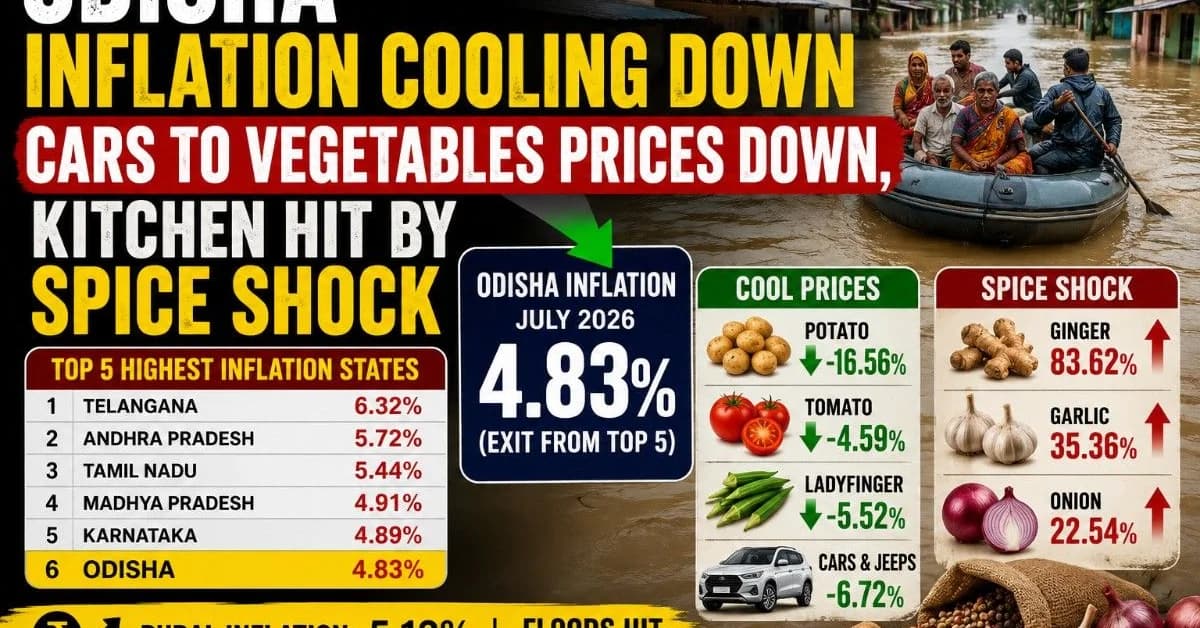
More importantly, Odisha has managed to bow out of the country’s top-five high-inflation States after figuring among the five costliest States continuously in May and June. At 4.83% in July 2026, Odisha’s headline inflation is now lower than that of the five States leading the table among States with populations above 50 lakh.
|
Rank |
State |

📱 Get Argus News App
✨CPI Inflation, July 2026
1
Telangana
6.32%
2
Andhra Pradesh
5.72%
3
Tamil Nadu
5.44%
4
Madhya Pradesh
4.91%
5
Karnataka
4.89%
6
Odisha
4.83%
The movement is significant because the national inflation rate actually increased marginally from 4.38% in June to 4.45% in July. Odisha, therefore, has moved in the opposite direction, with its July inflation remaining below the national rural inflation benchmark of 4.84% and only moderately above the national combined rate.
July CPI: Odisha Beats the Flood-Inflation Test
Odisha’s combined CPI inflation stood at 4.83% in July, according to the provisional data. On the face of it, the number is noteworthy given the scale of the monsoon disruption.
Rain and flood conditions affected 22 districts, potentially putting pressure on the movement of vegetables, perishables and other essential commodities. Yet the State did not see the kind of broad-based price acceleration that could have pushed it further up the inflation table.
This is where the July CPI data offers a positive signal for the State government’s supply-side management. While CPI by itself cannot establish that government intervention alone caused the moderation, the numbers indicate that supply disruptions did not overwhelm the distribution network sufficiently to trigger a broad consumer-price surge.
The contrast with the national picture is sharper. While India’s headline inflation edged up to 4.45%, Odisha remained at 4.83% and, crucially, slipped from the top-five high-inflation group to sixth place.
The State’s July performance also needs to be read against its own recent trajectory. After remaining among the five States with the highest inflation in May-June, Odisha has now exited that list.
Rural-Urban Divide: Village Markets Still Feeling the Heat
But the headline number hides a significant fault line.
Odisha’s rural inflation stood at 5.12% in July, against 4.02% in urban areas. That creates a substantial 1.10 percentage-point rural-urban inflation gap.
|
Inflation measure |
Odisha |
National |
|
Rural |
5.12% |
4.84% |
|
Urban |
4.02% |
3.96% |
|
Combined |
4.83% |
4.45% |
The data indicates that price stabilization has been considerably faster in urban Odisha than in the State’s rural markets.
Rural consumers are also facing inflation above the national rural benchmark of 4.84%. The likely pressure points include transportation disruptions, localized supply-chain bottlenecks and the greater weight of food items in household consumption.
Flooding can amplify such differences. When roads, local markets and transport links are disrupted, the additional logistics cost tends to reach smaller and more dispersed markets faster. Urban centres, meanwhile, generally have greater access to multiple supply channels and larger wholesale networks.
The urban number of 4.02% is, however, remarkably close to the national urban inflation rate of 3.96%, suggesting comparatively strong price resilience in Odisha’s cities.
Spice Shock in Kitchen: Ginger Is the New Gold
The most striking feature of July’s national CPI basket is the sharp divergence between vegetables and spices.
While some of the most frequently consumed vegetables have cooled dramatically, the kitchen has simultaneously been hit by a spice-price shock.
Ginger inflation shot up to 83.62% in July, from 50.41% in June. Garlic inflation also accelerated sharply from 17.93% to 35.36%.
Onion, another kitchen staple, re-entered high-inflation territory, with its inflation rate rising from just 4.73% in June to 22.54% in July.
The numbers create an unusual food-price picture: the vegetable basket is offering relief while spices and selected root crops are becoming increasingly expensive.
Ginger, in particular, has emerged as the standout pressure point. Its 83.62% inflation means that the item has effectively behaved like the “new gold” of the kitchen, even though the broader food-price picture is nowhere near uniformly inflationary.
At the other end of the spectrum, silver jewellery continued to record extraordinarily high inflation, although it moderated from 133.24% in June to 109.84% in July.
Cool Cars, Potato, Tomato, Ladyfinger Give Smile
The good news for household budgets comes from a different corner of the consumption basket.
Potato inflation remained firmly negative at -16.56% in July, although slightly less negative than the -20.34% recorded in June.
Tomato delivered an even more dramatic turnaround. After registering 31.92% inflation in June, tomato prices swung into deflation of -4.59% in July.
Ladyfinger also reversed sharply, moving from 5.54% inflation in June to -5.52% in July.
And it is not just the vegetable basket providing relief. Motor cars and jeeps registered -6.72% inflation, meaning prices remained in deflationary territory.
The tomato correction is particularly important because it demonstrates how quickly the inflation composition can change. A commodity that was adding significant pressure to the June CPI basket became a source of price relief in July.
The Bottomline
So, Odisha’s July inflation story is not one of universal price moderation. It is a story of a changing inflation basket. Potatoes, tomatoes, ladyfinger and even cars are providing a cooling effect, while ginger, garlic and onions are heating up the kitchen.
For Odisha, the bigger takeaway is that this moderation has come despite an unusually difficult monsoon month. The State’s 4.83% inflation rate, its exit from the national top-five high-inflation group and the near-national urban inflation rate suggest that the supply chain has so far absorbed much of the monsoon shock.
The concern,
however, remains the 5.12% rural inflation rate. If flood-related
logistics disruptions persist or spice and other essential commodity prices
remain elevated, the rural-urban gap could become the next pressure point for
Odisha’s inflation management.
Also Read: June Inflation Inches Up to 4.38%; Odisha Among Top Five Costliest States as Food Prices Continue to Pinch Consumers| Special Report
Related Topics
Explore more stories