



EXCLUSIVE| The Saffron Milk Model: How Odisha’s BJP Govt Is Doubling Dairy Payouts Without Pinching Aam Admi Pockets
Key Points
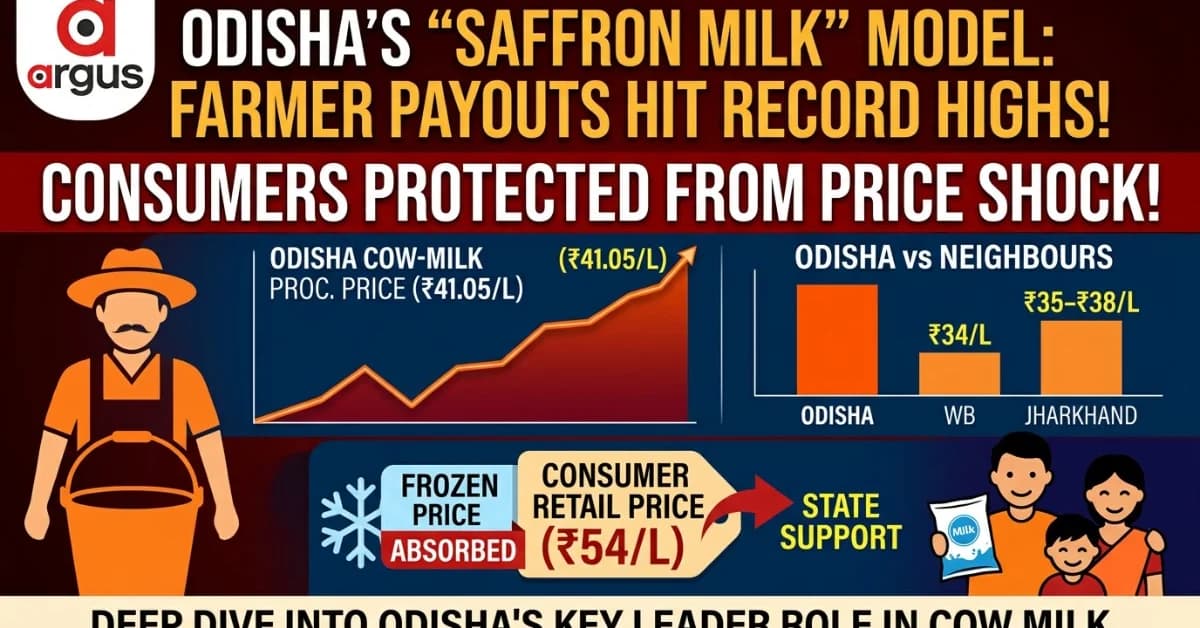
OMFED raised the cow milk procurement price to ₹41.05 per litre, ranking highest among neighboring state benchmarks.
The latest ₹2 per litre procurement increase is fully absorbed by the state and OMFED, keeping consumer retail prices frozen at ₹54 per litre.
Over 3 lakh local cow milk producers benefit from state-backed logistics, chilling infrastructure, and income support frameworks.
Bhubaneswar: Tuesday the BJP government in Odisha announced its third hike in milk procurment price in the last 2-year period. However, after hiking the retail price by Rs 6 during the last 2-years, it has spared consumers from another hike, when the festival season is looming over.
The BJP government's milk policy needs a deep dive to find out how it has emerged as a key state in the neighbourhood in Cow Milk.
In the aforementioned context, it is pertinent to state that for years, increasing what farmers earned for every litre of milk meant consumers ultimately had to pay more.
Between 2018 and 2024, OMFED broadly operated on a conventional balance-sheet model: whenever procurement prices increased, the additional cost was reflected in retail prices.
Here is the balance sheet of milk policy over the last decade.

📱 Get Argus News App
✨Two eras of Odisha's dairy pricing
|
Parameter |
2018–2024 |
2024–2026 |
|---|---|---|
|
Starting farmer procurement price |
~₹26–₹28/L |
₹35.05/L |
Ending farmer procurement price
₹35.05/L
₹41.05/L
Absolute increase
₹7–₹9/L
₹6/L
Approx. annualised increase
₹1.20–₹1.50/L
~₹3/L
Frequency
Spread over several years
3 major hikes in rapid succession
Consumer pricing approach
Increases largely passed through
State-backed cushioning
Primary policy approach
Cooperative balance-sheet management
Farmer income support + state subvention
The contrast is striking: the absolute procurement increase during the shorter 2024–26 period is almost comparable to the entire increase accumulated during 2018–24. More importantly, the pace has doubled – from roughly Rs1.20–Rs1.50 per litre annually in the earlier period to around Rs3 per litre annually in the later period.
How is Odisha absorbing the latest hike?
The arithmetic behind the latest intervention is straightforward. OMFED is collecting around 7 lakh litres of milk daily. A Rs2-per-litre procurement increase therefore creates an additional burden of approximately Rs14 lakh every day, or around Rs4.2 crore a month. Instead of immediately transferring this entire burden to consumers, the state/federation is absorbing it through the dairy-support mechanism.
|
Latest September 2026 intervention |
Figure |
|---|---|
|
Additional farmer payout |
₹2/L |
|
Daily OMFED collection |
~7 lakh litres |
|
Additional daily burden |
~₹14 lakh |
|
Approx. monthly burden |
~₹4.2 crore |
|
Consumer retail price |
Held at ₹54/L |
|
Immediate consumer impact |
No corresponding ₹2/L hike |
The policy therefore creates a three-way balancing act: farmers receive more, consumers remain insulated from the latest procurement shock, while OMFED uses its scale and government support to manage the narrower margin. The supplied inputs also point to infrastructure and operating support under the Mukhyamantri Kamadhenu Yojana, including support for logistics, chilling and processing infrastructure.
Procurement vs. Retail Price Adjustments (2024–2026)
|
Hike Timeline |
Farmer Procurement Price Rise (per Litre) |
Consumer Retail Price Rise (per Litre) |
Standard Toned Retail Price Impact |
Policy Strategy & Operational Mechanics |
|---|---|---|---|---|
|
1st Move(June 2025) |
+₹3.00 |
+₹2.00 |
₹48.00 → ₹50.00 |
Partial State Absorption: The state government stepped in with a subvention package to cover the remaining ₹1.00 gap, protecting consumers from a full pass-through. |
|
2nd Move(May 2026) |
+₹1.00 |
+₹4.00 |
₹50.00 → ₹54.00 |
Network Correction: Retail prices were adjusted to catch up with packaging inflation and rising cold-chain logistics costs. |
|
3rd Move(Sept 11, 2026) |
+₹2.00 |
₹0.00 — Frozen |
Remains at ₹54.00 |
Full State Absorption: OMFED and the state dairy budget absorb the entire ₹2.00 hike internally, allowing the farmer payout to rise without a corresponding consumer price increase. |
|
Cumulative Total |
+₹6.00 |
+₹6.00 |
Net retail increase: ₹48 → ₹54 |
Balanced Value Chain: Over the two-year cycle, the cumulative procurement and retail adjustments are both ₹6.00, but the timing is deliberately decoupled to provide greater protection to consumers during the latest hike. |
Key takeaway: Odisha's model seems essentially “higher farmer payout, delayed/absorbed consumer impact” – with the latest Rs2-per-litre procurement increase being fully shielded from consumers.
Odisha emerges as the leader in cow-milk farmer payout
The second important finding emerges when the comparison is restricted specifically to cow milk procurement.
That distinction matters because headline milk payouts in some neighbouring states can be misleading when they include high-fat buffalo milk. As per the available figures, OMFED's Rs41.05 per litre cow-milk procurement price places Odisha at the top among the neighbouring state benchmarks examined.
Odisha's advantage becomes particularly visible against West Bengal and Andhra Pradesh. West Bengal's enhanced procurement rate is cited at Rs 34 per litre, while Andhra Pradesh's standard cow-milk baseline is Rs31 per litre. Andhra's much higher figure of Rs85 per litre relates to buffalo milk with substantially higher fat content and therefore is not an apples-to-apples comparison with Odisha's cow-milk payout.
Cow-milk procurement: Odisha vs neighbours
|
State / Dairy |
Cow-milk procurement price |
Odisha's position |
|---|---|---|
|
Odisha – OMFED |
₹41.05/L |
Highest in comparison |
|
West Bengal – Banglar Dairy |
₹34/L |
Odisha pays ₹7.05 more |
|
Chhattisgarh – Devbhog |
₹38–₹40/L |
Odisha pays ₹1.05–₹3.05 more |
|
Jharkhand – Medha |
₹35–₹38/L |
Odisha pays ₹3.05–₹6.05 more |
|
Andhra Pradesh – Vijaya Dairy |
₹31/L for cow milk |
Odisha pays ₹10.05 more |
The Andhra Pradesh ₹85/L figure cited is for high-fat buffalo milk and should not be compared directly with Odisha's cow-milk rate.
This is where Odisha's model acquires its distinctive character. The state's dairy ecosystem is predominantly relevant to producers of cow milk, and the data estimates around 3 lakh local producers. By pushing the base procurement rate for cow milk to Rs41.05, OMFED is effectively concentrating its farmer-support intervention on the milk type that forms the core of its producer network.
But what does the consumer actually pay? Odisha remains in the middle
The farmer-side advantage does not translate into Odisha having the cheapest milk in the region. At the retail end, OMFED's toned milk at Rs54 per litre sits between cheaper Jharkhand and Chhattisgarh and costlier West Bengal and Andhra Pradesh.
Jharkhand's Medha toned milk is cited at around Rs48–Rs50/L, while Chhattisgarh's Devbhog is around Rs50/L. At the other end, West Bengal's Banglar Dairy is around Rs56–Rs60/L, while Andhra Pradesh's Vijaya Dairy is around Rs56–Rs58/L.
Retail milk price: Odisha vs neighbouring states
|
State |
Cooperative / Brand |
Approx. toned milk retail price |
|---|---|---|
|
Jharkhand |
Medha / JMF |
₹48–₹50/L |
|
Chhattisgarh |
Devbhog / CGCDF |
₹50/L |
|
Odisha |
OMFED |
₹54/L |
|
West Bengal |
Banglar Dairy / Mother Dairy |
₹56–₹60/L |
|
Andhra Pradesh |
Vijaya Dairy |
₹56–₹58/L |
The resulting picture is therefore more nuanced than a simple "cheapest milk" or "highest subsidy" story.
Odisha is deliberately spending more on the producer side while refusing to let the latest procurement shock immediately hit the household consumer. At Rs54 a litre, its retail price is not the region's lowest, but it is also below West Bengal and Andhra Pradesh, even as its cow-milk procurement payout is higher than the neighbouring benchmarks examined.
That
is the essence of the “Saffron
Milk Model”:
raise
the farmer's share, hold the consumer line, and use state-backed
financial and structural support to absorb the difference rather than
making the aam admi pay for every upward revision in the farm-gate
price.
Also Read: With 42-Year Golabandha Jinx Broken, How CM Majhi's Gopalpur Tour Signals BJP’s Political Consolidation Strategy in Ganjam|Special Story
Related Topics
Explore more stories