



EXCLUSIVE | Odisha’s Economic Vision Gets Paradigm Shift: BJP Govt Models CMEAC on PM’s Economic Advisory Council, Taps National Experts for 2047 Roadmap
Key Points
Institutional Shift: Odisha moves from traditional administrative planning to a formal, expert-driven Chief Minister’s Economic Advisory Council (CMEAC).
High-Profile Panel: The seven-member council features eminent economists, former Union secretaries, tax experts, and AI entrepreneurs.
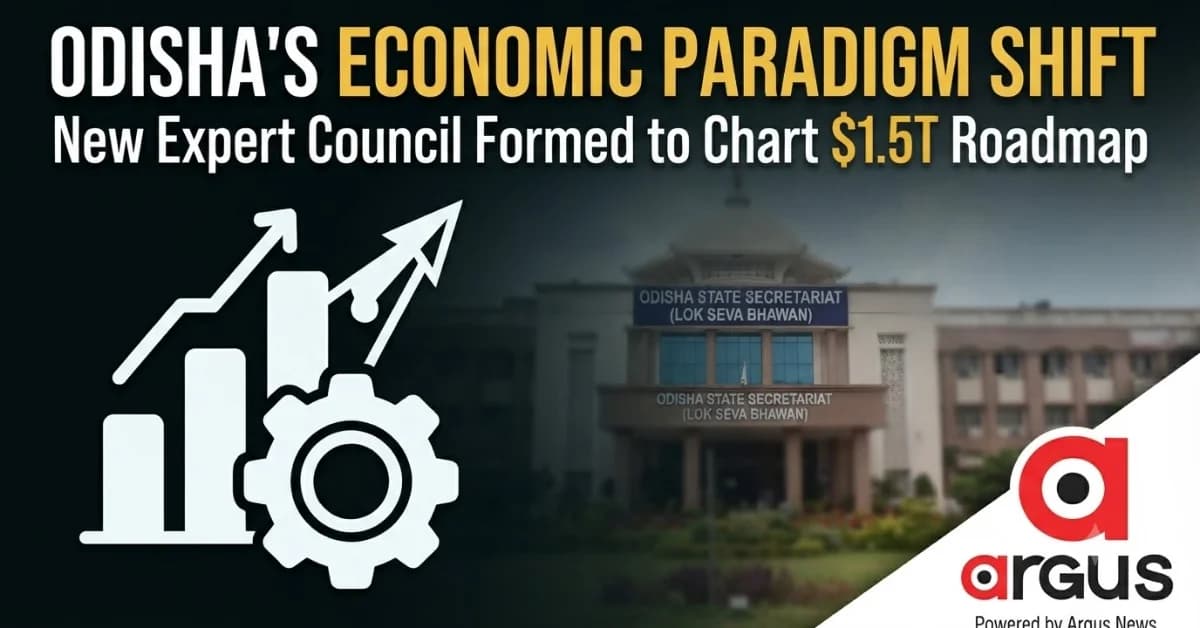
Long-Term Vision: The advisory body aims to shape Odisha into a USD 500-billion economy by 2036 and a USD 1.5-trillion economy by 2047.
Bhubaneswar: In a significant shift in Odisha’s economic policymaking, the BJP government led by Chief Minister Mohan Charan Majhi has formally institutionalised an expert-driven economic planning mechanism, modelled on the Economic Advisory Council to the Prime Minister (EAC-PM).
The Finance Department’s notification on September 25, 2026, establishing the Chief Minister’s Economic Advisory Council (CMEAC), marks a potential turning point in the state’s approach to economic visioning, moving towards structured macroeconomic advice, specialised sectoral expertise and long-term fiscal planning.
The council brings together seven experts with backgrounds spanning public finance, taxation, agriculture, infrastructure, macroeconomics, development economics and frontier technology.
Its mandate is to help shape Odisha’s ambition of becoming a USD 500-billion economy by 2036 and a USD 1.5-trillion economy by 2047, while addressing structural challenges such as dependence on mineral revenues, rising expenditure commitments, agricultural productivity and the need for technology-led governance.

📱 Get Argus News App
✨The council’s members are:
Dr. Jugal Kishore Mohapatra — Former Chief Secretary of Odisha and Union Secretary for Rural Development.
Santosh Kumar Mohapatra — Former Chairman of Paradip Port Authority.
Dr. Shobhana Kumar Pattanayak — Former Union Agriculture Secretary.
Arbind Modi — Former senior economist at the IMF and former convener of the Income Tax Act Rewriting Task Force.
Dr. Deepak Mishra — Distinguished Visiting Professor at ICRIER.
Prof. Srijit Mishra — Professor of Economics at the University of Hyderabad.
Pratyush Kumar — Co-founder and CEO of Sarvam AI.
BJP Govt’s Paradigm Change: From Administrative Planning to an Expert-Driven Economic Roadmap
The establishment of the CMEAC represents a shift in the institutional architecture of economic planning in Odisha.
For decades, the state’s economic priorities were largely shaped through government departments, traditional planning mechanisms, administrative leadership and, in more recent years, specialised investment and governance initiatives.
The new council introduces a formal platform in which external experts and experienced policymakers can contribute to the state’s long-term economic strategy.
The contrast becomes clearer when the evolution of Odisha’s economic planning is viewed across successive political eras.
EVOLUTION OF ECONOMIC PLANNING IN ODISHA
1. Institutional Model
Congress Era (Pre-2000): Traditional State Planning Board and departmental planning.
BJD Era (2000–2024): Administrative-led governance, specialised task forces, and institutional mechanisms.
BJP Government / CMEAC Era: Formal, dedicated Chief Minister’s Economic Advisory Council.
2. Planning Approach
Congress Era (Pre-2000): Five-Year Plan-linked development and central allocation-oriented planning.
BJD Era (2000–2024): Execution-driven development, investment promotion, and targeted sectoral strategies.
BJP Government / CMEAC Era: Long-term macroeconomic strategy, fiscal planning, and independent expert advice.
3. Key Expertise
Congress Era (Pre-2000): Senior administrators, planning officials, and traditional sector specialists.
BJD Era (2000–2024): Senior bureaucrats, management consultants, and sectoral specialists.
BJP Government / CMEAC Era: Economists, former Union secretaries, tax experts, infrastructure specialists, and AI entrepreneurs.
4. Economic Focus
Congress Era (Pre-2000): Public-sector industries, basic infrastructure, and poverty alleviation.
BJD Era (2000–2024): Mining, metals, manufacturing, investment attraction, welfare, and governance delivery.
BJP Government / CMEAC Era: Revenue diversification, fiscal sustainability, agricultural reform, frontier technology, and climate resilience.
5. Strategic Horizon
Congress Era (Pre-2000): National Five-Year Plan cycles.
BJD Era (2000–2024): Sector-specific investment and development programmes.
BJP Government / CMEAC Era: USD 500-billion economy by 2036 and USD 1.5-trillion economy by 2047.
6. Advisory Mechanism
Congress Era (Pre-2000): Traditional planning and departmental structures.
BJD Era (2000–2024): Task-oriented teams, administrative coordination, and consultancy inputs.
BJP Government / CMEAC Era: Dedicated expert council with a formal advisory mandate.
The table above describes broad planning approaches, not an exhaustive inventory of every government initiative.
Under the Congress governments, economic planning was closely connected to the national Five-Year Plan framework, with state departments and traditional planning institutions playing a central role.
The BJD government subsequently placed greater emphasis on administrative coordination, investment promotion, sector-specific execution and initiatives such as IPICOL, IDCO, Team Odisha and the Make in Odisha investment platform.
The CMEAC marks a different institutional approach.
Rather than relying exclusively on departmental expertise, the BJP government has brought together a dedicated group of economists, former senior bureaucrats, sectoral specialists and technology entrepreneurs to advise on the state’s economic direction.
The distinction is not simply the creation of another committee; it is the formalisation of a multidisciplinary advisory structure intended to connect fiscal policy, investment, productivity and technological change within a common long-term roadmap.
Modi’s Trusted Men in Odisha: Central Policy Experience Pooled to Shape State’s Economic Future
The composition of the CMEAC has drawn attention to the professional trajectories of its members, several of whom held important positions in the Union government or participated in national policy initiatives during the Narendra Modi-led administration.
Their appointment comes just over two years after the BJP government assumed office in Odisha in June 2024, signalling an effort to bring experienced national policymakers into the state’s economic planning process at an early stage of its tenure.
The inference that the council carries the confidence and policy imprint of the Prime Minister’s leadership rests on the members’ documented institutional roles, rather than on any publicly established personal endorsement of their appointments by Modi.
Arbind Modi, for instance, was appointed convener of the task force to rewrite the Income Tax Act in 2017, following a high-level initiative under the Union Finance Ministry.
Dr. Jugal Kishore Mohapatra was appointed Union Secretary for Chemicals and Fertilizers in 2014 and subsequently served as Union Rural Development Secretary.
Dr. Shobhana Kumar Pattanayak led the Union Agriculture and Farmers’ Welfare Department and was nominated by India in 2022 for the leadership of the International Fund for Agricultural Development.
The technology dimension is represented by Pratyush Kumar, whose Sarvam AI was selected under the IndiaAI Mission in 2025 to develop a sovereign large language model (Bhasini) ecosystem. The other members bring experience in Odisha’s administration, infrastructure management, international economic relations and development economics.
Why the council is seen as aligned with the Centre’s policy ecosystem
National-level institutional experience: Former Union secretaries and central policy advisers bring experience of designing and implementing national programmes.
Tax and fiscal reform: Arbind Modi’s role in national tax reform connects the council’s mandate with the modernisation of tax administration and revenue mobilisation.
Agricultural policy: Pattanayak’s experience in the Union Agriculture Ministry offers a link to national farm-sector reform and technology-led agricultural initiatives.
Frontier technology: Sarvam AI’s participation in the IndiaAI Mission places the council’s technology expertise within a national push for domestic AI capabilities.
Shared development horizon: The CMEAC’s stated focus on Viksit Odisha 2047 broadly corresponds with the Centre’s Viksit Bharat 2047 vision.
These connections provide the basis for interpreting the council as an institutional bridge between national policy experience and Odisha’s state-level priorities. However, the council is an advisory body, and its recommendations and the government’s eventual policy decisions will determine how far this alignment translates into actual changes in governance and economic outcomes.
The timing is also significant. Having completed two years in office in June 2026, the Majhi government is entering a phase in which its longer-term economic priorities must increasingly be reflected in fiscal allocations, infrastructure investment, revenue strategies and measurable sectoral outcomes. The CMEAC gives the government a formal mechanism to seek specialised advice as it moves from establishing its administrative priorities to pursuing a longer-term economic transformation agenda.
CMEAC’s Stamp on the 2027 Budget: From Annual Allocations to Long-Term Economic Engineering
The first major test of the council’s relevance is expected to be the Odisha Budget for 2027–28, scheduled for presentation in February 2027.
With the pre-budget process beginning in October, the council’s recommendations could feed into the Finance Department’s preparation of the next annual budget. Its formal notification on September 25 provides an institutional basis for this engagement.
The potential change is in the way budgetary priorities are formulated.
Instead of looking at expenditure primarily through annual departmental demands and individual schemes, the council could encourage the government to assess allocations against longer-term fiscal, productivity and economic-development objectives.
ANTICIPATED CMEAC INFLUENCE ON THE BUDGET
1. Debt Management
Potential Policy Shift: Greater emphasis on sustainable borrowing, fiscal consolidation, and linking capital expenditure with long-term economic returns.
2. Non-Mineral Revenue
Potential Policy Shift: Modernisation of GST administration, data-driven tax compliance, and broadening of the state’s own-tax base.
3. Frontier Technology
Potential Policy Shift: Potential dedicated funding for AI-based governance, digital public infrastructure, and technology incubation.
4. Agriculture
Potential Policy Shift: Greater attention to crop diversification, climate-resilient agriculture, productivity, market access, and cold-chain infrastructure.
5. Infrastructure
Potential Policy Shift: Port-led development, road-to-port connectivity, logistics corridors, and public-private partnerships.
6. Human Development
Potential Policy Shift: More integrated consideration of public health, gender budgeting, tribal welfare, and region-specific development indicators.
7. Capital Expenditure
Potential Policy Shift: Sectoral allocations assessed against the state’s 2036 and 2047 economic targets.
These are anticipated areas of policy influence based on the council’s stated composition and mandate, not confirmed allocations in the forthcoming budget.
One of the most consequential areas is fiscal management, when Odisha’s outstanding debt at approximately Rs1.48 lakh crore by March 2027, making the balance between development expenditure, revenue mobilisation and borrowing an important consideration for the next budget. The council could help the government evaluate its fiscal space, improve expenditure efficiency and maintain compliance with applicable fiscal responsibility rules.
The other major shift could be in the composition of state revenue. Odisha’s mineral wealth has generated substantial royalty and related receipts, but mineral-linked revenues are exposed to changes in production, prices and demand. A broader and more resilient revenue base, particularly through non-mineral own-tax collections, could reduce this exposure. The involvement of a national tax reform specialist suggests that tax administration, compliance systems and data analytics may receive greater attention in the 2027 budget exercise.
The technology agenda could also acquire a more defined fiscal identity. With a technology entrepreneur on the council, AI-enabled public services, digital agricultural advisories, improved data infrastructure and governance automation could move from broad policy aspirations towards specific pilot projects and budgetary proposals. Similarly, the inclusion of infrastructure and agricultural specialists could encourage a closer relationship between investment in connectivity, farm productivity and market access.
The CMEAC’s potential budgetary influence, therefore, lies in connecting annual spending decisions with the state’s longer-term economic ambitions. Whether this results in far-reaching changes in the 2027 budget will depend on the recommendations submitted, the Finance Department’s assessment and the government’s final allocation decisions.
Who’s Who in CMEAC: The Expertise Behind Odisha’s Economic Roadmap
The seven-member expert panel has been structured around distinct areas of economic policymaking. Its composition brings together administrative experience, taxation and fiscal reform, agricultural policy, infrastructure development, macroeconomic analysis and emerging technology. Each member’s professional background points to a specific set of challenges that the government may seek to address through the council.
1. Dr. Jugal Kishore Mohapatra
Administration and public finance
A 1979-batch Odisha cadre IAS officer, Mohapatra has served as Odisha’s Chief Secretary and Principal Secretary of Finance, besides holding Union Secretary positions in Rural Development and Chemicals and Fertilizers. He holds master’s degrees in economics from the Delhi School of Economics and Boston University and has also held senior corporate finance responsibilities after retirement.
What to expect: His institutional knowledge of Odisha’s finances and administration could be central to aligning welfare expenditure, rural development, capital investment and fiscal sustainability. His experience across state and Union governments could also help connect central schemes with Odisha’s development priorities.
2. Santosh Kumar Mohapatra
Logistics and infrastructure
A 1976-batch Gujarat cadre IAS officer, Mohapatra moved into major infrastructure management after his civil service career. He served as Chairman of Paradip Port Authority, CEO of Dhamra Port Company and the first CEO of Vizhinjam Port. His experience covers port operations, infrastructure development and public-private partnerships.
What to expect: His contribution could focus on port-led industrialisation, maritime logistics, multimodal transport and the expansion of private investment in infrastructure. Odisha’s coastline and industrial geography provide scope for stronger links between ports, manufacturing centres and inland transport corridors.
3. Dr. Shobhana Kumar Pattanayak
Agriculture and farmers’ welfare
A 1982-batch IAS officer with a PhD in Food Security, Pattanayak served as Union Secretary for Agriculture and Farmers’ Welfare. His policy experience includes agricultural development, farm-sector technology and initiatives intended to improve farmers’ access to information and markets. India also nominated him for the leadership of the International Fund for Agricultural Development in 2022.
What to expect: His expertise could help Odisha explore crop diversification, higher agricultural yields, climate-resilient farming, improved market linkages and modern storage infrastructure. A greater focus on millets and other indigenous crops, alongside value addition and export opportunities, could also form part of the policy discussion.
4. Arbind Modi
Taxation and revenue mobilisation
A veteran Indian Revenue Service officer and former senior economist at the IMF’s Fiscal Affairs Department, Modi has been associated with major Indian tax reforms. He served as convener of the task force to rewrite the Income Tax Act and has held key roles in national tax policy.
What to expect: His role could be particularly important in expanding Odisha’s non-mineral tax base. Tax compliance, data analytics, identification of revenue leakages and improvements in the administration of GST could help the state strengthen its own-tax revenue. His expertise could also inform the relationship between borrowing, revenue growth and long-term fiscal sustainability.
5. Dr. Deepak Mishra
Macroeconomics and international economic relations
Mishra is a Distinguished Visiting Professor at ICRIER, with expertise in international economic relations and broader macroeconomic issues. His background provides the council with an analytical perspective on investment, economic growth and the relationship between domestic development and global economic trends.
What to expect: His contribution could include evaluating Odisha’s growth strategy, examining investment and trade opportunities, and assessing how the state can improve productivity and economic competitiveness while maintaining macroeconomic stability.
6. Prof. Srijit Mishra
Development economics and welfare
A Professor of Economics at the University of Hyderabad, Mishra is known for his work in development economics, public health, agricultural welfare and the use of localised economic data. His research interests connect economic growth with the social and regional dimensions of development.
What to expect: His expertise could help the government assess the distributional effects of economic policies, improve the targeting of welfare expenditure and strengthen allocations for tribal communities, public health, gender-focused programmes and vulnerable rural populations.
7. Pratyush Kumar
Emerging technology and artificial intelligence
Kumar is the co-founder and CEO of Sarvam AI, an Indian artificial intelligence company developing language models and AI systems suited to Indian languages and applications. Sarvam AI’s selection under the IndiaAI Mission places the company within the national initiative to build domestic AI capabilities.
What to expect: His participation could help Odisha explore AI applications in public service delivery, agricultural advisories, digital governance, language-based citizen services and data-driven administration. The council may also examine technology incubation, AI infrastructure and ways to encourage technology entrepreneurship beyond the state’s major urban centres.
The Bottomline: A New Expert Panel to Address Odisha’s Structural Economic Challenges
Two years into office, the BJP government has moved to establish a formal expert advisory mechanism to help chart Odisha’s next phase of economic development. The CMEAC’s significance lies in the breadth of expertise it brings together and the opportunity to integrate fiscal management, revenue diversification, infrastructure, agricultural productivity, human development and frontier technology within a common policy framework.
The challenges before the council are substantial:
managing rising debt while sustaining development expenditure,
increasing the share of non-mineral tax revenue, improving agricultural yields,
strengthening logistics and deploying emerging technologies in governance.
Its recommendations could influence the February 2027 budget and the state’s longer-term economic strategy towards 2036 and 2047.
The
ultimate test, however, will not be the credentials of its members or
the institutional design of the council, but the extent to which its
advice translates into measurable outcomes – stronger public
finances, more diversified economic activity, higher productivity,
better public services and more balanced development across Odisha.
Also Read: EXCLUSIVE | Odisha’s Great Land Scam: CAG Audit Exposes 12,393 Acres of Idle Industrial Land, Forest Encroachments, ₹597-Crore Public Asset Leak