



EXCLUSIVE| Odisha Power Lifeline: CCEA Green Energy Corridor Phase III Approval Shields Consumers From Tariff Hikes & Summer Blackouts
Key Points
Shielding Household Tariffs: Central Financial Assistance blocks infrastructure-driven per-unit electricity hikes for domestic consumers.
Bypassing the 2028 Toll Trap: Massive Intra-State Transmission (InSTS) pool funding allows Odisha to bypass costly post-2028 interstate green power transit tolls.
Eradicating Summer Blackouts: Dedicated Battery Energy Storage Systems (BESS) secure stable power across urban hubs like Bhubaneswar during peak evening hours.
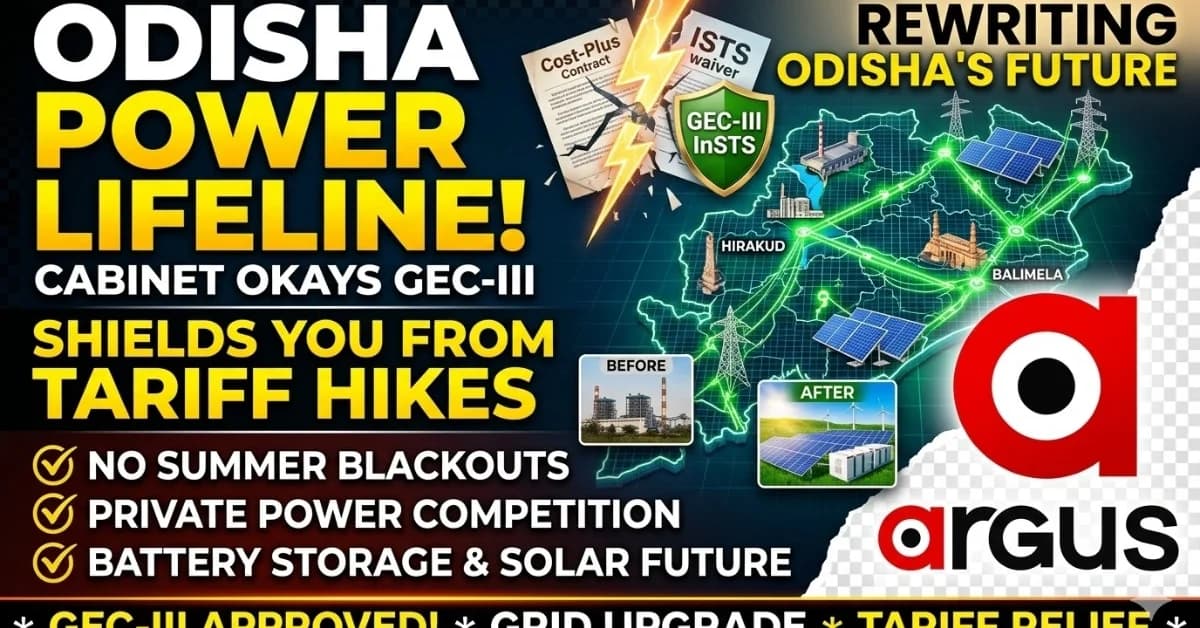
Bhubaneswar: In a move that effectively rewrites Odisha’s energy future, the Union Cabinet’s approval of the Green Energy Corridor Phase-III (GEC-III) scheme on Wednesday has handed the state a critical power lifeline.
As the clock ticks down towards a sweeping national regulatory overhaul, this massive infrastructure push is set to directly shield Odisha’s domestic electricity consumers from aggressive tariff hikes, while structurally securing the state's power grid against summer blackouts.
While macroeconomic announcements often feel far removed from the average household, this specific Cabinet Committee on Economic Affairs (CCEA) clearance hits home. By fundamentally altering how power infrastructure is funded and built, the policy directly targets the hidden costs that drive up monthly domestic utility bills.
How the new CCEA green signal meant for Odisha is summarised below

📱 Get Argus News App
✨1. Grid Evacuation & Bottlenecks
Status BEFORE CCEA Clearance: The state largely relied on Interstate Transmission (ISTS) waivers to offload green power. State grids were structurally unequipped for heavy, variable intra-state loads, creating looming fears of local grid congestion.
Status AFTER CCEA Clearance: Integration into a massive ₹1,36,378 crore nationwide InSTS pool engineered to seamlessly handle up to 135 GW of renewable energy.
Future Outlook (Odisha): High Probability — Odisha’s ambitious floating solar pipeline (across reservoirs like Hirakud and Balimela) will achieve successful grid integration without risking local transformer failure or forced curtailment.
2. Bidding & Contractor Rules
Status BEFORE CCEA Clearance: State transmission lines could be awarded under legacy "Cost-Plus Basis" (CPB). State utility monopolies faced less financial pressure to prevent asset-building cost overruns and delays.
Status AFTER CCEA Clearance: Legally mandated transition to Tariff-Based Competitive Bidding (TBCB) for all new greenfield lines via a Build-Own-Operate-Maintain (BOOM) model. CPB is strictly restricted to brownfield expansions.
Future Outlook (Odisha): High Probability — Private and central infrastructure giants will enter the state transmission landscape, driving project delivery costs down by an expected 30% to 40% due to aggressive bidding.
3. Consumer Retail Tariffs
Status BEFORE CCEA Clearance: Rapid local infrastructure rollouts traditionally led to higher capital expenditure for state utilities. These ballooning costs were added to the state utility's asset base and pushed to the public through tariff hikes.
Status AFTER CCEA Clearance: Backed by a ₹54,082 crore Central Financial Support framework. Central Financial Assistance (CFA) will actively step in to offset intra-state transmission charges.
Future Outlook (Odisha): High Probability — Even as the state aggressively replaces fossil fuels with green power, local electricity regulators will be able to shield home consumer meters from sharp, infrastructure-driven per-unit hikes.
4. Grid Intermittency & Flexibility
Status BEFORE CCEA Clearance: Solar generation remained strictly dependent on daytime hours. During non-solar evening peaks (6 PM – 10 PM), utilities had to fire up expensive thermal plants or execute localized load shedding.
Status AFTER CCEA Clearance: Access to a dedicated ₹50,000 crore segment carved out exclusively for deploying 50 GWh of Battery Energy Storage Systems (BESS).
Future Outlook (Odisha): Medium-to-High Probability — Major sub-stations feeding industrial clusters and urban hubs like Bhubaneswar will see the deployment of utility-scale storage. This will capture daytime solar overflows and discharge them to eliminate summer peak blackouts.
Bypassing the 2028 "Interstate Toll" Trap
The clock is ticking for India's power sectors. Under current federal mandates, the 100% Inter-State Transmission System (ISTS) charge waiver—which previously allowed states to import cheap renewable energy across the country for free—is undergoing a strict phased rollback. By June 2028, this waiver will drop significantly, threatening to add an extra ₹0.40 to ₹0.50 per kWh in interstate transit tolls to imported electricity.
For Odisha, GEC-III is an economic survival blanket. Instead of leaving the state dependent on resource-rich western states and exposing consumers to heavy post-2028 interstate toll penalties, the CCEA clearance activates a massive nationwide pool of ₹1,36,378 crore for Intra-State Transmission (InSTS). Backed by ₹54,082 crore in Central Financial Assistance, Odisha is now empowered to build a self-sustaining internal network. The state can generate, transport, and consume its own local green energy – such as its upcoming reservoir-based floating solar projects – completely bypassing the national toll network and keeping retail prices insulated.
The Death of Monopoly Tax: How TBCB Lowers Your Bill
For decades, domestic consumers have silently paid the price for inefficient infrastructure development. Under the legacy "Cost-Plus" model, state transmission monopolies faced little financial pressure; if a project suffered bureaucratic delays or ballooning costs, the extra expenses were simply passed down to the public through higher "Wheeling Charges" on monthly electricity meters.
The CCEA clearance shatters this legacy model for good. Under GEC-III mandates, all brand-new greenfield transmission corridors must legally be awarded via Tariff-Based Competitive Bidding (TBCB).
Through a strict Build-Own-Operate-Maintain (BOOM) framework, private and central infrastructure giants will compete transparently to build Odisha's clean energy pathways. Because winning developers must lock in fixed tariffs for 35 years, any future cost overruns or delays are absorbed entirely by the corporations—not the consumer. Historical data shows this shift alone drives project delivery costs down by 30% to 40%, systematically lowering the baseline per-unit cost of electricity delivered to homes.
Eradicating Peak-Hour Summer Blackouts
Beyond financial relief, the CCEA clearance brings a tangible upgrade to grid stability. The most frustrating pain point for the common consumer remains the frequent voltage fluctuations and power cuts during sweltering summer evenings (6 PM to 10 PM), when solar generation drops to zero and air conditioning loads peak.
To address this grid intermittency, the CCEA has carved out a dedicated ₹50,000 crore framework for 50 GWh of Battery Energy Storage Systems (BESS). By deploying utility-scale storage batteries directly at critical sub-stations across Odisha, the grid can capture massive daytime solar surpluses and smoothly discharge that power when the sun sets.
For the average household in urban hubs like Bhubaneswar or rural districts alike, this translates to a rock-solid grid: consistent voltage, a drastic reduction in sudden transformers blowing out, and the elimination of evening load shedding.
By aligning heavy central funding with strict competitive bidding laws, today's CCEA clearance ensures that Odisha's transition to green energy will not be built on the backs of its domestic consumers. Instead, it delivers exactly what was promised: cheaper, cleaner, and uninterrupted power straight to the home meter.
Also Read: EXCLUSIVE| ASI 2024-25: “Make in Odisha” Paying off, Odisha 4th in Country in Industrial Investments; Engineers, Technicians, Managers Pay Check HighRelated Topics
Explore more stories