



EXCLUSIVE| Odisha Final SIR: 2.49 Lakh Added, 10.07 Lakh Migrant/Absent Names Out;Why Female Voter Ratio Fell to 961?
Key Points
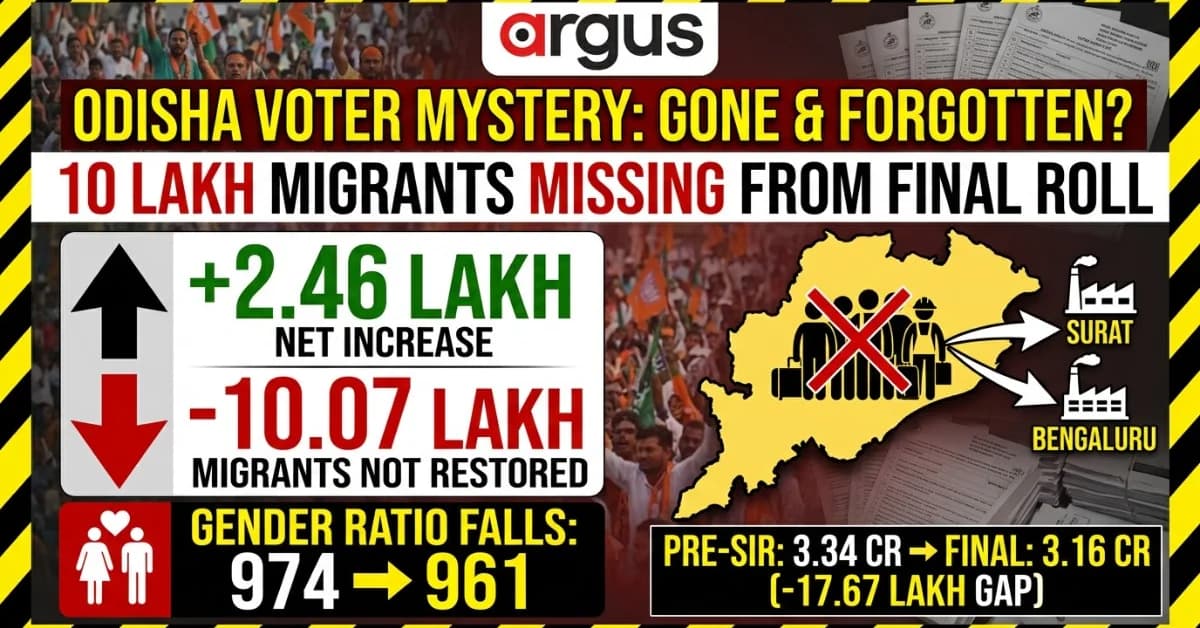
Odisha's final electoral roll contains 3,16,32,754 electors, marking a net increase of 2,45,720 voters over the July draft but remaining 17.67 lakh below the pre-SIR level.
The 2.46 lakh net addition cannot be interpreted as a wholesale restoration of the 10.07 lakh voters initially classified as migrated or absent.
The state's female-to-male voter ratio declined significantly from 974 prior to the revision down to 961 per 1,000 males in the final roll.
Bhubaneswar: Odisha's Special Intensive Revision (SIR) of electoral rolls has ended with a striking mismatch at its heart: the state has added nearly 2.46 lakh net voters to the draft roll, but the 10.07 lakh voters classified as migrated or absent during the initial deletion exercise have not returned as a distinct category in the final roll.
The final electoral roll published on Monday contains 3,16,32,754 electors, up from 3,13,87,034 in the July 5 draft – a net increase of 2,45,720. But the increase does not represent a corresponding restoration of the 10.07 lakh voters who were left out during the first stage of the SIR.
That distinction changes the way the final SIR numbers need to be read.
The initial revision had removed 20,12,557 names from the pre-SIR electorate of 3,33,99,591. Of these, around 10.07 lakh were classified as migrated/absent, 8.32 lakh as deceased and 1.58 lakh as duplicate entries. The July draft therefore fell to 3.13 crore electors.

📱 Get Argus News App
✨The final exercise did not reverse that 10.07-lakh block.
The numbers that matter
|
SIR stage |
Electors |
|---|---|
|
Pre-revision electorate |
3,33,99,591 |
|
Draft roll — July 5 |
3,13,87,034
Initial exclusion
20,12,557
Final roll — September 21
3,16,32,754
Net increase over draft
2,45,720
The Election Commission's final figures show that 2,90,497 electors were added during the claims, objections and verification phase, while 44,777 entries were deleted from the draft roll. The resulting arithmetic is straightforward:
2,90,497 additions – 44,777 deletions = 2,45,720 net increase.
This is important because the nearly 2.46 lakh net increase cannot be presented as a restoration of the 10.07 lakh migrated/absent voters.
The 10.07-lakh question
The draft-stage classification had put approximately 10.07 lakh electors in the migrated/absent category, accounting for about 3.02% of the electorate at that stage. The same broad figure remained in the finalised deletion data supplied for the SIR.
In other words, the final roll did not show a category-wise reversal of that original deletion.
This creates the central distinction in the final SIR story:
New voters were added. But that is not the same as restoring the voters who disappeared during the first enumeration.
The final additions therefore have to be read as a separate stream of enrolment and restoration applications rather than as a wholesale recovery of the migrant/absent population.
Where the 2.49 lakh came from
The final numbers show that 2,90,497 electors were added during the post-draft process.
At the same time, 44,777 entries failed subsequent verification and were deleted.
The result was a net gain of 2,45,720 voters, taking Odisha's electorate from 3.13 crore in the draft to 3.16 crore in the final roll.
So, strictly speaking, the headline figure of 2.49 lakh refers to the rounded net increase of 2.46 lakh, rather than 2.49 lakh gross additions. The gross addition figure is 2.90 lakh.
That distinction matters in a story about SIR because otherwise the numbers can suggest that 2.49 lakh of the original deleted voters were brought back.
They were not.
The Gender Signal: Female Voter Ratio Falls After SIR
There is another important signal in the final electoral data: Odisha's female-to-male voter ratio has declined following the SIR.
Before the revision, Odisha's electoral roll had a gender ratio of 974 female voters per 1,000 male voters. In the final roll published in September 2026, the ratio stands at 961 females per 1,000 males.
That represents a decline of 13 female voters per 1,000 male voters.
The change becomes significant when read alongside the scale of the initial SIR exclusions. The first-stage exercise removed more than 20 lakh names, including around 10.07 lakh electors classified as migrated/absent. The subsequent claims and verification process added 2,90,497 electors and removed another 44,777, producing a net increase of 2,45,720 over the draft roll.
The gender data therefore adds another dimension to the SIR outcome: the final electorate has grown from the July draft, but the female share relative to male electors remains lower than the pre-revision level.
This does not, by itself, establish that the decline in the gender ratio was caused entirely by the deletion of migrant or absent voters. The aggregate figures do not provide a category-wise gender breakdown of the 10.07 lakh deleted electors.
But the movement from 974 to 961 is an important demographic indicator that merits closer examination – particularly in a state where large-scale labour migration means that a substantial number of working-age voters may spend periods outside their home districts or outside Odisha.
The final roll thus presents two parallel outcomes: a net addition of voters after the draft, alongside a lower female-to-male voter ratio than before the SIR.
Why the migrant-worker issue matters
The most difficult question concerns voters who were physically away from their Odisha homes during the enumeration and verification process.
The SIR process was built around house-to-house enumeration by Booth Level Officers. The Election Commission had said that voters who could not submit enumeration forms during the initial phase could subsequently apply through Form 6 with the prescribed declaration during the claims and objections period.
But for a worker living hundreds or thousands of kilometres away from his or her native village, the practical question was different.
A worker employed in Surat, Bengaluru, Chennai, Hyderabad or another industrial centre could be absent when the BLO visited the registered address. As a consequence, such voters faced a greater practical burden in responding to notices, attending local verification or producing supporting documentation within the prescribed period.
That is where the SIR's migration dimension becomes significant.
The issue is not that migration itself makes someone ineligible to vote in Odisha. Rather, long-term or seasonal migration can make physical verification at the home address substantially more difficult.
For a state with a large population working outside Odisha, that creates a very different electoral-roll problem from simply identifying deceased or duplicate voters.
A very different problem from dead or duplicate names
The three major deletion categories had fundamentally different characteristics.
|
Category |
Approx. names |
Nature of issue |
|---|---|---|
|
Deceased |
8.32 lakh |
Voter no longer alive |
|
Migrated/absent |
10.07 lakh |
Voter could not be located/was reported shifted or absent |
|
Duplicate |
1.58 lakh |
Multiple registrations |
|
Total |
20.12 lakh |
Initial exclusion |
The distinction is crucial.
A deceased elector cannot be restored.
A genuine duplicate entry should normally be eliminated from one location.
But a genuine elector who is temporarily working outside Odisha is a different case.
The question raised by the final numbers is therefore not simply how many names were cleaned from the roll. It is how effectively the system distinguished permanent migration from temporary absence and ensured that genuine migrant electors could re-establish their enrolment.
Odisha's migration map is visible in the deletion numbers
The district pattern also gives the SIR a distinctly migration-linked dimension.
Ganjam recorded the highest absolute deletion at 2,07,624, followed by Cuttack at 1,55,166, Balangir at 1,11,267, Nayagarh at 1,05,014 and Jajpur at 99,258. Malkangiri recorded the highest percentage reduction at about 10.2%.
Ganjam's position is particularly significant because of its large migrant population and extensive labour movement outside the state.
The numbers therefore show that SIR's effect was not evenly distributed across Odisha.
Some of the state's migration-prone districts experienced substantially larger electoral-roll reductions than others.
The final roll is cleaner – but the migrant question remains
The Election Commission's stated objective of SIR is to ensure that eligible citizens are not left out while ineligible entries are excluded. The ECI had explicitly described the exercise as one intended to ensure that every eligible Indian citizen aged 18 or above on the qualifying date is registered.
Odisha's final numbers show that the revision achieved a substantial clean-up while also adding nearly 2.46 lakh net electors after the draft.
But the data also leaves a separate question over the 10.07 lakh migrated/absent voters initially excluded from the draft.
The final roll demonstrates that Odisha added voters after the draft. It does not, from the figures released, demonstrate that the original 10.07 lakh migrated/absent voters were collectively restored.
That is the crucial distinction.
What the final SIR actually changed
The transformation can therefore be read in three stages:
First: Odisha started with roughly 3.34 crore electors.
Second: the enumeration exercise produced a draft roll of 3.13 crore, after 20.12 lakh names were excluded, including 10.07 lakh classified as migrated/absent.
Third: the claims and verification process added 2.90 lakh electors, deleted another 44,777, and produced a final electorate of 3.16 crore.
The final figure is therefore higher than the draft—but still roughly 17.67 lakh below the pre-SIR electorate.
That gap is the bigger number behind Monday's final roll.
The bigger story behind 2.46 lakh
The headline number is 2,45,720 net additions.
The bigger structural number is 20,12,557 initial exclusions.
And within that initial exclusion, the most consequential category for a migration-dependent state is the 10.07 lakh classified as migrated/absent.
The final SIR has therefore settled one question—how many electors are on the revised roll—but left a more important administrative question in view:
How many genuine Odisha voters who were outside their home districts or the state during enumeration were able to successfully re-establish their names on the electoral roll?
The released aggregate figures do not provide a category-wise answer to that question.
That is why the final SIR should not be read merely as a story of 2.49 lakh new voters.
It is equally a story of a 10-lakh migrated/absent voter pool whose restoration cannot be established from the final aggregate additions.
And there is a second unanswered question: why did Odisha's female-to-male electoral ratio fall from 974 before the revision to 961 in the final roll?