



EXCLUSIVE | NSS Tourism Survey: Odisha Lags at #18 While Shopping Drives India's Travel Boom; UP, AP in Top 10
Key Points
Bhubaneswar: The new national tourism expenditure survey by National Sample Survey has thrown up an economic clue that goes far beyond how often Indians travel.
The NSS 80th Round Domestic Tourism Expenditure Survey, covering July 2025 to June 2026, shows that when Indians make same-day trips, social visits remain the most frequent purpose, but shopping is the second-biggest reason for travel – and, crucially, shopping generates the highest expenditure among all same-day trip purposes.
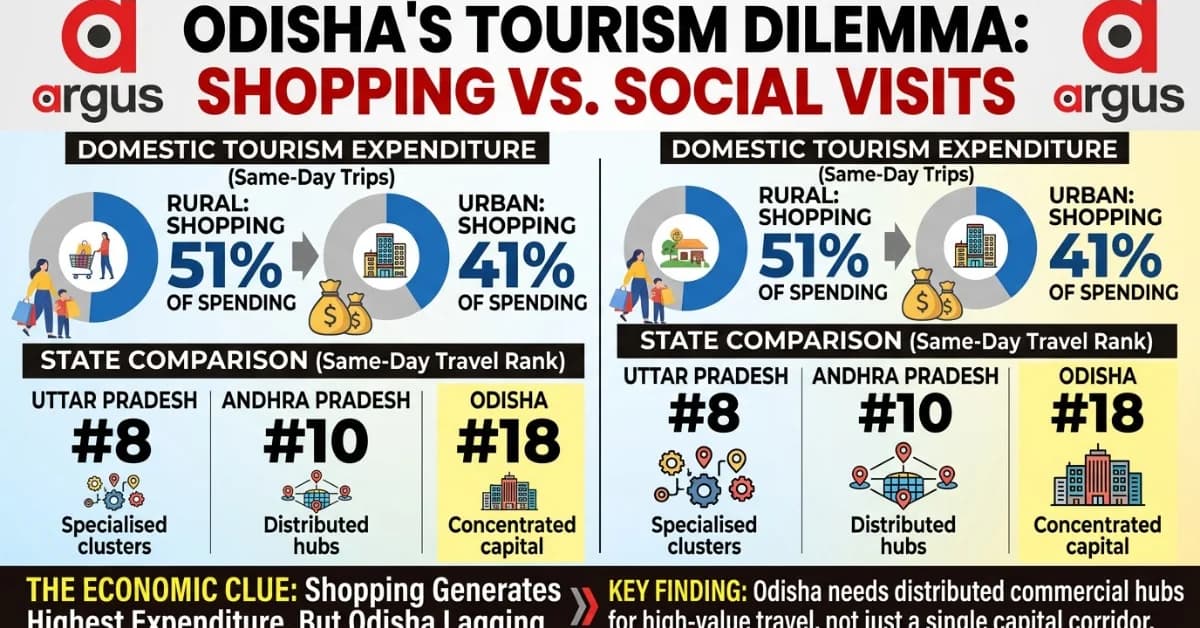
At the national level, social trips accounted for 33% and shopping 26% of same-day trips. But the spending pattern reverses the hierarchy: shopping recorded the highest expenditure among same-day trips in both rural and urban India, while shopping alone accounted for 51% of same-day trip expenditure in rural areas and 41% in urban areas.
That distinction is significant for Odisha.

📱 Get Argus News App
✨The data suggest that the issue is not simply whether Odisha’s people travel. They do. The deeper question is what economic infrastructure exists at the destination to make those journeys commercially productive.
And here the NSS evidence, read alongside the state-level comparison, exposes a structural weakness: Odisha has far fewer distributed shopping destinations capable of pulling consumers across districts for high-value purchases.
The result is a tourism economy in which social obligations and pilgrimage can generate movement, but shopping is not yet being converted into a comparable network of frequent intra-state economic journeys.
The NSS revelation: No.2 in frequency, No.1 in money
The national figures tell an unusually clear story.
|
Same-day trip indicator |
Rural |
|---|
Urban
Social — share of trips
32%
37%
Shopping — share of trips
29%
17%
Shopping — share of total trip expenditure
51%
41%
Highest-spending purpose
Shopping
Shopping
The NSO says social and shopping were the two most frequently undertaken same-day trip purposes in both rural and urban households. Yet shopping generated the highest expenditure, followed by health and medical trips.
This creates an important economic distinction.
Social travel creates mobility. Shopping creates monetisation.
A person travelling to meet relatives may spend primarily on transport and food. A person travelling to purchase a television, jewellery, garments, wedding items, electronics, agricultural equipment or other higher-value goods can put substantially more money into the destination economy.
That is why the shopping number matters disproportionately.
The survey covered 24,778 first-stage sampling units and 2,46,113 households, giving the finding a substantial national statistical base.
And this is where Odisha’s problem begins
The state-level analysis of the NSS data places Odisha significantly below Andhra Pradesh and Uttar Pradesh in the frequency of same-day travel.
The comparative picture is stark:
|
Indicator |
Uttar Pradesh |
Andhra Pradesh |
Odisha |
|---|---|---|---|
|
Position in same-day travel comparison |
#8 |
#10 |
#18 |
|
Approx. same-day trips |
180+ |
165+ |
— |
|
Rural same-day trips |
— |
— |
~130 |
|
Urban same-day trips |
— |
— |
~110 |
|
Dominant structural pattern |
High-density trade corridors |
Distributed commercial hubs |
Social/religious-heavy movement |
The
analysis attributes the difference not merely to income, but to
where
shopping infrastructure is located, how many commercial centres exist
and how easily consumers can reach them within a day.
This
is the key finding for Odisha:
The State does not merely need more tourists. It needs more reasons for its own people to travel – and more places within the State where that travel can turn into high-value consumption.
Andhra Pradesh: The multi-hub model
Andhra Pradesh provides the closest structural comparison.
The state does not depend on one overwhelmingly dominant retail centre. Instead, commercial activity is distributed across several major urban destinations, including Visakhapatnam, Vijayawada, Guntur, Nellore and Tirupati.
That changes the economics of a shopping trip.
A consumer does not necessarily need to travel to one distant state capital. Different parts of Andhra Pradesh have different commercial destinations within relatively accessible travelling distances.
The analysis identifies this distributed commercial grid, with high-value shopping linked to regional centres rather than being concentrated in one urban block.
The products themselves create the travel incentive.
A comparison identifies bridal gold, Dharmavaram silk, household appliances and other high-value consumer goods as examples of products capable of drawing buyers across district boundaries.
In other words, AP has something Odisha needs to examine closely:
commercial destinations that are themselves reasons to travel.
Uttar Pradesh: Shopping grows out of specialised clusters
Uttar Pradesh presents a different model.
Its advantage is not simply the presence of large cities. It is the existence of specialised commercial and production clusters.
Kanpur has leather. Bhadohi has carpets and rugs. Varanasi has silk. Noida has large-scale retail and consumer markets.
Such clusters create a very different tourism equation.
A consumer does not travel merely because a shop exists. The consumer travels because the destination offers a product, price, variety or cluster advantage that may not be available locally.
The analysis points out these as specialised micro-markets and high-volume trade corridors.
That distinction is important for Odisha.
A district headquarters can have supermarkets, apparel stores and electronics dealers and still fail to generate large-scale shopping tourism.
Why?
Because ordinary retail does not necessarily create destination retail.
Destination retail is different. It gives consumers a reason to leave their normal market.
Odisha’s problem is not the absence of shops – it is the absence of enough shopping destinations
This may be the most important interpretation of the NSS data.
It would be inaccurate to read the findings as saying Odisha has no shopping infrastructure.
The deeper issue is distribution and specialisation.
An analysis finds that modern high-margin retail is heavily concentrated around the Bhubaneswar-Cuttack urban corridor, while peripheral markets are more heavily oriented towards everyday consumption.
That produces a geographic problem.
Consider a consumer in Malkangiri, Nuapada or Mayurbhanj.
If the objective is routine household consumption, local markets may be adequate.
But if the consumer wants a wider choice of premium garments, jewellery, electronics, appliances, wedding merchandise, specialised construction material or other high-value products, the available destination market becomes much narrower.
The distance to Bhubaneswar-Cuttack can make a same-day journey commercially irrational.
So the consumer does not travel.
And when the consumer does not travel, the destination does not capture the expenditure.
That is the hidden economic cost of an underdeveloped shopping network.
The paradox: Odisha has products, but not enough product destinations
There is another irony.
Odisha already possesses a large cultural and artisanal product base.
Its handloom traditions, textiles, handicrafts, stonework, silver filigree and tribal products have destination value.
But the NSS shopping framework points towards something broader: shopping-led travel is often generated by specialised, high-value and differentiated products, including wedding textiles, jewellery, electronics, bulk consumer goods, hardware and specialised goods unavailable in smaller markets.
That means Odisha's challenge is not necessarily to create an entirely new shopping culture.
It is to create commercial ecosystems around existing strengths.
A handloom town that combines production, branded retail, food, accommodation, transport and experience can become a destination.
A craft village that only has a few scattered outlets remains a market.
That is the difference between a product and a tourism economy.
Why Andhra Pradesh converts travel into spending
The AP-Odisha comparison becomes particularly revealing when transport is added.
An analysis identifies Andhra Pradesh's highways, regional transport links and coastal rail connectivity as factors supporting two-to-three-hour regional journeys. Odisha, by contrast, has much greater dependence on road transport in rural travel, creating what is konown as "time poverty".
The economics are simple.
A shopping trip is discretionary.
If the journey takes too long, costs too much and offers uncertain product availability, the consumer postpones the purchase or buys locally.
Therefore:
Poor commercial connectivity does not merely reduce tourism. It suppresses retail demand at destination markets.
The Odisha capital trap
This produces what can be called the Bhubaneswar-Cuttack concentration effect.
The capital region has:
large-format retail;
branded consumer goods;
premium electronics;
jewellery;
wedding shopping;
specialised services;
hospitality;
entertainment;
wholesale and distribution networks.
But these facilities do not automatically create statewide shopping tourism.
They create a powerful single destination.
The problem is the distance between that destination and much of Odisha.
When analysed, it specifically identifies the absence of competitive tier-2 commercial centres as a reason peripheral districts remain underrepresented in shopping-led same-day travel.
This is where Odisha differs structurally from AP.
AP's commercial network is more distributed.
Odisha's is more concentrated.
The income question: Why mining wealth does not automatically become retail tourism
There is also an economic dimension.
Odisha's strong economic growth is substantially linked to capital-intensive sectors such as mining and mineral processing. But state-level economic output does not automatically mean that disposable consumer income is distributed evenly across rural households.
An analysis conducted shows that this creates a different consumption pattern from Andhra Pradesh, where agriculture, aquaculture, services and commercial activity generate more distributed household cash flows.
This should not be read as saying Odisha's households do not spend.
Rather, the issue is what they spend on and where they spend it.
A household with a constrained discretionary budget is less likely to undertake a long journey merely to browse a distant market.
But if a specialised market is nearby, the calculation changes.
Hence the importance of regional commercial hubs.
Odisha's tourism success may actually be masking this weakness
Odisha has built a recognisable tourism economy around destinations such as Puri and Konark.
That model largely works through pilgrimage, heritage and overnight travel.
The NSS survey, however, separates overnight tourism from same-day tourism.
Nationally, the two behave very differently.
For same-day travel, social and shopping dominate frequency, with shopping dominating expenditure.
Therefore, a state can have a growing number of tourists while still having a relatively weak internal same-day consumption network.
That is the distinction Odisha now needs to confront.
Visitor arrivals are one tourism metric. Internal economic circulation is another.
What Odisha is potentially leaving on the table
The NSS numbers indicate that shopping is not a minor tourism activity.
It is the largest expenditure component of same-day travel nationally.
The opportunity therefore extends beyond malls.
Odisha could potentially develop specialised regional shopping circuits around:
|
Potential regional model |
Possible commercial focus |
|---|---|
|
Sambalpur–Bargarh belt |
Sambalpuri textiles, handloom, wedding shopping |
|
Rourkela–Sundargarh |
Industrial goods, consumer durables, specialised retail |
|
Berhampur–Ganjam |
Silk, textiles, jewellery and coastal consumer markets |
|
Balasore–Baripada |
Handloom, tribal/artisanal products, regional retail |
|
Koraput–Jeypore |
Tribal products, handloom, agricultural and cultural goods |
|
Cuttack–Bhubaneswar |
Premium retail, electronics, jewellery, wedding commerce |
|
Puri–Raghurajpur–Konark |
Pilgrimage-linked craft, souvenirs and cultural shopping |
These are analytical possibilities rather than recommendations contained in the NSS report. The report establishes the spending importance of shopping; the regional product circuits would require separate feasibility, infrastructure and market studies.
The real comparison: three different tourism economies
The AP-UP-Odisha comparison can ultimately be reduced to three models.
|
|
Uttar Pradesh |
Andhra Pradesh |
Odisha |
|---|---|---|---|
|
Commercial geography |
Specialised clusters |
Multiple regional hubs |
Strong capital concentration |
|
Shopping trigger |
Product specialisation |
Regional availability + product value |
Primarily major urban centres |
|
Same-day mobility |
High-volume corridors |
Distributed regional movement |
Greater distance for specialised shopping |
|
Rural market |
Large interconnected trade network |
Multiple commercial destinations |
More essential/localised consumption |
|
High-value shopping |
Cluster-based |
Hub-based |
Concentrated |
|
Tourism-shopping relationship |
Trade generates travel |
Commercial hubs generate travel |
Tourism stronger than internal shopping circuits |
Therefore, analysis of NSS report shows when UP has been ranked at number 8, AP at 10, Odisha is placed at 18 in its same-day travel comparison, reinforcing the wider structural gap.
The big takeaway for Odisha
The September 23 NSS report does not simply say Indians are travelling more.
It reveals something more consequential:
Shopping is the second-most common purpose of same-day travel, but it captures the largest share of spending.
That means every shopping trip represents a potentially larger economic transfer from the traveller's household to the destination economy.
For Odisha, the challenge is therefore not only to attract more tourists to Puri, Konark, Chilika or other established destinations.
It is to create more destinations worth travelling to for shopping inside Odisha itself.
And that requires more than malls.
It requires tier-2 commercial cities, specialised product clusters, wholesale markets, regional retail hubs, better inter-district connectivity and destination-level branding of Odisha's own products.
Andhra Pradesh demonstrates what happens when commercial infrastructure is distributed across several cities. Uttar Pradesh shows what specialised product clusters can do to generate high-volume travel. Odisha's present structure, by comparison, remains heavily concentrated around its Bhubaneswar-Cuttack commercial axis.
The NSS data therefore leave Odisha with a deceptively simple question:
If shopping is where the biggest same-day tourism money is spent, how many places in Odisha can actually make a consumer travel for shopping?
That may be the more important tourism-infrastructure question emerging from the latest NSS report.