



EXCLUSIVE| PLFS 2025: Odisha Youth NEET Crisis unravels Vicious Circle of Male Idleness and rising Crime graph from Baleswar, Jajapur to Ganjam
Key Points
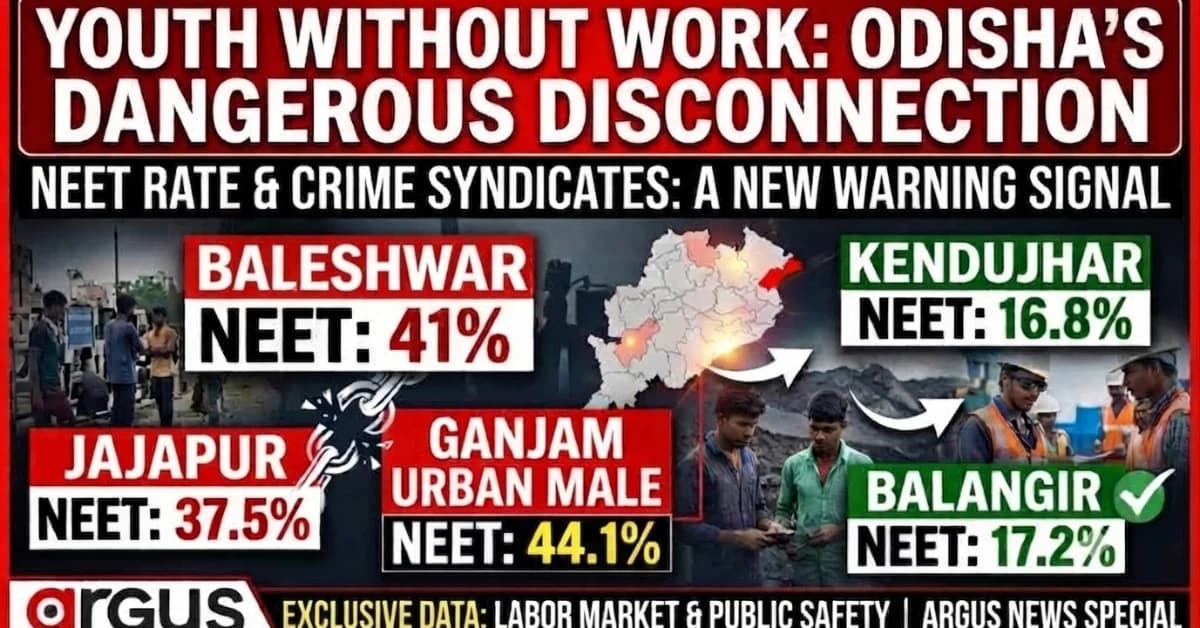
Baleshwar records Odisha's highest NEET rate at 41%, alongside a 25.6% male NEET rate that mirrors local crime and contraband networks.
Ganjam faces an urban shock with a striking 44.1% urban male NEET rate, fueling digital fraud and localized gang syndicates.
Jajapur highlights an industrial paradox where capital-intensive growth results in a high 37.5% NEET rate and local youth exclusion.
Bhubaneswar: A new reading of Odisha’s district-level labour data throws up a less discussed dimension of the State’s crime map: some of the districts showing substantial youth disconnection from employment, education and training are also districts repeatedly appearing in serious crime narratives.
The PLFS 2025 district snapshot puts the 15–29-year NEET rate at 41% in Baleshwar, 37.5% in Jajapur and 33.6% in Ganjam, against Odisha’s overall 26.3%. The same dataset, however, also shows that the relationship is not a simple one-to-one equation: Kendujhar and Balangir have much lower NEET rates of 16.8% and 17.2%, while their labour-market participation is substantially higher.
That makes the emerging story less about declaring NEET youth as a crime risk and more about asking a harder question: what happens when large sections of young people remain outside the institutional systems that normally absorb their time, skills and economic aspirations?
The numbers that raise the question
|
District |
|---|

📱 Get Argus News App
✨WPR, 15+ (%)
UR, 15+ (%)
NEET, 15–29 (%)
Baleshwar
61.2
3.3
41.0
Jajapur
47.5
5.0
37.5
Ganjam
52.3
4.1
33.6
Cuttack
55.0
3.6
25.7
Khordha
51.0
4.1
26.0
Sundargarh
62.9
3.6
19.0
Kendujhar
73.0
1.0
16.8
Balangir
68.2
1.8
17.2
Kalahandi
74.2
2.0
18.0
NEET is the principal youth-vulnerability indicator, while WPR and UR relate to the 15+ population.
Baleshwar: 41% NEET — and a string of recent crime incidents
Baleshwar presents one of the clearest examples of why the data deserves attention.
The district records a 41% NEET rate, the highest among the major populous districts covered in the dataset. Its overall WPR is 61.2% and unemployment rate 3.3%.
The recent crime record does not prove that the NEET population is producing crime. But the sequence of incidents demonstrates why the district's youth-economic profile merits examination alongside policing data.
The gender dimension is even sharper
The Baleshwar number hides a major gender divide.
While Baleshwar's overarching 41% NEET rate is skewed heavily by the 56.8% rate among rural women adapting to domestic roles, its 25.6% male NEET rate represents a critical mass.
Exactly one out of every four young men in the district is completely detached from the formal institutional architecture – creating an available talent pool for cross-border contraband networks and resource syndicates operating across the porous West Bengal border.
The PLFS dataset records 25.6% NEET among young males but 56.8% among young females in the district.
This distinction matters because a high female NEET rate cannot automatically be interpreted through a street-crime lens. A substantial part of female NEET can reflect unpaid domestic work, care responsibilities, mobility restrictions or barriers to formal employment.
The more direct crime-and-idleness question therefore concerns the male NEET population, and Baleshwar's 25.6% figure is still significant.
The Echo On Ground?
Recently, police arrested five persons accused of attacking and robbing a man near Nishi Hotel in Baleshwar town. The victim was allegedly attacked with a sword and other weapons and robbed of Rs 8,500.
Then came an armed bank robbery at Khaprapada under Baliapal police limits. A group allegedly entered an Odisha Grameen Bank branch, threatened and assaulted employees and escaped with around Rs 10 lakh.
Earlier in September, a history-sheeter from Bihar was injured in an exchange of fire with Baleshwar police after police said a group of criminals was allegedly planning a dacoity.
These are different categories of crime and should not be artificially bundled together. Yet their recurrence provides a real-world backdrop against which the 25% NEET figure becomes socially significant.
Ganjam: the crime question takes a different form
Ganjam's overall NEET rate is 33.6%, while its WPR is only 52.3% and UR 4.1%. The male NEET rate is 25.4%, compared with 41.9% among females.
But the urban-rural split changes the picture dramatically.
The dataset puts urban male NEET at 44.1%, against 22.3% in rural Ganjam.
Ganjam’s Urban Shock: While rural male NEET stands at a baseline 22.3%, the urban male NEET rate spikes to a striking 44.1%.
The Cyber-Mule Connection: This means nearly half of Ganjam's urban young men are completely unengaged. This structural deficit directly explains why Ganjam has seen a rise in localized gang syndicates and digital financial fraud networks (such as bank mule account rackets), which rely on an idle, tech-literate youth population.
Moreover, recent incidents show the district's exposure to several forms of organised and group crime.
On September 5, four men were assaulted by villagers in Hinjili on suspicion of being goat thieves.
Ganjam police have also reported major narcotics seizures. In one recent operation, police said they seized 612.58 kg of ganja in two cases during district-wide checking.
These incidents do not establish that NEET youth were responsible. Rather, they show the kind of criminal ecosystem in which economically disconnected young people can potentially become vulnerable to recruitment.
The Jajapur paradox
Jajapur may be the most revealing case.
It is an industrial and mineral-processing district, yet its NEET rate is 37.5%, the second highest among the major districts in the dataset. Its WPR is only 47.5% and unemployment is 5%, the highest among the districts listed.
That produces an important paradox: industrialisation does not automatically mean local youth absorption.
Capital-intensive industries can generate substantial economic output without necessarily employing large numbers of local young people, particularly where jobs demand specialised technical skills.
The result can be a visible divide between industrial wealth and local labour-market participation.
Jajapur highlights the limits of capital-intensive industrial expansion, showing a high 37.5% NEET rate and 5.0% unemployment because its local youth are excluded from highly specialized technical setups.
Conversely, Kendujhar (16.8% NEET) showcases the success of a high-absorption primary sector, where mining logistics, regional transport operations, and secondary local trade effectively engage the youth demographic, preventing the formation of volatile, unengaged populations.
What the numbers can – and cannot – say
The data supports a strong warning signal but not a criminal verdict on NEET youth.
Baleshwar's 41% NEET rate sits alongside a series of recent violent, robbery and organised-crime incidents. Ganjam's 33.6% overall NEET rate and 44.1% urban male NEET rate sit alongside a documented pattern of narcotics enforcement and other serious crime incidents.
But there are also counterexamples.
Kendujhar has a 73% WPR, 1% unemployment and only 16.8% NEET, while Balangir records 68.2% WPR, 1.8% unemployment and 17.2% NEET.
The underlying distinction may therefore be economic absorption rather than merely unemployment.
A young person who is not in a formal salaried job may still be engaged in farming, casual labour, family enterprise, mining logistics or self-employment. PLFS employment definitions capture these forms of work as well.
The bigger warning for Odisha
The most important finding is therefore not that “NEET causes crime”.
It is that districts with large populations of young people outside both employment and education/skill require a different form of public-safety planning.
Traditional policing addresses crime after it emerges. Labour-market intervention can address one of the conditions that may leave young people economically and institutionally disconnected in the first place.
For Baleshwar, that means examining the rural and border economy alongside policing and skills.
For Ganjam, the 44.1% urban male NEET figure points towards a different challenge: the transition from education to urban employment, technical skills and legitimate income opportunities.
And Jajapur offers the clearest industrial warning – factories can exist without sufficiently absorbing the surrounding youth population.
Odisha's overall labour market may look relatively strong, with a 61.3% WPR and 2.9% unemployment rate, but its 26.3% youth NEET rate shows that the headline employment picture does not capture the entire youth story.
The
crime map and labour map are therefore worth reading together – not
because one proves the other, but because the overlap identifies
where youth exclusion, economic opportunity and public safety deserve
to be examined at the same time.
Also Read: Excise Thunder From The Sky: Ganjam Takes The Biggest Hit As Odisha Hunts Illicit Liquor Dens| Special Report
Related Topics
Explore more stories