



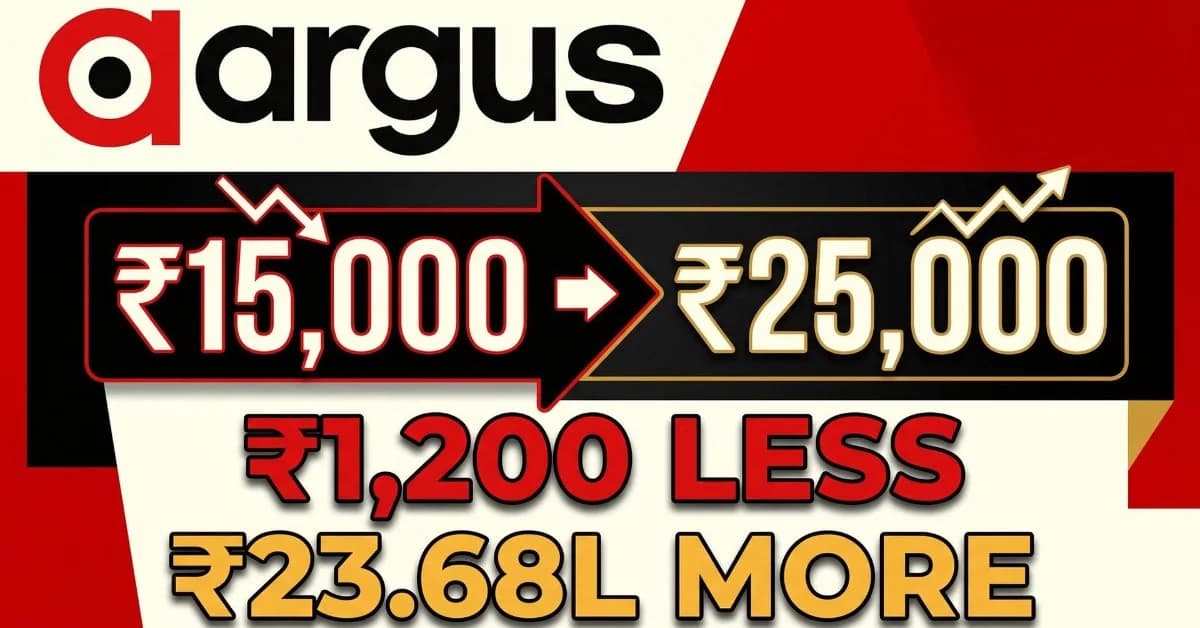
EXCLUSIVE BREAKING | How Odisha Employees Gain From New EPFO Ceiling: ₹1,200 Less Take-Home Monthly, Up To ₹23.68 Lakh More At Retirement
Key Points
The EPFO wage ceiling hike from Rs15,000 to Rs25,000 results in a monthly take-home pay reduction of Rs1,200 for basic earners in Odisha. Over a 30-year career, employees can potentially accumulate an additional Rs23.68 lakh in their EPF retirement corpus and a higher monthly pension. The policy change is projected to bring an estimated 1.5 lakh to 2.5 lakh new workers across Odisha's industrial and service sectors into mandatory EPFO coverage.
Bhubaneswar: For thousands of Odisha employees and formal-sector workers, the Union Cabinet’s decision to raise the EPFO wage ceiling from Rs15,000 to Rs25,000 creates an unusual financial trade-off: less cash in hand every month, but a substantially larger retirement corpus and higher pension potential.
For an employee with a basic salary of Rs25,000 who was earlier contributing PF only on the Rs15,000 ceiling, the immediate impact is straightforward. Employee PF deduction rises from Rs1,800 to Rs3,000 a month - meaning Rs1,200 less take-home pay every month.
But the employer’s contribution also rises. The combined monthly PF deposit moves from Rs3,600 to Rs6,000, creating an additional Rs2,400 in retirement-oriented savings every month.
The real difference becomes visible only when the employee looks beyond the monthly payslip.

📱 Get Argus News App
✨According to the analytical calculations, a worker completing a 30-year career could see an additional Rs23.68 lakh in EPF retirement wealth, while the illustrative EPS pension rises from Rs6,857 to Rs11,429 a month.
That means the central question for Odisha employees is no longer simply “How much salary will I lose today?” It is: “How much retirement security will that Rs1,200 monthly sacrifice potentially create?”
The first shock: ₹1,200 less in the monthly payslip
The
immediate arithmetic is easiest to understand at a basic salary of
Rs25,000.
| Monthly
Component |
Old
₹15,000 ceiling |
New
₹25,000 ceiling |
Change |
| Basic
salary |
₹25,000 |
₹25,000 |
No
change |
| Employee
PF deduction |
₹1,800 |
₹3,000 |
₹1,200
more |
| Employer
PF contribution |
₹1,800 |
₹3,000 |
₹1,200
more |
| Total
monthly PF deposit |
₹3,600 |
₹6,000 |
₹2,400
more |
| Illustrative
take-home pay |
₹23,200 |
₹22,000 |
₹1,200
less |
The employee therefore pays the immediate price through reduced disposable income. The employer, meanwhile, puts another ₹1,200 into the employee’s retirement-linked accounts.
The calculation shows that the employer contribution as Rs2,083 to EPS and Rs917 to EPF under the Rs25,000 ceiling, compared with Rs1,250 and Rs550 respectively under the Rs15,000 ceiling.
But where does the extra money actually go?
This is where the distinction between EPF and EPS becomes critical.
The employee’s entire 12% contribution goes into the PF mechanism, while the employer’s statutory contribution is divided between the pension and provident-fund components.
|
Extra monthly amount under ₹25,000 ceiling |
Additional amount |
|---|---|
|
Employee contribution |
₹1,200 |
|
Employer contribution |
₹1,200 |
|
Employer’s additional EPS component |
₹833 |
|
Employer’s additional EPF component |
₹367 |
|
Total additional retirement-linked saving |
₹2,400/month |
So, of the additional Rs2,400 entering the system every month, Rs1,200 comes directly from the employee and Rs1,200 represents the increased employer contribution.
The EPF portion ultimately builds the retirement lump-sum corpus, while EPS is the pension component used for the illustrative monthly pension calculation.
Five years, 10 years, 15 years, 20 years or 30 years: what changes?
For employees at different stages of their careers, the effect is dramatically different because the extra EPF contribution has more time to accumulate and earn interest.
The calculation when assumes a 7% annual salary increment and an average 8.15% EPF interest rate for the corpus comparison. The important point is that once the employee’s basic salary is above the relevant ceiling, the additional employee deduction remains structurally capped at Rs1,200 a month under the assumptions given below.
Career-stage comparison
|
Career already completed |
Extra cash sacrificed |
Projected additional EPF corpus |
Old illustrative monthly EPS pension |
New illustrative monthly EPS pension |
Monthly pension difference |
|---|---|---|---|---|---|
|
5 years |
₹72,000 |
₹1.20 lakh |
Not applicable in source |
Not applicable in source |
~₹42,000 one-time exit illustration |
|
10 years |
₹1.44 lakh |
₹2.97 lakh |
₹2,143 |
₹3,571 |
₹1,428/month |
|
15 years |
₹2.16 lakh |
₹5.59 lakh |
₹3,214 |
₹5,357 |
₹2,143/month |
|
20 years |
₹2.88 lakh |
₹9.46 lakh |
₹4,714 |
₹7,857 |
₹3,143/month |
|
30 years |
₹4.32 lakh |
₹23.68 lakh |
₹6,857 |
₹11,429 |
₹4,571/month |
The 30-year employee sees the biggest retirement difference
The most striking calculation comes at the end of a 30-year career.
Under the supplied assumptions, the employee’s additional out-of-pocket contribution is:
Rs1,200 × 12 months × 30 years = Rs4.32 lakh.
Against that, the projected additional EPF retirement corpus is Rs23.68 lakh.
|
30-year career comparison |
Old framework |
New framework |
Difference |
|---|---|---|---|
|
Employee’s monthly PF deduction |
₹1,800 |
₹3,000 |
₹1,200 more |
|
Employer EPF component |
₹550 |
₹917 |
₹367 more |
|
Employer EPS component |
₹1,250 |
₹2,083 |
₹833 more |
|
EPF corpus projection |
₹36.35 lakh |
₹60.59 lakh |
+₹24.24 lakh in the detailed simulation |
|
Illustrative monthly EPS pension |
₹6,857 |
₹11,429 |
+₹4,572/month |
How much does the employee sacrifice versus potentially gain?
The simplest way to read the numbers is this:
|
Career horizon |
Monthly reduction in take-home |
Total extra employee contribution |
Projected additional retirement corpus |
Illustrative pension gain |
|---|---|---|---|---|
|
5 years |
₹1,200 |
₹72,000 |
₹1.20 lakh |
|
|
10 years |
₹1,200 |
₹1.44 lakh |
₹2.97 lakh |
+₹1,428/month |
|
15 years |
₹1,200 |
₹2.16 lakh |
₹5.59 lakh |
+₹2,143/month |
|
20 years |
₹1,200 |
₹2.88 lakh |
₹9.46 lakh |
+₹3,143/month |
|
30 years |
₹1,200 |
₹4.32 lakh |
₹23.68 lakh |
+₹4,571/month |
This is the core financial story: the monthly sacrifice does not grow in proportion to the employee’s career length, but the potential retirement benefit does.
How many more Odisha workers could come under EPFO?
The second major impact is not on existing contributors but on workers who were previously outside mandatory coverage.
The EPFO data suggets that the national wage-ceiling revision is expected to bring 51 lakh additional employees into the mandatory EPFO fold. And, the Odisha projection produces an estimated 1.5 lakh to 2.5 lakh additional workers entering EPFO coverage in the state.
|
Odisha EPFO impact |
Estimated figure |
|---|---|
|
Existing active contributory base |
18–22 lakh |
|
Estimated additional workers |
1.5–2.5 lakh |
|
Projected expanded base |
23.5–24.5 lakh, according to the supplied projection |
|
Main affected wage band |
₹15,000–₹25,000 basic pay |
Who are the likely new beneficiaries?
The projected expansion is particularly relevant to Odisha’s industrial and services workforce like industrial contract workers in steel, power and aluminium, along with technicians, logistics workers and heavy-machinery operators in areas such as Kalinganagar, Jharsuguda and Angul. The beneficiary also includes entry-level IT/ITES, BPO, support-engineering and retail workers around Bhubaneswar as potential beneficiaries.
For these workers, the change is more fundamental than simply increasing an existing PF balance: the wage ceiling expansion can pull previously uncovered workers into formal retirement-security arrangements.
The Odisha employee takeaway
For an employee already earning ₹25,000 basic and covered under the old ₹15,000 PF ceiling, the new architecture creates a very visible monthly trade-off:
₹1,200 less in hand today.
But under the assumptions explained above, the same employee gets:
₹2,400 more deposited into PF-linked retirement savings every month, potentially ₹23.68 lakh more retirement corpus after 30 years, and an illustrative ₹4,571–₹4,572 higher monthly pension.
For Odisha as a whole, the larger structural change could be the estimated 1.5 lakh–2.5 lakh additional workers brought into EPFO coverage.
The immediate effect will therefore be felt in the payslip. The larger economic effect, however, will emerge years later – in the size of retirement savings, pension eligibility and the number of Odisha workers formally connected to the country’s social-security system.
(Note:
All retirement-corpus and pension figures above are projections based
on the assumptions, including the stated contribution rates, 7%
annual increment assumption and 8.15% EPF interest assumption. They
should not be read as guaranteed individual payouts.)
Also Read:Odisha Employment / SBI Research Report: Odisha Emerges as High-Quality Employment Hub, but Wage Gaps Persist
Related Topics
Explore more stories