



‘Double Engine’ MSP Bonanza Peaked Farmer Paddy Registration in 2025; Flood Plays Spoilsport in 2026 | Exclusive
Key Points
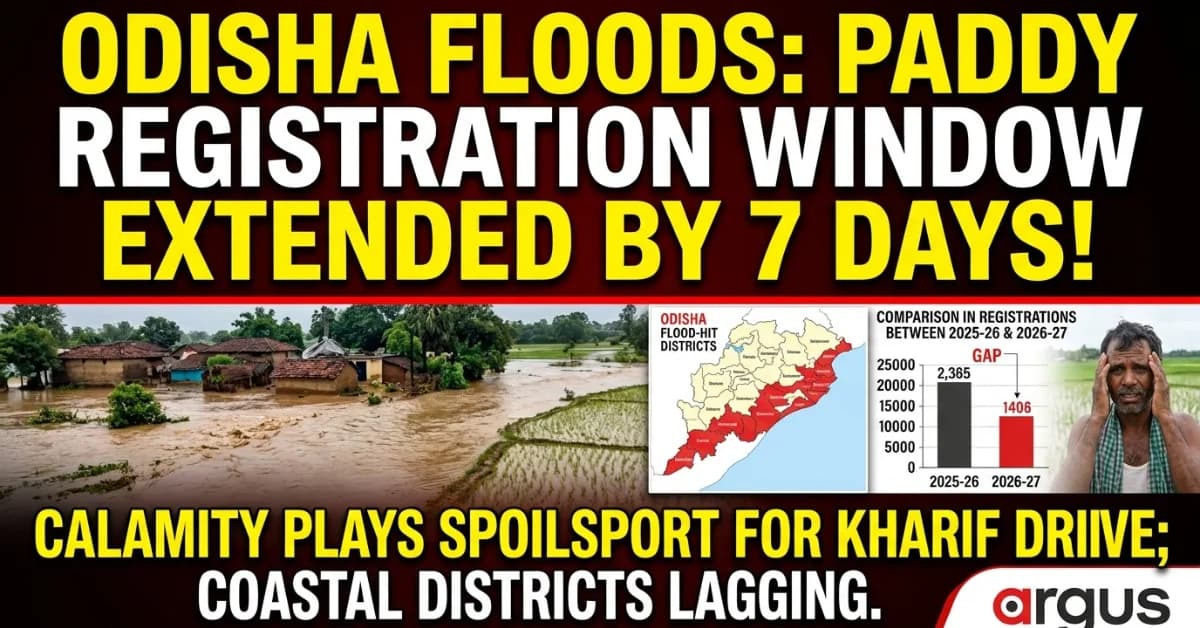
Bhubaneswar: Floods appear to have played spoilsport in Odisha’s otherwise high-stakes Kharif paddy registration drive, forcing the state government to extend the registration window by another seven days on Sunday.
The extension comes at a crucial stage of the Kharif 2026–27 procurement cycle.
In the initial days, the new Agristack-linked Farmer ID system had clouded the registration process, with apprehensions over land-record mismatches and digital verification slowing the pace in several districts. But as the season progressed, it increasingly appeared that the bigger disruption came not from the digital stack alone, but from the devastating floods that swept through several districts.
As of August 30, 17.74 lakh cultivators had registered, against the all-time high of 19.67 lakh in 2025–26, leaving a gap of nearly 1.92 lakh farmers.

📱 Get Argus News App
✨Significantly, several flood-hit districts are still lagging well behind their previous peak registrations, while western and southwestern Odisha has moved much closer to its historical highs. The contrast has forced the government to buy seven more days for farmers to register.
MSP Plus Bonus Triggered a Registration Surge
The BJP government's enhanced paddy price support has dramatically changed the incentive structure for farmers since 2024–25. The promise of procurement at an effective ₹3,100 per quintal, combining the MSP and state support, has encouraged farmers to get themselves registered early and secure access to the government procurement system.
The result has been a sharp jump in the registration base. Odisha moved from the 15-lakh range in earlier years to a record 19.67 lakh farmers in 2025–26.
|
Kharif Season |
Registered Farmers |
|---|
Farmer Code Issued/Validated
Broad Situation
2021–22
14.95 lakh
14.88 lakh
Drought-prone/late rain
2022–23
15.32 lakh
15.28 lakh
Normal
2023–24
17.73 lakh
15.32 lakh
Deficient rainfall/early drought stress
2024–25
17.50 lakh
17.48 lakh
Normal; enhanced price incentive gains traction
2025–26
19.67 lakh
19.65 lakh
Normal; all-time peak
2026–27 (as on Aug 30)
17.74 lakh
17.72 lakh
Flood-affected/registration window extended
The numbers show that the MSP-plus-bonus pull created a powerful registration momentum after the change in government. Registration had already risen to 17.50 lakh in 2024–25 before peaking at 19.67 lakh in 2025–26.
The 2026–27 drive, therefore, began with expectations of another massive farmer turnout. Instead, with just seven days added to the registration period, Odisha is still short of last year's peak by about 1.92 lakh farmers.
Calamity Years vs 2026: Floods Have Changed the Registration Equation
Weather disruptions have historically affected the pace and final profile of paddy registration. The current year is particularly significant because Odisha entered the season with a record registration benchmark and a stronger price incentive, but then encountered both digital transition issues and severe flooding.
|
Season |
Registered Farmers |
Weather/Calamity Situation |
Registration Impact |
|---|---|---|---|
|
2019–20 |
11.50 lakh |
Severe cyclone/flood impact |
Lower registration footprint amid infrastructure disruption |
|
2020–21 |
13.20 lakh |
Flood and pandemic period |
Registration rose despite disruptions |
|
2021–22 |
14.95 lakh |
Drought-prone/late rains |
Registration growth slowed |
|
2023–24 |
17.73 lakh |
Rainfall deficiency/early drought stress |
High registration, but validation and final procurement conversion weakened |
|
2025–26 |
19.67 lakh |
Normal year |
Record peak registration |
|
2026–27 (Aug 30) |
17.74 lakh |
Severe regional floods plus weather disruptions |
Registration deadline extended by 7 days |
The bigger concern for 2026 is that the flood disruption has come at a time when Odisha had built a much larger farmer registration ecosystem. The government, therefore, appears to have used the seven-day extension as a recovery window for districts where registration has been physically slowed by the flood situation.
Floods Bump Down Farmer Registration
The clearest impact is visible in several flood-affected and coastal districts that remain substantially behind their historical peak registrations.
Balasore, Puri, and Cuttack, among others, have recorded major gaps. While some western districts are already operating close to their previous highs, these coastal districts still have substantial catching up to do.
However, the notable exception to this pattern has been Ganjam. The district has not recorded any severe floods, nor highly deficient rainfall (cumulative rainfall has been only 9% below normal), yet it shows a large gap in registration vis-à-vis its historical peak performance.
|
District |
Kharif 2026 Registrations (as on Aug 30) |
Estimated Gap from Peak/Normal-Year High |
Broad Position |
|---|---|---|---|
|
Balasore |
1,02,227 |
About 45,000–50,000 |
Major flood-related lag |
|
Ganjam |
1,46,516 |
About 35,000 |
Large registration shortfall |
|
Puri |
62,420 |
About 15,000–20,000 |
Lagging amid flood/drainage disruption |
|
Cuttack |
57,991 |
About 15,000–20,000 |
Flood-hit areas slowing registration |
|
Mayurbhanj |
82,848 |
About 30,000 |
Large gap; technical and access issues |
|
Deogarh |
21,850 |
Significant percentage gap |
Agristack/land-record friction |
The pattern is important. The state is not witnessing a uniform registration slowdown. The lag is geographically concentrated, with flood-affected and technically constrained districts accounting for a major part of the deficit.
This means the seven-day extension could trigger a late rush if floodwaters recede and registration infrastructure returns to normal. But whether Odisha can erase the entire 1.92-lakh gap and touch the 19.67-lakh record again remains a much bigger question.
Coastal vs Western: The Big Registration Divide
The 2026 registration numbers reveal a sharp regional divide. On one side is western and southwestern Odisha, where several paddy-intensive districts are already close to their historical registration peaks. On the other is the coastal belt, where flooding has created a logistical bottleneck.
Western/Southwestern districts closer to peak:
Bargarh: 1,65,920
Kalahandi: 1,17,977
Balangir: 94,289
Subarnapur: 70,023
Sambalpur: 59,061
Nuapada: 46,379
Bargarh, Kalahandi, and Balangir alone account for a formidable registration base, reflecting the strength of Odisha's western paddy belt. The western region appears to have benefited from better registration momentum and its robust paddy procurement network. Bargarh, for instance, has already crossed 1.65 lakh registrations and is operating close to its historical peak.
Coastal districts face a flood bottleneck:
Ganjam: 1,46,516
Balasore: 1,02,227
Puri: 62,420
Cuttack: 57,991
Bhadrak: 57,821
Kendrapada: 51,558
Jagatsinghpur: 51,493
Jajpur: 45,831
The coastal belt still holds a massive registration base, but the difference lies in the gap from expected historical peak levels. Flooding, waterlogging, and disrupted physical access appear to have slowed the movement of farmers to cooperative societies and registration centres. Thus, while western Odisha is approaching its registration ceiling, several flood-hit coastal districts still have a sizeable backlog to clear.
The regional split also explains why the statewide number looks reasonably strong at 17.74 lakh but remains nearly 1.92 lakh short of the record. Six districts had already moved exceptionally close to their peak registration benchmarks, but the remaining gap is heavily concentrated in districts facing flood, access, and technical hurdles.
Stocktaking the Stack Issue
The Agristack transition remains the other important layer of the 2026 registration story.
As on August 30, Odisha had registered 17,74,535 cultivators, of whom 17,72,965 had already been issued Farmer Codes. However, only 1,72,032 farmers had been integrated with the Agristack FID.
This suggests that while Farmer Code generation has largely progressed smoothly, Agristack integration is still in an early stage relative to the overall registration base.
|
Agristack FID Situation |
Districts/Pattern |
|---|---|
|
Relatively high FID issuance |
Baleshwar (13,647), Bargarh (12,990), Ganjam (12,277), Kalahandi (11,974) |
|
Moderate FID issuance |
Balangir (7,945), Cuttack (7,648), Jagatsinghpur (7,573), Keonjhar (7,090), Mayurbhanj (6,891) |
|
Lower FID issuance |
Kandhamal (418), Gajapati (1,278), Rayagada (1,659), Deogarh (2,206), Malkangiri (2,211) |
The Agristack issue, therefore, has produced a mixed picture.
In some districts, the transition appears to be progressing relatively well, with thousands of farmers already linked to the new digital identity system. In others, especially districts with difficult terrain, scattered landholdings or greater dependence on manual verification, FID generation remains comparatively low.
The striking point, however, is that Agristack cannot alone explain the 2026 registration gap.
The larger statewide deficit appears to have come from the slowdown in getting farmers into the registration pipeline in the first place – particularly in flood-affected districts.
That is where the story of Kharif 2026 changes.
Odisha's MSP-plus-bonus policy had created the conditions for another record-breaking paddy registration year. The Agristack transition initially clouded the exercise. But as August drew to a close, the numbers increasingly suggested that the floods – not just the digital stack—had become the bigger spoilsport.
With another seven days now available, the race is on to see whether receding floodwaters and a final registration rush can rescue the season from falling short of Odisha's 2025-26 record.
Also Read: 28% Excess Rainfall in Odisha This Monsoon May Cut Rice Production by 4 LMT | Exclusive
Related Topics
Explore more stories