



28% Excess Rainfall in Odisha This Monsoon May Cut Rice Production by 4 LMT | Exclusive
Key Points
Bhubaneswar: After a parched June left Odisha staring at a massive rainfall deficit, the skies opened up with a vengeance.
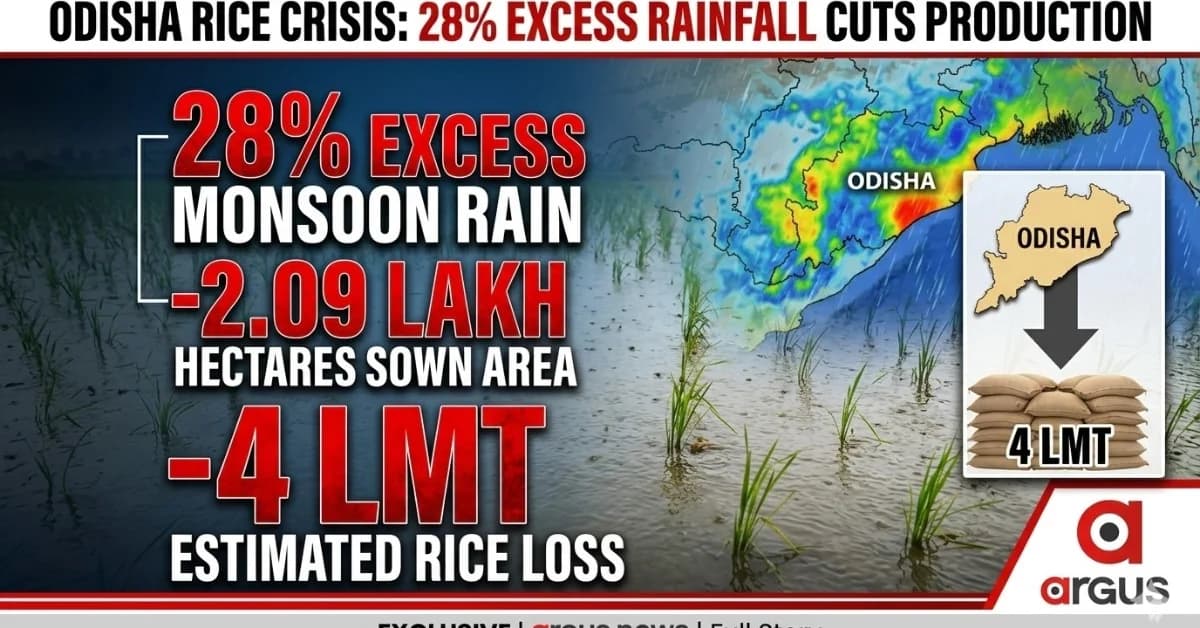
The turnaround has been extraordinary: the State moved from severe rainfall deficiency in June to 28% excess cumulative rainfall during the 2026 monsoon so far, while August alone has recorded 13% excess rainfall till August 17.
The paradox is now beginning to hurt Odisha's most important kharif crop.
Despite emerging as the only major eastern Indian state with such a whopping 28% monsoon rainfall surplus, Odisha has suffered one of the country's sharpest contractions in rice acreage. Union Agriculture Ministry data show that rice sowing in the State stood 2.09 lakh hectares below last year's level as of August 14.

📱 Get Argus News App
✨Odisha's acreage loss is the fourth highest in the country, behind Karnataka, Jharkhand and Maharashtra. Its neighbours tell a strikingly different rainfall story. Jharkhand has received 21% less rainfall, Chhattisgarh 7% less, while West Bengal has recorded just 4% excess rainfall during the monsoon so far.
June Drought, July Deluge: Odisha's Rice Paradox
The reason lies not in the quantity of rain alone, but in when and how the rain arrived.
June is a crucial month for Odisha's kharif paddy cycle, when farmers prepare fields, raise nurseries and begin transplantation. But the State entered the season with a severe rainfall deficit, delaying land preparation and disrupting the early stages of cultivation.
The monsoon subsequently swung to the other extreme. Heavy and persistent rainfall in July and August brought widespread waterlogging, flooding and prolonged submergence in several paddy-growing areas. Fields that need controlled standing water were instead exposed to excess water at critical stages.
This sharp transition – from too little rain in June to excessive rain later – has proved particularly damaging in a State where a large share of rice cultivation remains vulnerable to rainfall variability.
In low-lying and poorly drained areas, excessive rain can wash away nurseries, prevent timely transplantation and leave fields submerged for days. As a result, the cumulative rainfall surplus has not translated into higher rice acreage.
The regional comparison underlines the peculiarity of Odisha's agricultural shock. Jharkhand's 21% rainfall deficit has also contributed to a steep rice-area contraction, but Odisha has suffered acreage loss despite receiving exceptionally high rainfall. West Bengal, with only a marginal 4% surplus, has seen a much smaller decline in rice acreage.
Rain Hits Rice Production: Nearly 4 LMT Rice Loss Already Built In
The most worrying implication of the acreage data is the likely hit to Odisha's rice production.
Based on Odisha's recent average paddy productivity of around 2,850 kg per hectare, the 2.09 lakh hectare contraction translates into an estimated loss of about 5.95 lakh metric tonnes of raw paddy.
At an average milling recovery of around 66%, that works out to approximately 3.93 lakh metric tonnes of clean rice.
In other words, the acreage loss alone has already created a baseline production gap of nearly 4 lakh MT of rice, even before accounting for damage to crops that have actually been planted.
This is significant for Odisha, which normally produces around 115–118 lakh MT of rice annually. The estimated 3.93 lakh MT loss from the reduced acreage alone represents roughly 3.3% of the State's normal rice output.
And this could be only the starting point.
The Bigger Risk: The Crop That Was Sown May Also Yield Less
The final production shock could be substantially larger because rice output depends on two variables – area and productivity.
The 2.09 lakh hectare acreage decline represents roughly a 5% contraction in Odisha's normal 40-lakh-hectare kharif rice portfolio. That land is effectively out of the production equation.
But the remaining roughly 38 lakh hectares cannot be assumed to deliver normal yields either.
The prolonged excess rainfall has exposed standing crops to waterlogging and submergence. Paddy plants submerged for prolonged periods can suffer from oxygen deprivation around the roots, nutrient loss, disease pressure and plant damage. The longer the fields remain underwater, the greater the risk of productivity loss.
That creates a potentially damaging twin blow for Odisha: fewer hectares under rice and lower productivity on a portion of the hectares that have been cultivated.
If severe submergence and weather stress damage yields across even a fraction of the remaining crop, the overall production decline could move well beyond the baseline acreage-driven loss.
An assessment of the possible impact suggests that a 6–8% decline in overall rice production cannot be ruled out if weather stress persists and productivity falls substantially in affected areas.
Odisha's Rainfall Boom Has Become an Agricultural Paradox
The numbers tell a counter-intuitive story.
Odisha has received more rain than almost every other major eastern State this monsoon, but its rice acreage has fallen sharply. The problem, therefore, is increasingly appearing to be one of rainfall distribution and intensity rather than rainfall availability.
A farmer can benefit from rain only when it arrives at the right time and in manageable quantities.
June's deficit came when moisture was crucial for the beginning of the kharif cycle. The subsequent excess came when large-scale waterlogging and flooding could disrupt transplantation and damage young crops.
That makes Odisha's 2026 kharif season a textbook example of how climate volatility can undermine agriculture even in a year of abundant rainfall.
A Dry Late August-September Now Holds the Key
With the sowing window already advanced and the acreage gap running into 2.09 lakh hectares, there is limited scope for Odisha to recover the lost area.
The immediate priority is therefore to protect the crop that has survived.
A relatively dry, sunny spell during the latter part of August and September would help drain excess water, reduce further submergence damage and allow the surviving crop to maximise yield.
But if heavy rainfall continues, the State could face a double agricultural setback—lost acreage first, followed by productivity losses on the surviving crop.
For now, the near-4 lakh MT baseline rice loss calculated from the acreage gap is the clearest warning.
Odisha
may have won the monsoon rainfall race, but its farmers could still end up
paying the price for getting the rain at the wrong time and in the wrong
intensity.
Also Read: Low Pressure Rain Makes Hirakud Inflow Surge, 5 More Gates May Open Soon| Exclusive
Related Topics
Explore more stories