



Dhenkanal Smart Meter Flashpoint: Why Odisha's Public Anger Mirrors a Nationwide Trust Crisis; Here’s State-by-State Reality-Check Behind India's Biggest Power
Key Points
- Dhenkanal violence reflects a nationwide trust crisis over smart electricity meters, not just an isolated Odisha protest.
- Experts say higher bills after smart meter installation are often due to accurate measurement replacing ageing under-recording legacy meters.
- From Gujarat to Bihar and Delhi, both state-run and private power utilities have faced similar public resistance despite identical national meter standards.
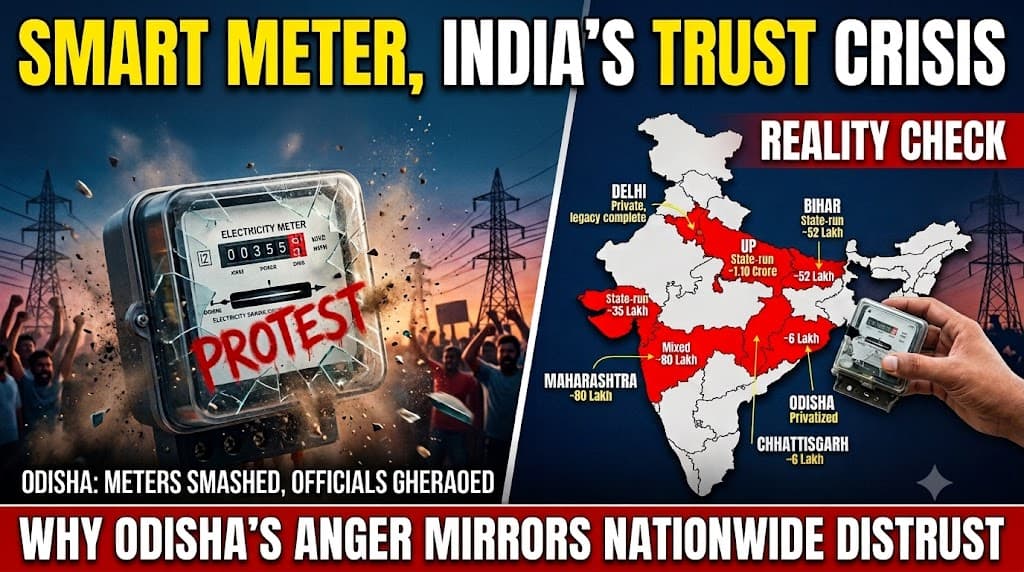
Bhubaneswar: The destruction of smart electricity meters and the gherao of electricity department personnel in Odisha's Dhenkanal on Friday is not an isolated law-and-order issue. It is the latest manifestation of a deep trust deficit that has followed India's smart meter revolution from Delhi to Gujarat, Bihar, Uttar Pradesh and now Odisha.
The immediate confrontation took place in Dhenkanal's Kunjakanta area, where local residents blocked utility staff, believing smart electricity meters were being installed. During the protest, several smart meters were reportedly damaged.
However, TP Central Odisha Distribution Limited (TPCODL) clarified that its field teams were not installing consumer smart meters at that location. According to the utility, workers were upgrading distribution boxes and strengthening local grid infrastructure to improve voltage stability and power reliability.
The clarification, however, came too late to calm public fears.

📱 Get Argus News App
✨The incident once again underlines a larger reality: across India, smart meters have become one of the most controversial symbols of power sector reforms.
Why Are Smart Meters So Deeply Distrusted?
Across Odisha, consumer groups, lawyers' associations and local residents have repeatedly opposed smart meter installations.
The concerns are remarkably similar wherever protests erupt.
1. Fear of Higher Electricity Bills
The biggest grievance is the widespread belief that smart meters record electricity consumption much faster than conventional meters, resulting in inflated monthly bills.
Many consumers believe that after smart meter installation, electricity charges increase sharply without any corresponding rise in power usage.
2. Infrastructure vs Revenue Collection
Residents often argue that distribution companies appear more focused on digitising billing than solving everyday electricity problems such as:
- Low voltage
- Frequent outages
- Transformer failures
- Voltage fluctuations
For many consumers, better billing technology without better electricity supply appears unfair.
Why Utilities Want Smart Meters
Electricity distribution companies present an entirely different picture.
According to utilities, smart meters are central to India's power reforms because they help:
- Reduce power theft
- Cut Aggregate Technical & Commercial (AT&C) losses
- Detect faulty transformers quickly
- Improve load management
- Enable real-time electricity monitoring
- Reduce billing disputes
Utilities also argue that attacks on field staff delay maintenance work and ultimately worsen the very power supply issues consumers complain about.
The 'Delhi Effect': Where the Smart Meter Fear Began
Much of today's nationwide suspicion can be traced back to the early smart meter deployments in Delhi under private distribution companies that led to the birth of Arvind Kejriwal led Aam Admi Party.
However, energy experts say the controversy has less to do with faulty meters and more to do with how consumers compare them with ageing conventional meters.
Old Meters Often Under-record Consumption
Many older electro-mechanical meters gradually become slower with age because of:
- Mechanical wear
- Weak magnetic coils
- Dust accumulation
As a result, they may under-record electricity usage by around 5-15%.
When replaced by modern solid-state smart meters, the new devices record electricity consumption far more accurately.
Consumers often interpret this sudden increase in recorded units as proof that the new meter is "running fast", whereas experts say the old meter had been recording less than actual consumption.
Smart Meters Also Measure Standby Power
Modern meters continuously record small electricity loads that older meters frequently missed, including:
- Television standby mode
- Mobile chargers left plugged in
- Wi-Fi routers
- Air-conditioners on standby
Although individually small, these loads add up over an entire month.
Daily Consumption Creates a Psychological Impact
Another major difference is visibility.
Many smart meters operate on prepaid systems that send daily balance alerts.
Watching the balance reduce every day creates a perception of higher expenditure compared to receiving one monthly bill, even if total consumption remains similar.
A glance at the above facts clearly hints at one BIG conclusion: Smarts Metres Will Definitely lead to a higher electricity bill, which is based on real usage, not by running faster. And people’s opposition has been exactly this – they want old metres to stay even as it ducks many real time usages. After all , it is money that matters.
Smart Meters Favourite of State-Run Utilities Too
A common assumption is that only private companies managing electricity distribution have been eager in implementing Smart metres.
Ground reality suggests otherwise.
Gujarat Offers the Biggest Example
Gujarat operates one of India's most efficient state-owned electricity systems through GUVNL and its four state distribution companies.
Yet Gujarat has witnessed protests similar to Odisha.
Residents in cities such as Vadodara and Surat raised concerns over:
- Faster billing
- Prepaid disconnections
- Smart meter accuracy
To address these fears, Gujarat introduced large-scale public awareness campaigns and digital portals allowing consumers to verify hourly electricity usage.
The experience shows that public resistance is not confined to private utilities.
India's Smart Meter Rollout: State-by-State Reality
The smart
meter programme is part of the Union Government's Revamped Distribution
Sector Scheme (RDSS), which aims to replace nearly 25 crore conventional
electricity meters with smart prepaid meters nationwide.
| STATE | SMART METERS SANCTIONED | INSTALLED(APPROX) | DISTRIBUTION MODEL |
| Uttar
Pradesh |
2.90 crore |
1.10 crore |
State-run |
| Maharashtra |
2.35 crore |
80 lakh |
Mixed |
| Bihar | 1.70 crore | 52 lakh | State-run |
| Gujarat | 1.64 crore | 35 lakh | State-run |
| Madhya
Pradesh | 1.34 crore | 31 lakh | State-run |
| Chhattisgarh | 59 lakh | 32 lakh | State-run |
| Haryana | 55 lakh | 11 lakh | State-run |
| Odisha | 52 lakh | 6 lakh | Tata
Power joint ventures |
| Assam | 48 lakh | 14 lakh | State-run |
| Delhi | Legacy
rollout largely complete | About 5
lakh under current RDSS scope | Private |
*Delhi had implemented smart metering well before the RDSS programme.
Odisha's Unique Challenge
Unlike many states where government-owned distribution companies continue to operate, Odisha's electricity distribution system is managed through Tata Power joint venture distribution companies.
As a result, public opposition frequently merges two separate issues:
- distrust of smart meters;
- scepticism towards electricity privatisation.
This makes public acceptance significantly more difficult than a purely technological transition.
The Reality Check
The Dhenkanal protest illustrates that India's smart meter debate is less about the technology itself and more about public confidence.
Whether electricity distribution is handled by state-run companies in Gujarat, Bihar and Uttar Pradesh or by private utilities in Delhi and Odisha, the smart meters deployed generally conform to the same national technical standards.
Experts say that higher recorded consumption after replacement is most often linked to the greater precision of modern digital meters replacing ageing conventional meters, rather than deliberate over-billing.
Yet unless utilities pair infrastructure upgrades with transparent communication, public demonstrations like the one witnessed in Dhenkanal are likely to continue.
As India's
largest electricity modernisation programme accelerates, the biggest challenge
may not be installing millions of smart meters – but convincing millions of
consumers to trust them.
Also Read: Odisha Doctors' Strike Enters Crucial Phase: Why OMSA Wants Central-Style DACP, Pay Parity & KBK Exit Policy - And What a State-by-State Reality Check Reveals
Related Topics
Explore more stories