



CWC Technical Committee Begins Assessment in Mahanadi Water Dispute; The Shift Signals What? | Explainer
Key Points
* CWC technical committee begins assessment of Odisha and Chhattisgarh’s water claims in the Mahanadi dispute.
* Focus shifts from total water availability to lean-season flow, water demand, upstream storage and distress-sharing.
* The exercise follows the May 2, 2026 agreement fixing Mahanadi basin water availability at 62.36 MAF
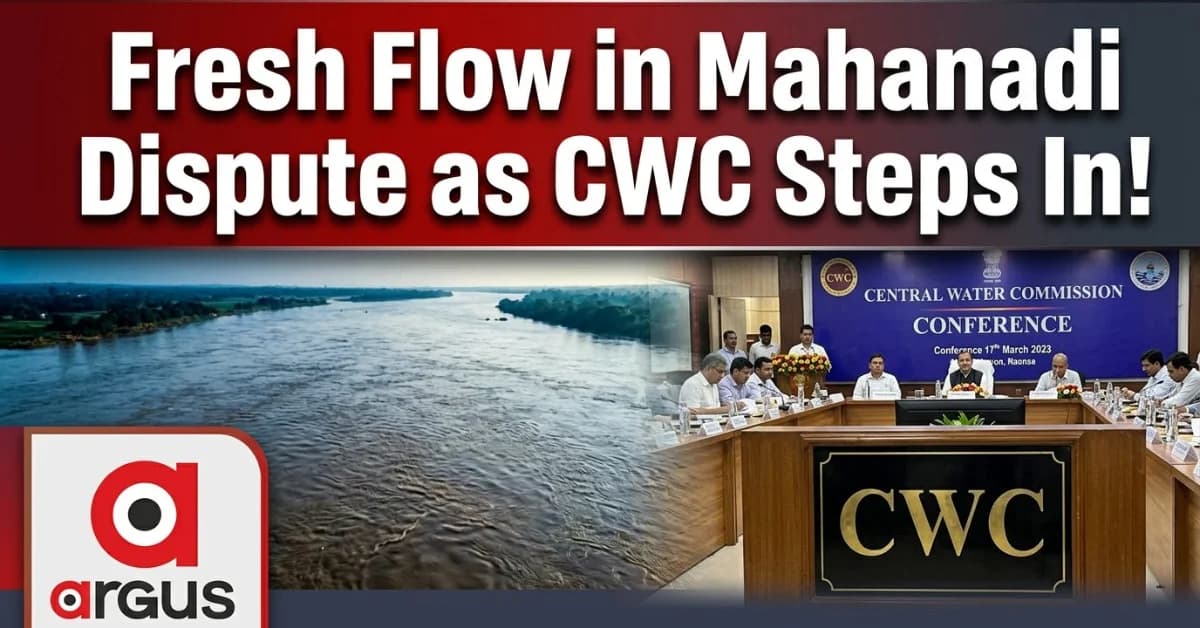
Bhubaneswar: In a fresh development in the long-running Mahanadi river water dispute, the newly constituted technical committee of the Central Water Commission (CWC) has begun assessing the water-related claims, demands and datasets submitted by Odisha and Chhattisgarh.
The development marks a significant shift in the decade-long dispute. After years of contesting even the basic water availability figures and taking their differences before the Mahanadi Water Disputes Tribunal, the two states are now moving towards a technical, data-driven assessment of the unresolved issues.
The new exercise, however, does not mean that the committee is recalculating the total water available in the Mahanadi basin. That question was substantially settled when the Joint Technical Committee of the two states agreed on the historical baseline water availability.
What the CWC Panel Will Undertake?

📱 Get Argus News App
✨The CWC panel will instead examine the more difficult question of how the available water is being used, stored and shared, particularly during the critical lean months.
The committee will analyse the October-May lean-season flow pattern and assess how upstream barrages and other structures in Chhattisgarh affect downstream water availability. This remains one of Odisha’s core concerns, as reduced lean-season flow directly impacts the Hirakud reservoir and downstream irrigation and water needs.
The panel will also examine the water demands projected by both states, including requirements for irrigation, drinking water, industry and future development. The claims and projections submitted by Odisha and Chhattisgarh will be subjected to technical scrutiny to assess their actual water requirements.
Another major task before the committee will be to examine how water scarcity should be handled in a deficient rainfall year. While average annual water availability has been assessed, the crucial challenge is evolving a mechanism for sharing the shortage when the river yield falls during drought or low-rainfall years. The technical assessment is expected to help develop an objective framework for such distress-sharing.
In essence, the CWC committee’s exercise could move the Mahanadi dispute from the stage of determining how much water exists to the more complex question of how the available water should be managed and shared between the two riparian states.
Background: The May 2 Breakthrough
The present technical exercise follows the breakthrough achieved on May 2, 2026, when the Joint Technical Committee of Odisha and Chhattisgarh submitted its report to the Mahanadi Water Disputes Tribunal.
After analysing historical hydrological data from 1980-81 to 2018-19, the two states agreed on an average water availability of 62.36 million acre-feet (MAF) in the Mahanadi basin. The assessment also recorded 33.17 MAF of the yield on the Odisha side and 28.94 MAF on the Chhattisgarh side.
The agreement was crucial because it ended a major technical deadlock over the basic water availability in the river basin. With the baseline now agreed upon, the focus has shifted to unresolved questions surrounding lean-season flow, upstream storage, projected water demand and the formula for sharing water during distress years.
The formation of the CWC technical committee therefore signals the next phase of the Mahanadi dispute – an attempt to convert the agreed hydrological baseline into a workable framework for water management and, potentially, an amicable settlement between Odisha and Chhattisgarh.
Related Topics
Explore more stories