



Centre's Big Move to Improve Free PMGKAY Rice Quality: Will Odisha Farmers Face More 'Katni-Chhatni' at Mandis?| Special Report
Key Points
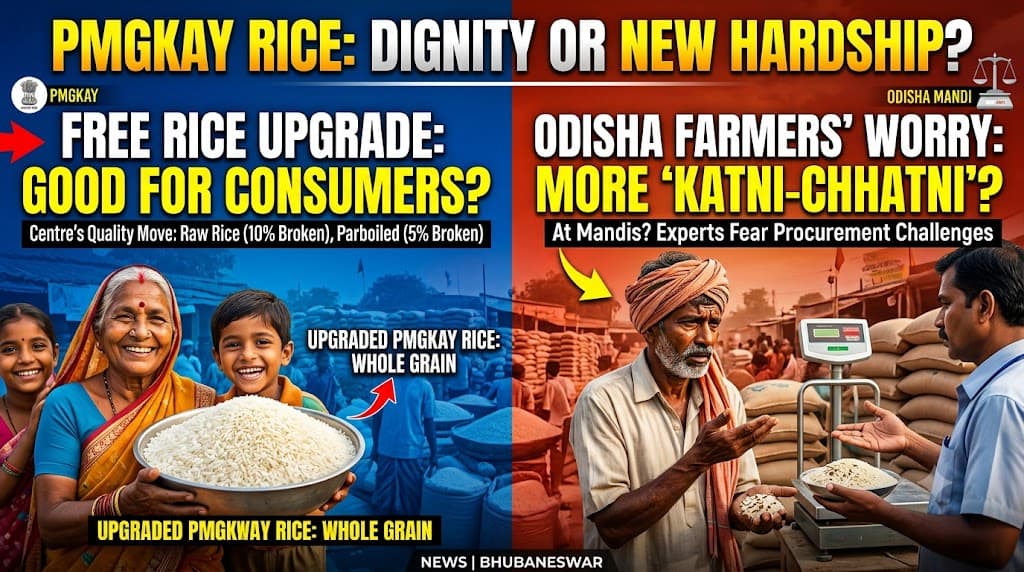
The Centre has slashed permissible broken grain limits in raw rice to 10% and parboiled rice to 5% under PMGKAY.
Experts warn the strict standards eliminate processing margins for millers, potentially shifting the burden to farmers via aggressive quality screening.
Weather-damaged or moisture-heavy crops face a higher risk of weight deductions or rejection at Odisha procurement centers.
Bhubaneswar: The Centre has taken a major step to improve the quality of rice supplied under the Pradhan Mantri Garib Kalyan Anna Yojana (PMGKAY), signalling a shift from merely providing food security to ensuring better-quality food for over 80 crore beneficiaries.
However, while consumers are set to receive cleaner and better-quality rice, the new policy could create fresh challenges for farmers in Odisha, particularly during paddy procurement at mandis.
What Has Changed?

📱 Get Argus News App
✨For decades, rice supplied to the Public Distribution System (PDS) was allowed to contain a sizeable percentage of broken grains.
The Centre has now sharply tightened those limits.
- Raw rice: Broken grain limit reduced from 25% to 10%
- Parboiled rice: Reduced from 16% to 5%
The objective is simple – ensure beneficiaries receive better-quality rice.
Why Odisha Matters
Odisha is among the states where the new system is being rolled out.
The state procures millions of tonnes of paddy every year through PACS and mandis before it is milled and supplied under welfare schemes.
The new quality standards mean rice millers will have much less room for error while supplying Custom Milled Rice (CMR) to government agencies.
Why Farmers May Be Affected
Experts say the pressure may now shift to the procurement stage.
If millers fear that rice with higher broken grain content could be rejected by the Food Corporation of India (FCI) or Odisha State Civil Supplies Corporation (OSCSC), they are likely to become much stricter while buying paddy from farmers.
This could lead to:
- More rigorous quality checks at mandis.
- Higher chances of katni-chhatni (weight deductions).
- Delays in lifting paddy.
- More disputes between farmers and millers.
The issue has long been a major grievance among Odisha farmers.
Weather Makes the Problem Bigger
Odisha's farmers frequently face droughts, cyclones, untimely rains and floods.
These weather conditions often produce paddy that is either immature or contains excess moisture. Such grains are more likely to break during milling.
Earlier, millers could accommodate a larger percentage of broken grains. Under the new norms, that cushion has largely disappeared, making weather-damaged paddy much riskier to procure.
Centre Plans Phased Rollout
The government is not implementing the changes overnight.
Its roadmap includes:
- Distribution of higher-quality rice produced during pilot projects, including in Odisha.
- QR code-based tracking of rice bags to improve traceability and reduce diversion.
- Full implementation across participating states by the Kharif Marketing Season (KMS) 2027-28.
What Needs to Be Done
Agricultural experts believe Odisha can protect farmers while implementing the new standards.
They suggest:
- Installing automated moisture meters and grain analysers at all procurement centres to ensure transparent quality assessment.
- Preventing arbitrary katni-chhatni through technology-based testing.
- Quickly allowing procurement under Under Relaxed Specifications (URS) whenever crops are damaged by natural disasters.
The Bottom Line
The Centre's decision represents one of the biggest quality upgrades in India's food distribution system, promising better rice for millions of beneficiaries.
But in a major paddy-producing state like Odisha, its success will depend on whether better-quality rice for consumers can be achieved without increasing procurement hardships for farmers.
Related Topics
Explore more stories