



Burnout in Khaki? Did 13 Relentless Years of High-Pressure Policing Push Odisha IPS Officer Jagmohan Meena to Seek a Different Life?| Special Report
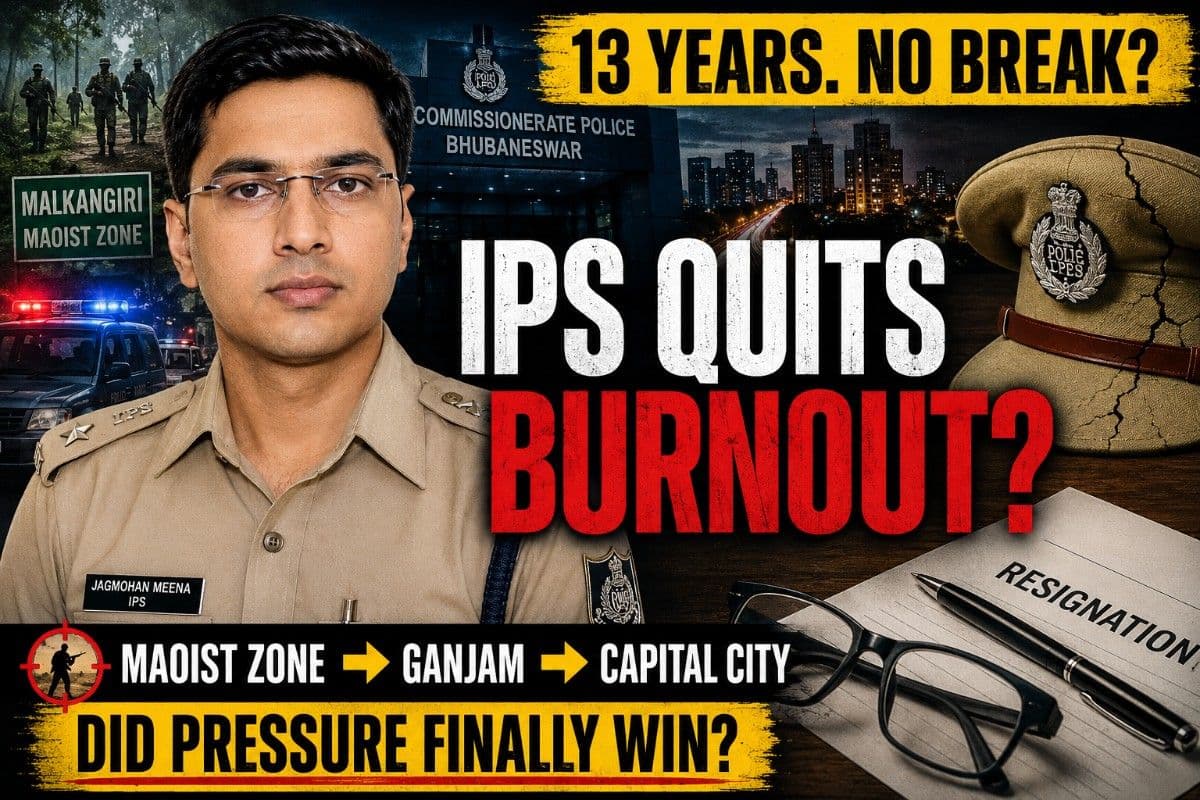
Key Points
The Unbroken Grind: Jagmohan Meena’s 13-year career showcases a continuous streak of grueling field assignments across Kalahandi, Malkangiri, Angul, Ganjam, Cuttack, and Bhubaneswar without a single administrative "cooling-off" period.
The Technocrat Mismatch: Elite technocrats entering the IPS often face professional fatigue when forced into reactive, daily crisis management instead of long-term, systems-oriented institutional reforms.
A Growing National Trend: Meena’s exit aligns with a distinct national pattern of young, highly qualified IPS officers choosing mid-career exits between their 12th and 15th years of service to protect professional autonomy.
Bhubaneswar: Can an Indian Police Service (IPS) officer remain on an uninterrupted treadmill of high-pressure postings for over a decade without eventually paying the price?
That question has come into sharp focus after Odisha-cadre IPS officer Jagmohan Meena, an IIT-trained technocrat who has spent nearly his entire 13-year career in demanding field assignments, resigned from the service citing "purely personal reasons."
The official reason may well be personal. There is no evidence suggesting otherwise.
Yet, an examination of his service profile raises another important institutional question: Did an unbroken sequence of some of Odisha's toughest policing assignments gradually lead to professional burnout, prompting an accomplished officer to seek a career outside the uniform?

📱 Get Argus News App
✨The answer may never be publicly known unless Meena himself chooses to elaborate. But his career graph presents a compelling case study on how sustained operational intensity can gradually wear down even the most capable officers.
A Career Without a Cooling-Off Period
Unlike many IPS officers who alternate between field command and relatively less stressful headquarters or training assignments, Jagmohan Meena's career resembles a continuous high-intensity operational graph.
He started his career as SDPO in Kalahandi around the year 2015. Then the district had been the hotbed of naxalism.
Malkangiri: The Baptism by Fire
One of his earliest major assignments came as Superintendent of Police of Maoist-hit Malkangiri.
Few districts in India test an IPS officer more severely.
Counter-insurgency policing demands:
- 24x7 operational readiness
- Intelligence-based anti-Maoist operations
- Command of armed forces
- Constant threat perception
- High-risk decision making
The assignment eventually earned him the Police Medal for Gallantry, reflecting operational success.
But counter-insurgency policing also extracts enormous mental and physical costs.
Unlike conventional policing, officers rarely switch off.
Every patrol can become an ambush.
Every intelligence input may involve life-and-death decisions.
Operational psychologists worldwide identify prolonged exposure to such environments as one of the strongest contributors to occupational burnout.
From Combat Stress to Administrative Stress
Normally, after completing difficult insurgency assignments, officers often receive relatively lower-pressure postings.
That did not happen here.
Instead, Meena moved directly into Angul, another demanding district.
Although very different from Maoist policing, Angul carries its own pressures.
Industrial disputes.
Coal belt law and order.
Corporate-security coordination.
Environmental protests.
Political sensitivities.
Instead of tactical fatigue, the challenge became institutional friction.
Ganjam: The Longest Stretch
His next major assignment – SP of Ganjam – proved to be the longest phase of his career.
For more than three years, he headed one of Odisha's largest and most complex districts.
Ganjam presents an entirely different policing ecosystem.
The district combines:
- massive population,
- crime management,
- political activity,
- migration,
- festival security,
- public protests,
- continuous law-and-order responsibilities.
Unlike insurgency policing where pressure comes in operational bursts, districts like Ganjam generate relentless day-to-day public engagement.
There are no quiet days.
Every major festival.
Every political programme.
Every local conflict.
Every VIP visit.
Every public grievance eventually lands on the SP's table.
By this stage, Meena had already spent over five consecutive years leading difficult field districts.
Still, there was no administrative breather.
The Urban Sprint
The final phase of his career became even more compressed.
He first headed Cuttack Urban Police District for barely five months.
Before settling into that role, he was shifted to become Deputy Commissioner of Police, Bhubaneswar.
On paper, both are promotions.
Operationally, they represent a different level of stress.
Urban commissionerate policing offers almost no buffer.
Unlike district policing, where geography distributes administrative pressure, a capital city's DCP functions under constant scrutiny.
Every crime.
Every protest.
Every traffic disruption.
Every social media controversy.
Every political allegation.
Every crowd incident.
Instantly becomes a state-level issue.
The DCP often bears maximum public accountability while operating within tightly structured institutional constraints.
The Technocrat in Uniform
Jagmohan Meena's profile is slightly different from many traditional police officers.
An IIT M.Tech graduate, he belongs to the growing generation of technocrats entering civil services.
Such officers often bring structured thinking, analytical decision-making and systems-oriented approaches.
However, modern urban policing increasingly forces officers into reactive crisis management.
Instead of long-term institutional reforms, officers frequently spend their time extinguishing immediate crises.
For officers trained to solve systems rather than symptoms, this mismatch can become professionally frustrating over time.
Experts studying occupational burnout describe this phenomenon as loss of professional autonomy, one of the strongest predictors of executive fatigue.
Burnout Is Not About Weakness
Burnout is frequently misunderstood.
It is not laziness.
Nor is it emotional fragility.
The World Health Organization classifies burnout as an occupational phenomenon resulting from chronic workplace stress that has not been successfully managed.
Three characteristics generally define burnout:
- emotional exhaustion,
- increasing detachment from work,
- reduced sense of professional accomplishment.
In policing, another dimension gets added:
continuous public scrutiny without corresponding control over systemic constraints.
A Larger Trend Emerging in IPS
Meena's resignation also fits into a wider national trend.
For decades, IPS officers rarely left the service before retirement.
During the 1980s and 1990s, resignations were exceptional.
The prestige of the uniform, pension security and limited private-sector opportunities kept officers within the system.
The post-liberalisation era gradually changed that.
Initially, officers left after 20 years of service, generally opting for voluntary retirement before joining corporations or international organisations.
Over the last decade, however, a new pattern has emerged.
Young officers are leaving much earlier.
Many belong to engineering, medical or management backgrounds.
Their professional skills remain highly marketable outside government.
Consequently, remaining in service becomes one career option – not the only one.
The New Generation of Mid-Career Exits
Several recent resignations illustrate this shift.
Shivdeep Lande, known for his high-profile policing career in Bihar, resigned after nearly two decades in service.
Siddharth Kaushal, an IIM graduate from the Andhra Pradesh cadre, resigned after around 13 years despite an impressive policing career.
Kamya Mishra, one of Bihar's most recognised young IPS officers, also quit early in her career.
Each cited personal reasons.
Each had served in demanding operational environments.
Each belonged to a generation possessing highly transferable professional skills.
Their individual reasons differed.
But one common thread appears repeatedly:
extended exposure to high-pressure policing without adequate recovery periods.
The 12-15 Year Burnout Window?
Institutional observers increasingly identify the 12-15 year service bracket as particularly demanding.
This is the phase when officers transition from energetic field commanders into senior administrative managers.
The responsibilities expand.
Political interactions intensify.
Media scrutiny grows.
Public expectations become enormous.
Yet systemic autonomy often remains limited.
Many officers describe this period as the most professionally challenging phase of their careers.
Interestingly, Jagmohan Meena's resignation also comes almost exactly at this career stage.
A Calculated Career Realignment?
Because Meena has officially cited only personal reasons, any attempt to attribute a single cause behind his resignation would be speculative and unfair.
However, viewed through the prism of his service record, one possibility stands out.
His career shows almost no institutional cooling-off phase.
Instead, it reflects:
- Maoist counter-insurgency,
- industrial conflict management,
- prolonged district policing,
- urban commissionerate command,
- capital-city policing.
Thirteen years.
Five major field assignments.
Almost uninterrupted operational intensity.
For an IIT-trained professional with multiple career opportunities beyond government, choosing to step away may therefore represent not an escape, but a calculated realignment after years of relentless public service.
Beyond One Officer
Jagmohan Meena's resignation should perhaps not be viewed merely as the departure of one IPS officer.
It raises a larger institutional question for policing in India.
Should high-performing officers continue to move from one pressure cooker posting to another without structured recovery periods?
Can modern policing retain its best talent if burnout is treated as an individual issue rather than an organisational challenge?
As India's police forces become increasingly professional and attract graduates from premier institutions, these questions are likely to become more relevant.
Whether Jagmohan Meena's decision was driven entirely by personal reasons, by professional fatigue, or by a combination of both may remain known only to him.
But his
career graph unmistakably highlights one reality: burnout in uniform
deserves as much institutional attention as bravery in uniform.
Also Read: https: Odisha Police Needs Urgent 'Operation Clean Sweep': The Truth Behind Broad Daylight Bhubaneswar Gang Violence Drops Big Statewise Hint| Special Report
Related Topics
Explore more stories