



Odisha Police Needs Urgent 'Operation Clean Sweep': The Truth Behind Broad Daylight Bhubaneswar Gang Violence Drops Big Statewise Hint| Special Report
Key Points
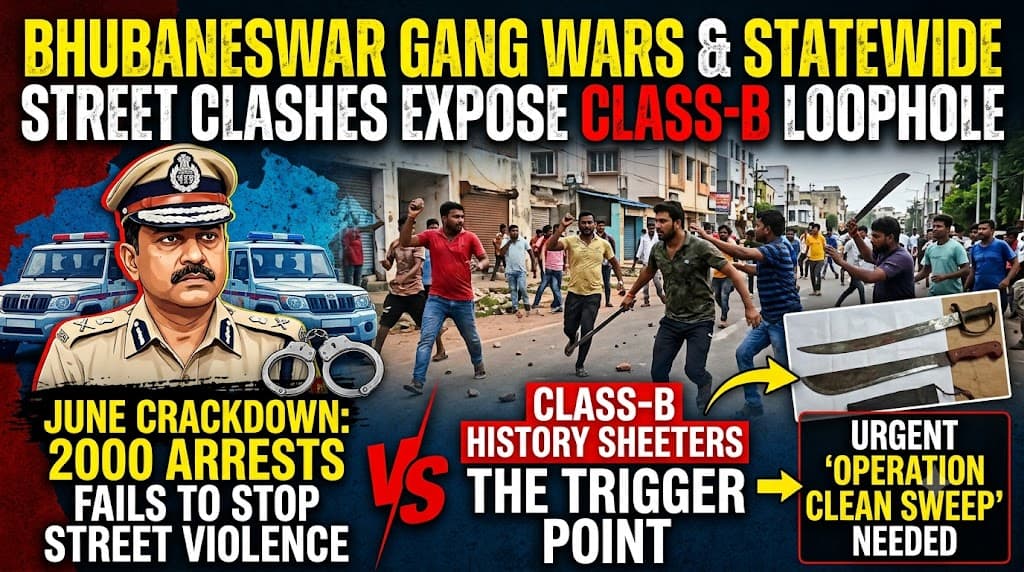
The Statistical Contrast: Odisha Police’s historic June drive netted nearly 2,000 arrests in 120 hours, yet failed to suppress immediate neighborhood street wars.
The Policy Loophole: Recent broad-daylight sword and machete clashes are explicitly triggered by active Class-B history sheeters who sit outside major state-level tracking databases.
The Policy Shift: Poliing protocols suggest Odisha to move away from headline numbers and adapt localized "Operation Clean Sweep" frameworks used in UP and Maharashtra to neutralize active turf networks.
Bhubaneswar: Barely a month after the Odisha Police showcased one of its biggest statewide anti-crime crackdowns under the direction of the Director General of Police (DGP), Bhubaneswar has witnessed a chilling reminder that statistics alone do not guarantee safer streets.
The sword-and-machete gang clashes near Buddha Vihar Colony on July 3 and 4 have exposed what policing experts call a "micro-crime blind spot" – the active street-level history sheeters who often escape the glare of large-scale statewide drives.
While the June operation projected strength with nearly 2,000 arrests in just 120 hours, the latest violence suggests the big swoop’s zero impact. Rather, it suggests a much significant next phase of policing that may require a far more targeted approach.
The Big June Crackdown

📱 Get Argus News App
✨The DGP-led statewide drive was unprecedented in scale.
Within five days, Odisha Police:
- Executed 1,771 pending Non-Bailable Warrants (NBWs)
- Arrested 190 absconding accused
- Booked 449 habitual offenders under Section 129 of the Bharatiya Nagarik Suraksha Sanhita (BNSS)
- Initiated preventive proceedings against 643 more persons under Section 126 BNSS
The operation sent a strong message that habitual offenders would no longer be allowed to remain outside the criminal justice system.
Police leadership also showcased aggressive use of the newly enacted BNSS provisions, signalling a shift from reactive policing towards preventive law enforcement.
At the time, the crackdown was widely viewed as a psychological blow to organised criminals.
Then Came Buddha Vihar
Only weeks later, two rival groups fought openly with stones, swords and machetes on busy public roads in Bhubaneswar.
Residents watched armed youths chase each other in broad daylight.
The violence returned the following night with another retaliatory attack.
Police later identified the groups as those led by Akash Behera alias 'Kumbhira' and Uttam Mekap of Salia Sahi.
More importantly, Assistant Commissioner of Police (ACP) Pradhan announced a significant legal step after the arrests.
"After sending them to jail, we will also file for Section 110 against them so that they remain in jail for a longer period, and before being released they will have to execute a bond for good behaviour."
While the sword attack became the headline, the invocation of Section 110 may prove to be the bigger policing story.
Why Section 110 Matters
Section 110 has traditionally been one of Indian policing's strongest preventive tools against habitual offenders.
Unlike ordinary criminal cases that punish offences after they occur, proceedings under Section 110 seek to prevent repeat offenders from returning immediately to the streets.
Once proceedings begin, habitual offenders can be compelled to execute substantial bonds for good behaviour. Violation of these conditions can result in stricter preventive action and continued custody through legal procedures.
For police officers, it is less about punishment and more about breaking the cycle of retaliatory violence before it escalates.
The Buddha Vihar case shows Odisha Police is beginning to use preventive policing more aggressively –but only after violence has already erupted.
The Missing Layer in Odisha's Crime Strategy
The June crackdown largely focused on offenders already under established police surveillance – those with pending warrants, absconding accused and long-known habitual criminals.
That strategy remains essential.
However, street violence today often originates elsewhere.
Across many cities, the most visible law-and-order problems are no longer being driven by organised syndicates alone.
Instead, they stem from neighbourhood gangs, extortion groups, slum-based rivalries and young repeat offenders – individuals who frequently fall into Class-B History Sheet categories or are yet to be formally classified despite repeated involvement in local disturbances.
These are precisely the groups that dominate public spaces with swords, machetes and social media intimidation.
Odisha Crime By Class-B History Sheeters
The headline grabbing violent crimes unleashed in the State in the past 1 year or so have been triggered by History sheeters B. Therefore, post the DGP ordered swoop, instances similar to Bhubaneswar have kept the crime pot boiling in the State.
Ironically, these Class-B offenders often generate the highest public fear because they operate in residential localities, markets and densely populated urban areas.
Why First Drive May Not Have Changed Street Reality
Large statewide operations naturally prioritise hardened criminals because they already appear prominently in police databases.
But neighbourhood violence frequently originates from younger, rapidly emerging gangs.
If such offenders remain outside sustained surveillance, they often perceive that statewide crackdowns are directed elsewhere.
Policing experts describe this as a tactical immunity effect.
The result is visible:
Major arrest statistics coexist with continued sword fights, extortion, public intimidation and retaliatory violence.
What Other States Have Changed
Several states have quietly shifted towards neighbourhood-based policing rather than relying only on periodic statewide crackdowns.
Uttar Pradesh
Police launched operations targeting active mohalla gangs instead of concentrating solely on legacy criminals.
Local history sheeters underwent physical verification, behaviour bonds and constant monitoring of neighbourhood rivalries.
Madhya Pradesh
Urban policing increasingly focused on repeat knife offenders, land-grabbing groups and market extortionists through preventive detention and continuous surveillance of recurring troublemakers.
Maharashtra
Facing the rise of notorious "Koyta" gangs, commissionerates concentrated on youths repeatedly carrying swords and machetes.
Area domination exercises, weapon-based surveillance and micro-level policing significantly reduced visible street violence in affected localities.
The common thread across these states was simple:
They shifted attention from dormant hardened criminals to active neighbourhood offenders.
What Odisha Police Could Consider Next
The Bhubaneswar incident may indicate that the next policing challenge lies in another statewide crackdown on the History sheeters B, identifying the next generation of repeat offenders before they evolve into organised gangs.
Among the measures policing experts often recommend are:
- Dynamic updating of Class-B History Sheets.
- Digital mapping of neighbourhood gangs and their areas of influence.
- Regular surveillance on known history sheeters B by conducting surprise checks at their homes or areas of influence
- Greater use of preventive bond proceedings under BNSS against repeat offenders.
- Quarterly review of offenders repeatedly involved in public violence.
- Upgrading persistent violent offenders into higher surveillance categories when legally justified.
Such measures focus less on headline arrest numbers and more on sustained disruption of local gang ecosystems.
The Road Ahead
Odisha Police demonstrated in June that it possesses the capacity to execute one of the state's largest coordinated anti-crime operations.
The Buddha Vihar violence, however, suggests that the next challenge is more granular.
The immediate threat to public order may no longer come only from notorious gangsters already under permanent watch.
It increasingly comes from smaller neighbourhood groups whose repeated acts of intimidation gradually normalise violence until one confrontation turns into a citywide law-and-order concern.
If the June
operation represented Odisha Police's show of strength against established
criminals, the next decisive test may be whether it can systematically
dismantle the ecosystem of emerging street gangs before they become tomorrow's
organised crime networks.
Also Read: Odisha Police YB Khurania / Odisha Police 5-day Mega Swoop on Criminals: How Big Policing Objectives Achieved
Related Topics
Explore more stories