



Politics / BJP'S Poll Manager Back at Helm, Dharmendra Pradhan’s Key Meet Trumps Opposition's Resignation Narrative
Key Points
Bhubaneswar: When Dharmendra Pradhan told Jairam Ramesh in Parliament that he was “a street fighter, not an AC room activist,” he there had delivered the political message to the Opposition camp's top architect that your narratives are going to fall like a pack of cards.
Barely days latter in Bhubaneswar, he translated the viral reply on to the ground.
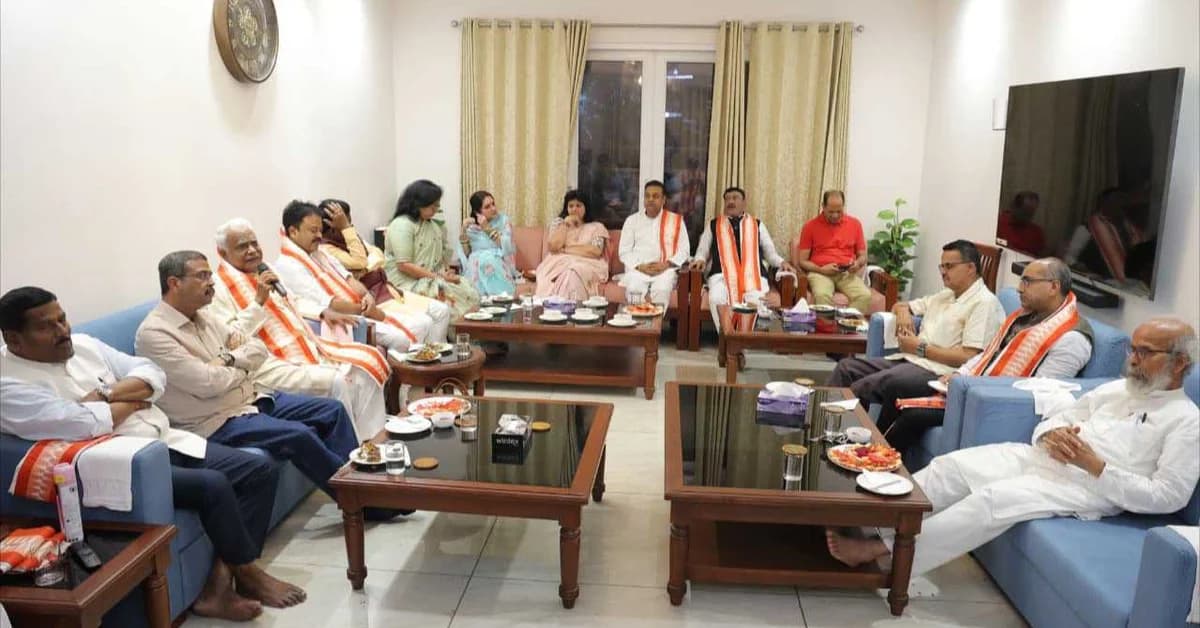
Dharmendra Pradhan on Wednesday convened a high-level meeting, bringing under one roof Chief Minister Mohan Charan Majhi, Assembly Speaker Surama Padhy, BJP Odisha in-charge Vijaypal Singh Tomar, all BJP Members of Parliament from the state and other senior leaders.
In politics, photographs often speak louder than press releases.

📱 Get Argus News App
✨Pradhan himself shared on X that the meeting reviewed Odisha's developmental priorities and discussed ways to accelerate implementation of public welfare programmes through close coordination between the Centre, the state government and party representatives.
Yet, beyond the official description, the meeting's visual grammar attracted equal attention.
Instead of occupying the central chair, Pradhan chose to sit on a sofa alongside his colleagues.
The room brought together virtually every important pillar of the Odisha BJP- the government, the legislature, the organisation and the parliamentary wing – under one roof.
The optics tells a story, demonstrating that he remains capable of convening every important stakeholder whenever the political situation demands.
Seen Through Political Prism: The Organisational General Returns
If viewed politically, the meeting was far more than a routine review of development works.
It came at a time when the BJD and the Congress had sought to politically corner Pradhan by demanding his resignation over the NEET-UG paper leak controversy. The expectation in opposition circles was that his exit from the Union Cabinet would weaken his standing in Odisha and create uncertainty within the BJP's organisational structure.
The developments since then, however, appear to point in the opposite direction.
First came Amit Shah and BJP top central leadership meeting Pradhan and hailing his epochal work as Union Minister of Education. Then the grand welcome in Parliament, which even ruffled Rahul Baba!
Then the massive reception to the son of the soil on his return to Bhubaneswar.
All the pieces , when seen altogether, reinforce the perception that Pradhan continues to enjoy the confidence of the party's highest leadership and cadre alike.
Against that backdrop, Wednesday's meeting assumes greater political significance.
Pradhan was widely regarded as the principal organisational architect of the BJP's rise in Odisha, painstakingly building the party's grassroots network over the past decade before the Modi wave transformed that organisation into an electoral machine capable of ending Naveen Patnaik's uninterrupted 24-year rule in 2024.
That organisational role was once again on display.
By bringing together the Chief Minister, Assembly Speaker, party in-charge and all MPs, Pradhan effectively demonstrated that despite no longer holding a Union ministerial office, he continues to remain the principal organisational coordinator capable of synchronising the party and the government.
Interestingly, he did so without projecting himself as the central character, conveying message that leadership is exercised through organisation rather than symbolism.
For the cadre, the takeaway is unmistakable: the BJP leadership remains united, the organisational command structure remains intact, and the party is already preparing for the next electoral battle.
That assumes significance because the rural panchayat and urban local body elections, expected in early 2027, will be the first major electoral examination of the two-year-old BJP government in Odisha.
For the opposition, weakening the BJP organisation before those elections remains politically important. For the BJP, therefore, preventing even the perception of factionalism has become equally important.
The meeting appears to have served precisely that purpose.
The Governance Lens: Synchronising Delivery Before Electoral Accountability
The meeting carries another equally significant dimension when viewed through governance rather than politics.
Officially, the discussion centred on Odisha's development agenda and improving coordination between elected representatives and the government.
That comes at a time when Odisha faces the twin challenge of managing an emerging flood situation while simultaneously accelerating delivery of flagship infrastructure and welfare projects under the BJP government's "double-engine" framework.
With heavy rains affecting several districts and the state administration remaining on alert, seamless coordination between the political leadership, administrative machinery and party organisation assumes added importance.
A newly elected government confronting one of its first major natural disasters can ill afford administrative lapses that may quickly acquire political overtones.
Equally important is the government's need to demonstrate visible delivery.
Having displaced the BJD after nearly a quarter century, the BJP now faces the more difficult task of proving that governance under its leadership can outperform the previous regime. That makes continuous monitoring of central schemes, infrastructure projects, welfare implementation and district-level execution politically valuable.
Pradhan, now free from the demands of a Union ministry, may increasingly assume the role of an organisational overseer – reviewing progress, identifying bottlenecks and ensuring that both the government and the party remain aligned on implementation.
The presence of MPs alongside the state leadership also
underlines the importance of synchronising central assistance with state
execution so that development becomes the BJP's principal political narrative
before voters return to the ballot.
Also Read: A Leader, A Legacy, A Message: Reading Between the Lines of Dharmendra Pradhan’s first Speech in Odisha after Resignation
The Larger Political Message
Ultimately, Wednesday's meeting was about much more than reviewing development projects.
It was about signalling continuity after the opposition’s play out of ‘resignation narrative’.
It was about demonstrating organisational cohesion at a time when opponents expected vulnerability.
It was about reminding both supporters and rivals that while constitutional authority rests with the Chief Minister, the organisational architecture painstakingly built over the years continues to function under the guidance of the man who helped script the BJP's historic victory in Odisha.
The message appears calibrated for multiple audiences.
For the opposition, it suggests that expectations of organisational drift following Pradhan's resignation may be misplaced.
For BJP workers, it conveys that the command structure remains united and battle-ready.
And for voters heading towards the crucial rural and urban
local body elections, it seeks to reinforce the BJP's preferred narrative –that
governance and organisation are moving in tandem, with the party already
preparing for its next electoral test.
Related Topics
Explore more stories