



A Leader, A Legacy, A Message: Reading Between the Lines of Dharmendra Pradhan’s first Speech in Odisha after Resignation
Key Points
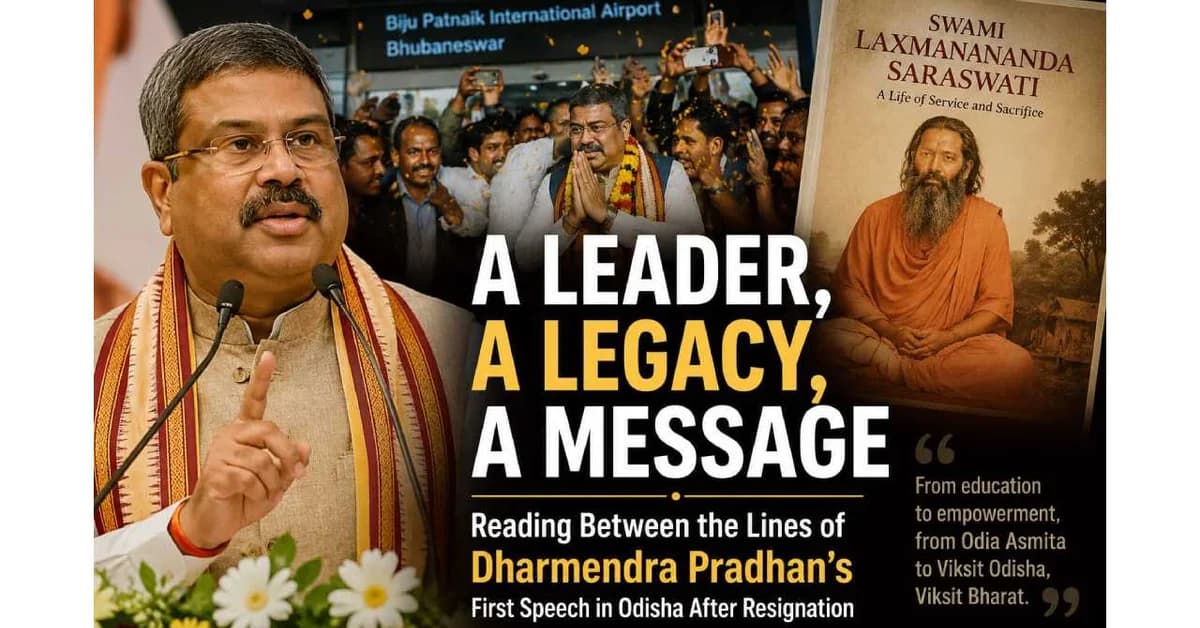
Bhubaneswar: From the rousing welcome at the Biju Patnaik International Airport by BJP ministers, legislators and hundreds of party workers to his address at the release of a biography on Swami Laxmanananda Saraswati, Sambalpur MP Dharmendra Pradhan's first public appearance in Odisha after stepping down from the Union Cabinet offered a revealing glimpse into his political temperament.
The event itself was non-political. Yet the backdrop was politically charged.
Only a day earlier, the Odisha government had entrusted the probe into the missing Justice A.S. Naidu Commission records relating to Swami Laxmanananda's assassination to the Crime Branch. Days before that, BJD president Naveen Patnaik had publicly demanded Pradhan's resignation.
Despite the combustible political atmosphere, Pradhan chose not to answer politics with politics.

📱 Get Argus News App
✨Even while referring to Swami Laxmanananda's assassination and the inquiry that followed, he refrained from political attacks or partisan sloganeering, leaving the matter to the state government. Instead, he devoted his address to the Swami's lifelong mission of educating tribal children, promoting nutrition, preserving Odisha's civilisational heritage and nurturing Odia Asmita.
That choice, more than the speech itself, carried the larger political message.
Statesmsnship Through Restraint
Political communication is often judged as much by what leaders choose not to say as by what they actually say.
Pradhan's demeanour throughout the programme reflected composure rather than confrontation. There was no trace of aggression in his tone, no attempt to settle political scores and no effort to turn a literary event into a political platform.
His body language remained calm and assured. His delivery was measured. The confidence he projected stemmed not from rhetorical aggression but from quiet conviction.
For a leader returning to Odisha amid intense political debate, the optics conveyed continuity and stability rather than disruption.
Letting the Government Govern
One of the more subtle aspects of Pradhan's speech was what it revealed about the evolving political roles within the BJP in Odisha.
The Chief Minister had already acted by transferring the missing Naidu Commission records case to the Crime Branch.
Pradhan did not seek to overshadow that decision by making fresh political statements from the dais.
Instead, he confined himself to the larger ideological canvas represented by Swami Laxmanananda's life and work.
The distinction was significant.
While the government addressed governance and investigation, Pradhan spoke about values, education, culture and society.
It reflected the demeanour of a leader more interested in
shaping the broader narrative than participating in day-to-day political
exchanges.
Swami Laxmanananda As Developmental Vision
Far from being a ceremonial tribute, Pradhan's address sought to present Swami Laxmanananda's life as a template for Odisha's future.
He repeatedly highlighted the Swami's commitment to tribal education, Sanskrit learning, nutrition for children, social upliftment and cultural confidence.
He argued that these ideals remain relevant as Odisha moves towards its centenary in 2036.
By placing Viksit Odisha 2036 alongside Prime Minister Narendra Modi's vision of Viksit Bharat, he presented development not merely as economic progress but as a process rooted in education, cultural identity and social empowerment.
In Pradhan's articulation, the Swami's legacy became the moral bridge connecting Odisha's aspirations with India's national journey.
Reinforcing Odia Asmita
A recurring thread through the speech was Odia Asmita.
Rather than invoking the phrase as a political slogan, Pradhan embedded it in discussions on Jagannath culture, indigenous traditions, tribal welfare and the preservation of Odisha's civilisational heritage.
The emphasis suggested that development and cultural identity are complementary rather than competing ideas.
That framing also reaffirmed one of the central ideological
narratives around which the BJP has sought to shape its politics in Odisha.
Also Read: Dharmendra Pradhan Receives Grand Welcome in Odisha
The Message Beyond the Speech
The significance of Pradhan's first public address after resignation, therefore, did not lie in political rhetoric.
It lay in the absence of it.
At a time when political confrontation would have been easy, he chose restraint over retaliation.
At a time when partisan exchanges dominated public discourse, he spoke about education, nutrition, culture and Odisha's future.
That approach projected the image of a leader seeking to elevate the conversation above immediate political contestation.
Whether viewed by party workers, supporters or political opponents, the message was unmistakable: leadership is not always asserted through confrontation. Sometimes, it is reinforced through composure, ideological clarity and the ability to keep the focus on a larger vision even amid political turbulence.
That, perhaps, was the enduring message of Dharmendra
Pradhan's first public speech in Odisha after his resignation.
Related Topics
Explore more stories