



Odisha Politics / BJD’s Persistent Disruptions Leave First Phase of Assembly’s Budget Session Almost Dysfunctional
·7 months ago·5 min read
Key Points
- The session commenced on February 17 with the Governor’s address — a constitutionally significant event that outlines the government’s priorities and legislative agenda.
- On February 20, Chief Minister Mohan Charan Majhi presented a Rs 3.10 lakh crore Budget for the financial year 2026–27.
- Both events represent foundational pillars of parliamentary democracy.
Bhubaneswar, Feb 25: The first phase of the Odisha Legislative Assembly’s Budget Session has neared its conclusion, but not without raising serious concerns about the health of legislative functioning in the state. What should have been a platform for deliberation, accountability, and policy scrutiny appears instead to have turned into a battleground of political positioning.
The session commenced on February 17 with the Governor’s address - a constitutionally significant event that outlines the government’s priorities and legislative agenda. On February 20, Chief Minister Mohan Charan Majhi presented a Rs 3.10 lakh crore Budget for the financial year 2026–27. Both events represent foundational pillars of parliamentary democracy. However, beyond these formal exercises, little substantive legislative business could be transacted during the first phase.
Confrontation as strategy
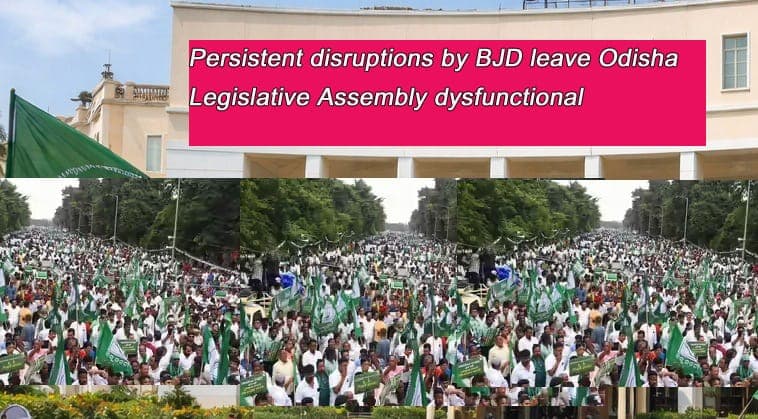
The principal Opposition party, the Biju Janata Dal (BJD), adopted an overtly confrontational stance against the ruling Bharatiya Janata Party (BJP) from the very first day. Signalling that farmers’ issues would dominate their political agenda, BJD members disrupted proceedings, including during the Governor’s address. Repeated disruptions during Zero Hour and Question Hour effectively stalled meaningful debate.
The session commenced on February 17 with the Governor’s address - a constitutionally significant event that outlines the government’s priorities and legislative agenda. On February 20, Chief Minister Mohan Charan Majhi presented a Rs 3.10 lakh crore Budget for the financial year 2026–27. Both events represent foundational pillars of parliamentary democracy. However, beyond these formal exercises, little substantive legislative business could be transacted during the first phase.
Confrontation as strategy
The principal Opposition party, the Biju Janata Dal (BJD), adopted an overtly confrontational stance against the ruling Bharatiya Janata Party (BJP) from the very first day. Signalling that farmers’ issues would dominate their political agenda, BJD members disrupted proceedings, including during the Governor’s address. Repeated disruptions during Zero Hour and Question Hour effectively stalled meaningful debate.

📱 Get Argus News App
✨📰 60 Word News🎬 Argus Podcast📺 Live TV and Breaking News🔔 Free Notification Alerts
Download Free:
In any democracy, legislative chambers are often described as “temples of democracy.” Citizens expect their elected representatives to debate pressing issues economic distress, regional imbalances, administrative failures with seriousness and decorum. When repeated adjournments replace deliberation, public faith inevitably suffers.
The question of legislative privilege and responsibility
Elected representatives enjoy legislative privilege - a constitutional protection that allows them to speak and act freely within the House. Yet constitutional experts consistently argue that privilege must be exercised with restraint and responsibility. The conduct of legislators is constantly under public scrutiny. The legitimacy of democratic institutions depends not merely on electoral mandates, but also on behavioural standards within those institutions.
The events of this session raise the question: where does legitimate protest end and institutional paralysis begin?
Farmers as political axis
Agriculture has always been a politically sensitive subject in India, both nationally and regionally. In Odisha, structural issues persist inadequate irrigation coverage, weak market linkages, distress sales, and insufficient storage infrastructure. It is therefore neither surprising nor illegitimate for the Opposition to foreground farmers’ grievances.
The question of legislative privilege and responsibility
Elected representatives enjoy legislative privilege - a constitutional protection that allows them to speak and act freely within the House. Yet constitutional experts consistently argue that privilege must be exercised with restraint and responsibility. The conduct of legislators is constantly under public scrutiny. The legitimacy of democratic institutions depends not merely on electoral mandates, but also on behavioural standards within those institutions.
The events of this session raise the question: where does legitimate protest end and institutional paralysis begin?
Farmers as political axis
Agriculture has always been a politically sensitive subject in India, both nationally and regionally. In Odisha, structural issues persist inadequate irrigation coverage, weak market linkages, distress sales, and insufficient storage infrastructure. It is therefore neither surprising nor illegitimate for the Opposition to foreground farmers’ grievances.
However, whether disruption of the Assembly is the most effective instrument to address these concerns is debatable.
On February 19, the Congress party had moved an adjournment motion specifically on farmers’ issues, and the Speaker permitted discussion. Yet the House could not function due to continued disruptions. Had the debate proceeded, the public could have heard detailed arguments on allegations of procurement irregularities in mandis.
The BJD has alleged that paddy procurement has been sluggish and that farmers are facing distress. The government, however, presents a contrasting statistical narrative. During the 2023–24 Kharif season under the previous BJD government, 55.80 lakh metric tonnes of paddy were reportedly procured from 12.74 lakh farmers by February 20. In comparison, by February 20, 2026, the current government claims procurement of 63.07 lakh quintals from 14.32 lakh farmers during the 2025–26 Kharif season. Additionally, an input assistance of Rs 800 per quintal has been cited as enhancing farmers’ per capita income.
The divergence between political claims and official data underscores the need for structured debate not disruption.
Also Read: Odisha Assembly Continues To Witness Massive Ruckus Over Paddy Procurement Issue
Political calculus behind the disruption
There is widespread discussion that the Opposition’s strategy may have been linked to mobilising momentum ahead of a farmers’ agitation scheduled for February 24. In that sense, legislative disruption may have been intended as a political amplifier projecting urgency, building narrative, and energising cadre support.
Such tactics are not uncommon in parliamentary democracies. Opposition parties often rely on high-visibility protest to challenge ruling governments. Yet when strategic obstruction prevents legislative oversight itself, it risks weakening the very institutional space that enables accountability.
The Democratic Cost
In politics, every move may be justified as tactically sound. But not every tactic strengthens democracy. Persistent disruption erodes the culture of debate and normalises legislative dysfunction. It also sets behavioural precedents for future legislators.
Democratic institutions are sustained not only by constitutional provisions, but by conventions, restraint, and mutual respect. If confrontation becomes the default mode, the Assembly risks devolving into a theatre of symbolism rather than a forum of substance.
The first phase of the Budget Session appears to have fulfilled constitutional formalities but fallen short of democratic expectations. The farmers’ issue deserves serious, data-driven debate. So does the Rs 3.10 lakh crore Budget. Both government and Opposition carry responsibility - the government to respond transparently, and the Opposition to hold it accountable within institutional frameworks.
If the Assembly becomes a casualty of competitive political theatrics, it is ultimately the people of Odisha who lose. Healthy democracy requires disagreement - but it also requires dialogue.
On February 19, the Congress party had moved an adjournment motion specifically on farmers’ issues, and the Speaker permitted discussion. Yet the House could not function due to continued disruptions. Had the debate proceeded, the public could have heard detailed arguments on allegations of procurement irregularities in mandis.
The BJD has alleged that paddy procurement has been sluggish and that farmers are facing distress. The government, however, presents a contrasting statistical narrative. During the 2023–24 Kharif season under the previous BJD government, 55.80 lakh metric tonnes of paddy were reportedly procured from 12.74 lakh farmers by February 20. In comparison, by February 20, 2026, the current government claims procurement of 63.07 lakh quintals from 14.32 lakh farmers during the 2025–26 Kharif season. Additionally, an input assistance of Rs 800 per quintal has been cited as enhancing farmers’ per capita income.
The divergence between political claims and official data underscores the need for structured debate not disruption.
Also Read: Odisha Assembly Continues To Witness Massive Ruckus Over Paddy Procurement Issue
Political calculus behind the disruption
There is widespread discussion that the Opposition’s strategy may have been linked to mobilising momentum ahead of a farmers’ agitation scheduled for February 24. In that sense, legislative disruption may have been intended as a political amplifier projecting urgency, building narrative, and energising cadre support.
Such tactics are not uncommon in parliamentary democracies. Opposition parties often rely on high-visibility protest to challenge ruling governments. Yet when strategic obstruction prevents legislative oversight itself, it risks weakening the very institutional space that enables accountability.
The Democratic Cost
In politics, every move may be justified as tactically sound. But not every tactic strengthens democracy. Persistent disruption erodes the culture of debate and normalises legislative dysfunction. It also sets behavioural precedents for future legislators.
Democratic institutions are sustained not only by constitutional provisions, but by conventions, restraint, and mutual respect. If confrontation becomes the default mode, the Assembly risks devolving into a theatre of symbolism rather than a forum of substance.
The first phase of the Budget Session appears to have fulfilled constitutional formalities but fallen short of democratic expectations. The farmers’ issue deserves serious, data-driven debate. So does the Rs 3.10 lakh crore Budget. Both government and Opposition carry responsibility - the government to respond transparently, and the Opposition to hold it accountable within institutional frameworks.
If the Assembly becomes a casualty of competitive political theatrics, it is ultimately the people of Odisha who lose. Healthy democracy requires disagreement - but it also requires dialogue.
Related Topics
Explore more stories