



Bhubaneswar's Biggest Urban Road Makeover Explained: What the ₹949-Crore Jayadev Vihar–Nandankanan Corridor Means for You Over Next Two Years
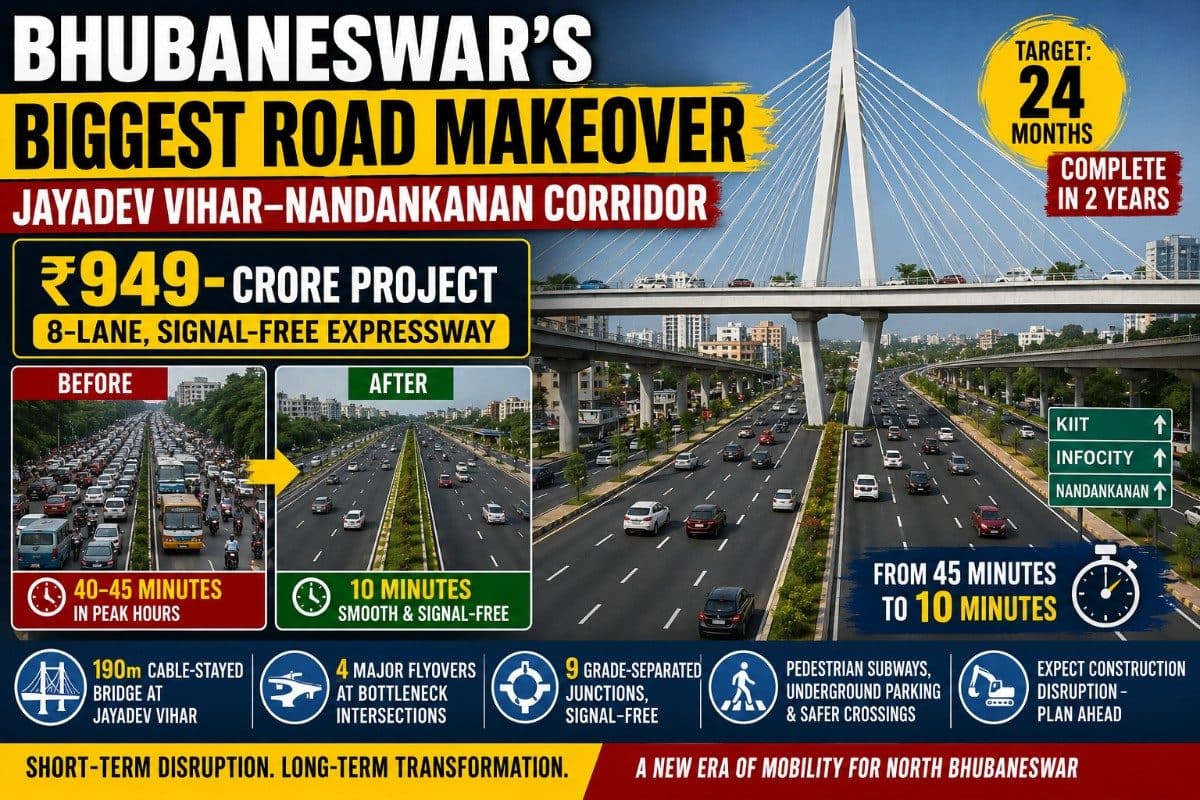
Key Points
* Introduces a striking 190-meter, 4-lane cable-stayed bridge over NH-16 at the Jayadev Vihar junction.\
* Awarded to DRA Infracon on a turnkey EPC model backed by a mandatory 10-year contractor maintenance guarantee.
Bhubaneswar: The Odisha Cabinet has cleared one of the biggest urban mobility projects in the capital's history – a complete transformation of the busy Jayadev Vihar–Nandankanan corridor into a signal-free 8-lane urban expressway.
Stretching 9.5 km from Kalinga Stadium Gate No. 4 to Raghunathpur Bridge, the project is expected to cost Rs 949.35 crore. While the overall administrative approval is nearly Rs950 crore, the core Engineering, Procurement and Construction (EPC) contract has been awarded to M/s Dineshchandra R. Agrawal (DRA) Infracon Pvt. Ltd. for Rs 579 crore (excluding GST) after it emerged as the lowest bidder.
The government's target is ambitious – finish the entire corridor within just 24 months.
For lakhs of commuters travelling daily between Jayadev Vihar, Damana, Patia, KIIT, Infocity and Nandankanan, the announcement promises a future of dramatically faster travel. But before that future arrives, residents should prepare for two years of intensive construction activity.

📱 Get Argus News App
✨Why is this project needed?
Anyone who drives through the Jayadev Vihar-Patia-Nandankanan stretch understands the problem.
Despite already being among Bhubaneswar's widest roads, the corridor has become one of the city's worst traffic bottlenecks due to:
- explosive residential growth in Patia and Raghunathpur,
- rapid expansion of KIIT, KIMS and educational institutions,
- Infocity's growing IT workforce,
- heavy inter-city traffic using NH-16,
- increasing commercial establishments.
Peak-hour travel between Jayadev Vihar and Patia frequently takes 40-45 minutes despite covering less than 10 kilometres.
The new project aims to reduce that journey to around 10 minutes by removing almost every major traffic signal.
What exactly will be built?
The project goes far beyond simply widening an existing road.
An 8-lane high-speed corridor
The present six-lane road will be converted into an 8-lane arterial corridor designed to separate fast-moving vehicles from local traffic.
17.5 km of service roads
Instead of mixing neighbourhood traffic with through traffic, dedicated 5.5-metre-wide service roads will run along both sides.
These roads will primarily serve:
- local residents
- shops
- schools
- hospitals
- KIIT campus
- Infocity
- nearby residential colonies
9 km of slip roads
Vehicles will enter and exit the main carriageway through specially designed 7.5-metre-wide slip roads, reducing sudden lane changes and improving safety.
The biggest engineering highlight: A cable-stayed bridge
Perhaps the most visually striking feature will rise at Jayadev Vihar Junction.
A 190-metre-long four-lane cable-stayed bridge will cross NH-16, becoming one of Bhubaneswar's most prominent urban landmarks.
Instead of waiting at one of Odisha's busiest intersections, vehicles will move continuously above the highway.
Four flyovers to eliminate major bottlenecks
The project also includes dedicated four-lane flyovers at:
- Kalinga Hospital Square
- Damana Square
- KIIT Square
- Kalarahanga Junction
Together, these structures are designed to eliminate the chronic stop-and-go traffic that currently defines the corridor.
Nine junctions will become signal-free
Instead of conventional traffic signals, the project proposes grade-separated junction improvements at:
- Jayadev Vihar
- XIMB Square
- Kalinga Hospital
- Care Hospital
- Damana
- Infocity
- Sishu Vihar
- KIIT
- Kalarahanga
The objective is simple – keep traffic moving continuously without repeated stops.
What will change for pedestrians?
The project isn't designed only for vehicles.
It includes:
- pedestrian subways,
- safer crossings,
- underground parking facilities,
- modern road signage,
- decorative bridge lighting,
- IRC-compliant safety infrastructure.
The intention is to improve safety even as vehicle speeds increase.
Why the contractor matters
Unlike conventional government road contracts, Odisha has chosen a turnkey EPC model.
That means a single private company will handle:
- engineering,
- procurement,
- construction,
- quality assurance.
More importantly, the contractor will remain responsible for maintaining the corridor for 10 years after completion under the defect liability clause.
If structural defects or pavement failures emerge during this period, repairs will have to be carried out by the contractor rather than the government, creating a strong incentive to maintain construction quality from the outset.
The EPC structure also shifts much of the execution and cost escalation risk onto the contractor, reducing uncertainty for the state.
What should commuters expect over the next two years?
This is perhaps the biggest question for ordinary citizens.
The answer is both disruption and relief.
Expect heavy construction activity
To build flyovers and elevated structures, engineers will need to:
- erect central piers,
- drill deep foundations,
- launch massive concrete segments,
- relocate utilities,
- shift traffic repeatedly.
Median barricading across long stretches will become unavoidable.
Night-time construction is expected to be extensive to minimise daytime disruption.
But complete closure is unlikely
The engineering strategy is expected to rely heavily on precast concrete technology, allowing large bridge components to be manufactured elsewhere and assembled on-site.
This significantly reduces construction time compared with traditional cast-in-place methods.
Ekamra Kanan–Infocity road
Urban planners believe one recently completed road could quietly determine whether the project meets its aggressive deadline.
The Ekamra Kanan–Infocity parallel corridor is expected to absorb a substantial share of diverted traffic while construction continues on the main Patia spine.
Without this parallel alternative, congestion could have become unmanageable.
Two challenges that could delay the deadline
Although funding and contracts appear firmly in place, two major risks remain.
Underground utilities
Before any foundations can be drilled, authorities must shift:
- water pipelines,
- electricity cables,
- fibre-optic networks,
- underground communication lines.
Utility relocation has historically delayed many urban infrastructure projects across India.
Tree transplantation
The corridor contains a significant urban tree canopy.
Authorities will have to balance infrastructure expansion with environmental concerns.
Successful transplantation of mature trees – and transparent compensatory plantation – will likely become a key public expectation.
How the city could change after completion
Beyond reducing travel time, the project could reshape northern Bhubaneswar's urban geography.
Commercial activity is expected to intensify along the Patia–Raghunathpur belt, while improved connectivity could increase the attractiveness of nearby residential and office developments.
For IT professionals, students, hospital visitors and daily commuters, the biggest gain will be predictability. Instead of budgeting nearly an hour for peak-hour travel, many journeys could be completed in a fraction of the current time.
The Bottom Line
The Rs949-crore Jayadev Vihar–Nandankanan corridor is not merely a road-widening exercise. It represents a complete redesign of one of Bhubaneswar's busiest transport arteries through flyovers, a signature cable-stayed bridge, service roads, slip roads and grade-separated junctions.
For residents, the next 24 months are likely to bring diversions, barricades and slower commutes as construction gathers pace. But if the ambitious schedule is achieved, the payoff could be transformative – a nearly signal-free urban corridor that dramatically cuts travel time, improves road safety and supports the capital's next phase of growth.
In short,
commuters should prepare for short-term inconvenience in exchange for a
long-term mobility upgrade that could redefine how northern Bhubaneswar moves.
Also Read: Amit Shah's Odisha Visit: BJP's Big Farmer Outreach Through Two Mega Projects| Special Political Analysis
Related Topics
Explore more stories