



Beyond Nabanna: How One Bargarh Village Has Turned Nuakhai Into a 15-Year Festival of Brotherhood
Key Points
Agrarian Tradition: Farmers and villagers performed early morning rituals, tied rakhis to the first paddy crops, and offered nabanna to Goddess Samaleswari.
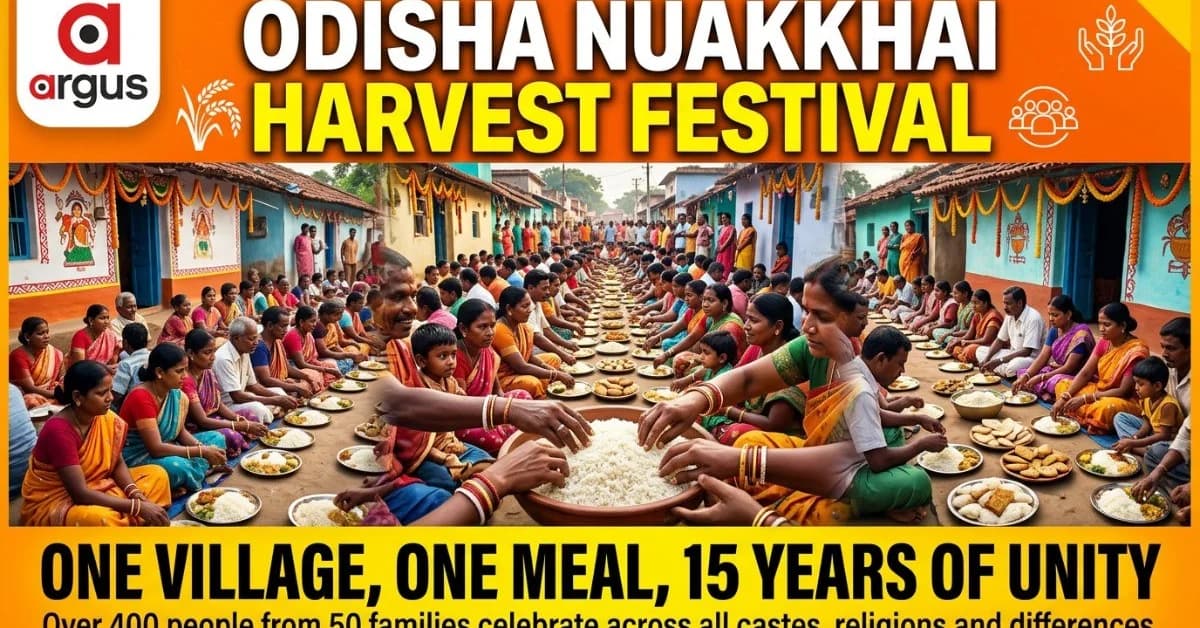
15 Years of Communal Harmony: Over 400 people across 50 families—regardless of caste, religion, or creed—gathered together to share the feast and exchange greetings (Juhar).
A Message of Unity: Led by local community efforts, the village continues to inspire Western Odisha by setting aside differences to celebrate collective brotherhood.
Bargarh: In western Odisha, Nuakhai is traditionally a celebration of the first harvest, family and gratitude. But in Bargarh’s Rangatikra village, the festival has acquired a larger meaning – one that has brought hundreds of people together for 15 years, cutting across caste, religion and social differences.
Gobindpur panchayat’s Rangatikra village came alive on Nuakhai with the aroma of traditional pithamada and freshly prepared nuānchara. Farmers began the day with rituals in their agricultural fields before the newly harvested paddy was brought back to the village for preparation of the traditional bhog.
The offering was made to Goddess Samaleswari, the presiding deity, followed by worship of village deities and cattle. Families then gathered to partake in the Nuakhai mahaprasad and seek the blessings of elders.

📱 Get Argus News App
✨But the most striking tradition unfolded beyond individual households.
More than 400 people from around 50 families sat together to celebrate Nuakhai, continuing a practice that has become a defining feature of Rangatikra’s festival for the past 15 years.
From harvest ritual to a village-wide bond
The day began with farmers, gountias and women dressing in new clothes and heading to their fields. Following local customs, they offered prayers with incense, lamps, arua rice and milk before tying rakhis to the first crop of paddy.
The village jhankar, or priest, then brought the harvested paddy from the fields. The new rice was used to prepare the offering for Goddess Samaleswari and other village deities.
Cows and calves were also worshipped, with villagers praying for the welfare of their families and the wider community.
The jhankar subsequently went from house to house distributing the newly harvested crop, carrying with it the traditional wish for prosperity and well-being.
At the auspicious moment, family members sat together and received the Nuakhai mahaprasad from the head of the household.
The ritual was followed by juhar bhet – the traditional exchange of greetings and respect. Younger members touched the feet of elders and sought their blessings.
50 families, one meal, one message
What makes Rangatikra different is what happens after the household rituals.
According to the Nuakhai Management Committee, the village youth group, encouraged by social worker Binod Kumar Dash, took a collective pledge in 2012 to celebrate Nuakhai as a festival of unity and brotherhood.
The idea was simple: irrespective of economic status or social differences, residents would contribute to a common celebration and sit together for the Nuakhai meal.
That tradition has continued for 15 years.
More than 400 people from around 50 families participated in the collective celebration this year, turning the harvest festival into an occasion for reconciliation and community bonding.
Residents contribute according to their capacity, allowing rich and poor alike to become part of the celebration.
Beyond caste and religion
The significance of the gathering goes beyond the common meal.
Residents belonging to different religious communities, including Hindu, Muslim and Christian families, participate in the celebration.
For the villagers, sharing nabanna - food prepared from the new harvest – is also a symbolic act of leaving behind anger, resentment, ego and old differences.
The common menu reflected the festive character of Nuakhai, with villagers sharing delicacies such as kheer, puri, arisa, kakara pitha and mada.
The village youth also used social media platforms to share the message of Rangatikra’s Nuakhai celebration with friends and relatives.
The larger meaning of Nuakhai
Nuakhai is deeply rooted in the agricultural life of western Odisha. It marks the arrival of the new harvest and traditionally brings families together to offer the first produce to the deity before consuming it.
But Rangatikra’s 15-year tradition adds another layer to that ritual.
Here, the harvest is not merely shared within individual families. It becomes a reason for an entire community to sit together.
“Nuakhai is not merely a festival of eating nabanna. It is a festival of unity and brotherhood,” the village’s celebration conveys through its continuing tradition.
For 15 years, Rangatikra’s 50 families have demonstrated that the essence of Nuakhai can extend beyond ritual — into a shared meal, shared respect and a shared sense of community.
And
on a festival whose very spirit is about welcoming the new harvest,
the village appears to have preserved something equally valuable: the
tradition of coming together.
Report: Balaram Dip, Argus News
Also Read:Special Report| Nuakhai Bhetghat: Dharmendra Pradhan Turns Festival Platforms Into a Wider Conversation on Western Odisha
Related Topics
Explore more stories