



Baitarani’s Dangerous Double Peak: Why August 19–21 Could Be the More Critical Flood Window For Bhadrak, Jajpur & Keonjhar| Exclusive
Key Points
Bhubaneswar: The Baitarani flood threat is no longer a single-wave event.
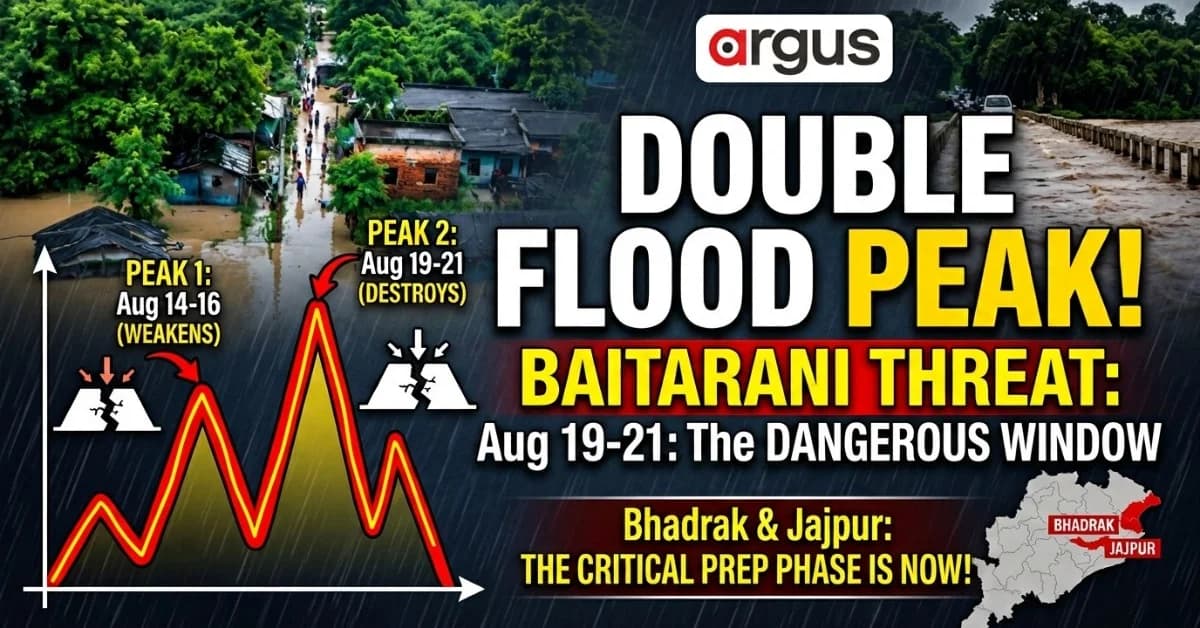
The latest hydrological projections by Central Water Commission (CWC) indicate a double-peak flood pattern, with the river expected to cross the danger mark first during August 14–16 and then rise again around August 19–21. The second peak could prove more dangerous because it would arrive after embankments, roads, homes and agricultural fields have already been exposed to sustained water pressure.
As a consequence, the emerging flood map puts Bhadrak, Jajpur and Keonjhar at the centre of the next phase of the crisis.
The critical message from the forecast is simple: the brief fall in river levels around August 17–18 should not be mistaken for the end of the flood.

📱 Get Argus News App
✨August 19–21: The dangerous window
The Baitarani system is showing a two-stage rise.
At Akhuapada in Bhadrak, the danger level is 18.33 metres. The river is projected to cross that level during the first wave and then rise again between August 19 and 21 as fresh runoff moves downstream from the upper catchment.
At Anandapur in Keonjhar, the forecast indicates another significant rise, with the river potentially approaching its 38.36-metre danger level around August 19.
That creates a potentially dangerous sequence: rainfall and runoff build up in the upper Baitarani basin, river levels rise around Anandapur, and the resulting flood pulse travels downstream towards Akhuapada.
For the lower basin, the problem is compounded by backwater effects and tidal resistance.
The result could be a second flood arriving before the first one has fully receded.
Bhadrak faces the biggest secondary threat
Among the districts Bhadrak appears to be the most exposed to the second wave.
The vulnerable belt includes Bhandaripokhari, Dhamnagar, Bonth and parts of Tihidi, particularly low-lying settlements around the Baitarani-Kochila river system.
The first wave is already putting pressure on embankments and rural connectivity. If, as predicted, the river rises again from August 19, those weakened structures could face a more severe test.
The danger is therefore not merely the peak water level.
It is the duration of flooding plus repeated hydraulic pressure.
Agricultural fields that remain waterlogged after the first wave could face prolonged crop damage. Rural roads that survive the first overtopping could become impassable during the second rise.
For Dhamnagar, the operational trigger is particularly important. If the Anandapur gauge moves above 38 metres around August 18–19, authorities should treat it as a signal for the second phase of flood preparedness rather than waiting for the downstream river to rise.
Jajpur could face a different kind of flood
Jajpur's vulnerability is different.
The district's lower Baitarani network can experience backwater flooding, particularly when the main river remains swollen and drainage from smaller channels slows down.
Dasarathpur, Korei, Binjharpur and Jajpur Sadar are among the areas requiring close monitoring.
The Kani and Budha river systems are particularly important in this scenario. When the Baitarani remains high, drainage from these smaller channels can become restricted, leaving water trapped across low-lying agricultural and residential areas.
This means Jajpur may continue to experience waterlogging even when the main river's level begins to decline.
That makes the August 17–18 lull potentially deceptive.
Instead of standing down, the administration would need to use the window to clear drainage channels, inspect embankments and replenish relief supplies before the second wave arrives.
Keonjhar: The upstream warning zone
Keonjhar is different again.
It is the upstream catchment zone feeding the Baitarani system, making rainfall there critical to what happens downstream several days later.
The most exposed areas include Anandapur, Ghasipura, Hatadihi, Champua and Joda.
The forecast indicates that renewed heavy rain in the upper catchment around August 17–19 could generate rapid runoff and push the Anandapur gauge towards the danger level.
Low-level bridges and crossings could temporarily go under water, while short-duration flash flooding may affect streams and rivulets in the hilly catchments.
For Keonjhar, therefore, the crucial period begins before the second downstream peak.
What happens in the upper catchment between August 17 and 19 could determine the severity of the Baitarani's second rise downstream.
Mayurbhanj remains a lower-risk zone
Mayurbhanj's threat appears comparatively limited and localised.
Low-lying pockets around Baripada, Sarasakana and Badasahi could experience temporary waterlogging, while fluctuations in the Budhabalanga system may produce minor bank overflow.
The impact, however, is currently projected to be more consistent with seasonal waterlogging than a major flood emergency, provided rainfall in the basin continues to taper.
The flood calendar that matters
|
Period |
Expected situation |
Risk |
|
Aug 14–16 |
First Baitarani rise; riverside inundation and initial evacuation pressure |
High |
|
Aug 17–18 |
River levels temporarily fall; upper catchment needs close monitoring |
False lull |
|
Aug 19–21 |
Fresh runoff reaches downstream system; Baitarani rises again |
Most dangerous window |
Why the second peak matters more
A second flood peak can be more damaging than the first even if its absolute height is similar.
By then, communities may already have:
- waterlogged homes and fields;
- weakened embankments;
- damaged rural roads;
- exhausted relief stocks;
- disrupted drinking-water systems; and
- reduced access to transport and medical facilities.
In other words, the second wave hits a system that is already weakened by the first.
That is why August 19–21 should be treated as the key danger window in the current forecast.
Dhamnagar: Don't mistake the lull for safety
For Dhamnagar, the operational strategy should effectively run in three stages.
August 14–16: evacuation and rescue readiness must remain the priority in the most vulnerable riparian settlements. Boats, ODRAF teams, food, drinking water and medical supplies need to remain positioned close to vulnerable pockets.
August 17–18: this should be treated as a preparation window, not a recovery phase. Embankment weak spots along the Baitarani and Kochila systems need inspection and reinforcement, while isolated villages from the first wave should receive replenishment of food, fodder and medical supplies.
August 19–21: if the upstream Anandapur gauge confirms a renewed sharp rise, secondary evacuation and boat-based rescue operations may become necessary.
Dasarathpur: Watch the backwater, not just the main river
Dasarathpur needs a different trigger system.
The key question is not simply whether the Baitarani crosses its danger level. It is how long the main river remains high enough to restrict drainage through the Kani and Budha systems.
If Akhuapada begins climbing again towards 18 metres around August 18–19, local authorities should prepare for renewed backwater pressure.
That means checking drainage outlets, vulnerable embankments, submerged roads and low-lying settlements before the second surge becomes visible on the ground.
The key warning for Odisha
The emerging Baitarani forecast changes the flood story from a single peak to a prolonged two-stage event.
The first wave is already the immediate concern.
But the August 19–21 period could become the more dangerous phase, particularly for Bhadrak and Jajpur, if renewed upper-catchment runoff in Keonjhar pushes the Baitarani above its downstream danger mark for a second time.
For disaster managers, the most important date may therefore not be the day the first flood peaks.
It could be the day after the river appears to have fallen.
The
August 17–18 lull may be the last window to prepare for the flood that follows.
Also Read: Odisha Floods 2026 Updates: Another Bay Low Looms Over State Before Independence Day; Reservoir Managers Brace for Fresh Flood Challenge| Exclusive
Related Topics
Explore more stories