



As Gujarat, Maharashtra, West Bengal Join Coal Gasification Race, How Odisha Is Emerging India's Front-Runner| Special Story
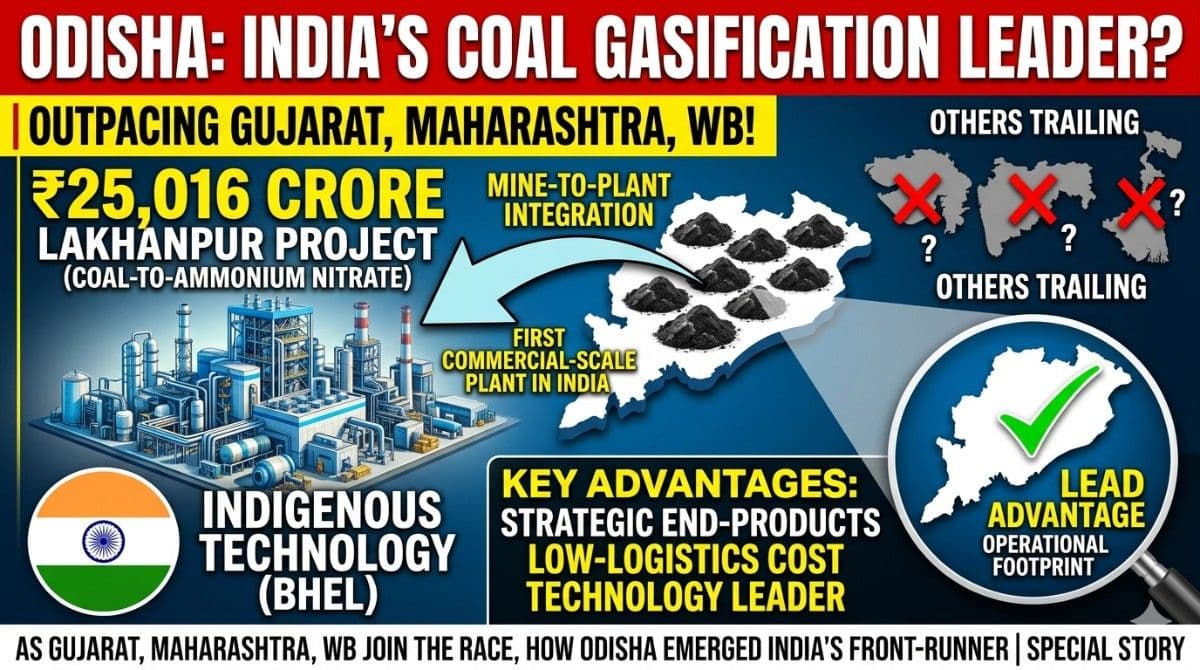
Key Points
* Unlike rival states targeting synthetic fuels, Odisha is focusing on chemical self-reliance through ammonium nitrate and urea production.
* Backed by abundant coal reserves, MCL mine proximity and indigenous BHEL technology, Odisha is emerging as the anchor of India's gasification mission.
Bhubaneswar: On Saturday, when Prime Minister Narendra Modi lays the foundation stone for the Rs 25,016-crore coal gasification project at Lakhanpur in Jharsuguda, Odisha's claim to being the front-runner in India's coal gasification race will become significantly stronger.
Across the country, coal-bearing states such as Maharashtra, West Bengal and Gujarat are racing to establish themselves in the Centre's ambitious push to gasify 100 million tonnes of coal by 2030. Yet, despite the growing competition, Odisha appears to have secured a decisive early advantage.
From hosting India's only operational commercial gasification footprint to becoming the launchpad for the country's first large-scale coal-to-ammonium nitrate plant, Odisha is increasingly positioning itself not merely as another participant in the coal gasification mission but as its principal anchor.
The question is no longer whether Odisha will play a role in India's gasification future. The more relevant question is whether any other state can currently match the ecosystem advantage Odisha has quietly assembled.

📱 Get Argus News App
✨Odisha's First-Mover Advantage
One reason Odisha stands apart is that it is not starting from scratch.
While many proposed projects elsewhere remain at memorandum-of-understanding or planning stages, Odisha already hosts one of India's most visible operational coal gasification footprints through JSPL's Angul facility, though it was in private sector.
That matters because coal gasification is not simply another industrial investment. It involves mastering complex chemical engineering processes, creating supply chains, training specialised manpower and building downstream markets.
In industrial transitions, first movers often gain advantages that are difficult to replicate later.
Lakhanpur now expands that advantage.
The BCGCL project will become India's first commercial-scale coal-to-ammonium nitrate facility, effectively turning Odisha into the national demonstration site for large-scale coal gasification economics.
The Only State Betting on Chemical Self-Reliance
What makes Odisha's approach different from rival states is its end-product strategy.
Most competing projects are focused primarily on producing fuel substitutes.
|
State |
Primary Focus |
|
West Bengal |
Synthetic Natural Gas (SNG) |
|
Maharashtra |
SNG, Hydrogen and Clean Fuels |
|
Gujarat |
Methanol and Underground Lignite Gasification |
|
Odisha |
Ammonium Nitrate and Urea |
This distinction is important.
West Bengal's Bardhaman project aims to feed synthetic natural gas into eastern India's gas grid.
Maharashtra is positioning itself as a clean-fuel and hydrogen hub.
Gujarat is experimenting with underground lignite gasification.
Odisha, however, is targeting a different strategic objective: chemical self-reliance.
The Lakhanpur plant will produce ammonium nitrate, a critical input for fertilizers, mining explosives and infrastructure development.
In other words, while some states are attempting to replace imported LNG, Odisha is attempting to replace imported industrial chemicals.
That gives the state a distinct position in India's industrial strategy.
Where Geography Gives Odisha an Edge
Coal gasification economics are heavily influenced by feedstock logistics.
This is where Odisha may possess one of the strongest structural advantages in the country.
Lakhanpur sits next to Mahanadi Coalfields Limited (MCL) mines.
Instead of transporting millions of tonnes of coal across state boundaries, the project can source coal directly from adjacent mining operations.
For an industry where logistics often determine profitability, that advantage is significant.
It also allows Odisha to monetise something many gasification technologies struggle with: India's high-ash coal.
The Real National Significance: Testing Indigenous Technology
Perhaps the most important aspect of Lakhanpur is not the product it will manufacture but the technology it will validate.
Most global gasification technologies were developed for coal with lower ash content than what is typically found in India.
BHEL's indigenous gasification technology was designed specifically for Indian coal conditions.
If Lakhanpur succeeds at commercial scale, Odisha will effectively become the proving ground for India's home-grown gasification platform.
That could reduce dependence on foreign technology providers and create an exportable engineering capability for India.
In that sense, Lakhanpur is not just a chemical plant.
It is a technology demonstration project of national importance.
Why Odisha May Become the Epicentre
The emerging picture suggests Odisha enjoys a combination that no competing state currently possesses:
- More than a quarter of India's coal reserves.
- India's only significant operational gasification footprint.
- The first commercial coal-to-ammonium nitrate project.
- Direct mine-to-plant integration through MCL.
- Indigenous BHEL technology deployment.
- Existing fertilizer and chemical manufacturing ecosystem through Talcher and Angul.
Individually, these advantages are meaningful.
Together, they create an industrial ecosystem that may be difficult for competitors to replicate quickly.
The Bigger Story
The Lakhanpur project is therefore about far more than Rs 25,016 crore of investment.
It represents a larger shift in Odisha's economic identity.
For decades, Odisha's role in India's coal economy was largely confined to extraction and supply.
Coal was mined in Odisha but much of the value addition occurred elsewhere.
Coal gasification changes that equation.
If the Lakhanpur project succeeds, Odisha will no longer be viewed simply as India's coal storehouse. It could emerge as the birthplace of India's indigenous gasification industry and the principal hub of a new chemical economy built around coal conversion rather than coal extraction.
That is why the real significance of Lakhanpur is not that Odisha has joined India's coal gasification race.
It is that
Odisha may already be leading it.
Also Read: Odisha Leads India in Health Spending at Nearly 2% of GSDP: SBI Study Suggests Health Investment Paying Off for Children| Special Story
Related Topics
Explore more stories