



Andhra COVID Cases Remain Distant from Odisha; Geography, Localised Spread Keep Immediate Risk Low Despite High Alert | Explained
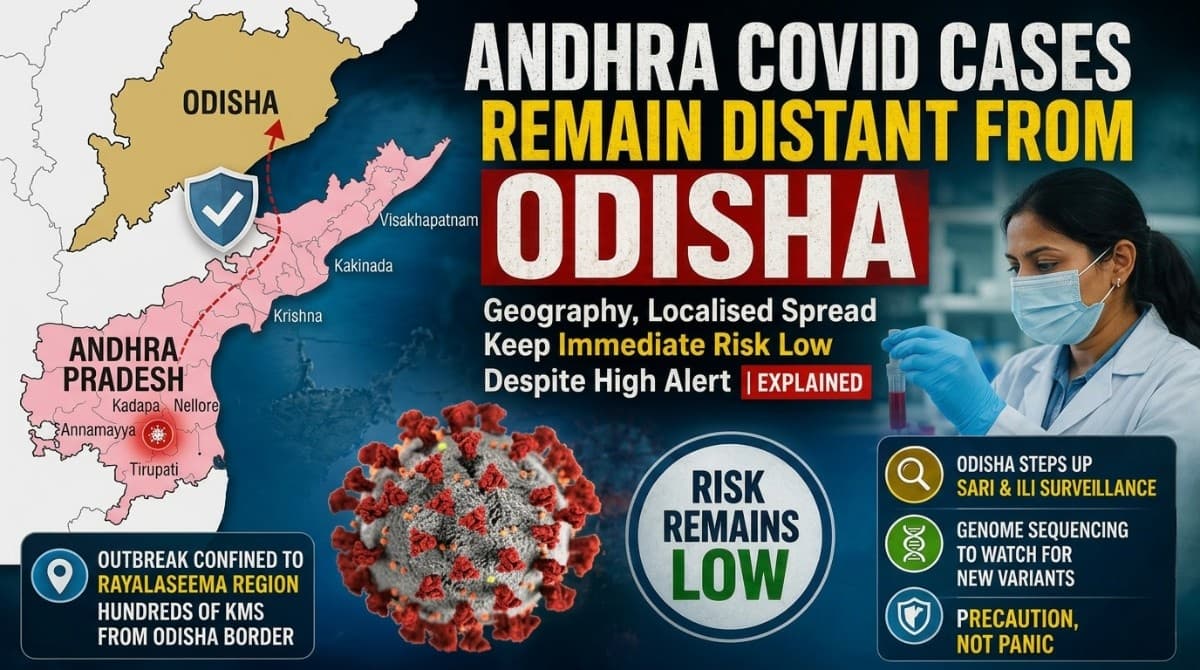
Key Points
Bhubaneswar: Even as the Odisha government has stepped up COVID-19 surveillance across its southern border districts following a rise in infections in Andhra Pradesh, epidemiological evidence indicates that the likelihood of the virus immediately spreading into Odisha remains low.
Health officials have intensified monitoring in Ganjam, Gajapati, Rayagada, Koraput and Malkangiri as a precautionary measure. However, the current outbreak in Andhra Pradesh is geographically confined to the Rayalaseema region – primarily Kadapa and Annamayya districts – which are located in the southwestern part of the state, several hundred kilometres away from the Odisha-Andhra border.
Significantly, there have been no reports of unusual COVID-19 activity from northern Andhra Pradesh districts such as Srikakulam, Vizianagaram and Visakhapatnam, which share direct connectivity with Odisha.
Distance Acting as a Natural Barrier

📱 Get Argus News App
✨Public health experts say the considerable distance between the affected districts and Odisha's border provides a natural buffer against immediate transmission.
Unlike previous nationwide COVID waves that spread simultaneously across multiple districts and states, the present cases in Andhra Pradesh remain confined to a specific region without evidence of wider geographical expansion.
The absence of reported infections in the northern Andhra corridor substantially reduces the probability of infected travellers routinely carrying the virus into Odisha through daily cross-border movement.
Cases Still Sporadic, Not Community Outbreak
Another factor limiting the current risk is the nature of the reported infections.
According to AP health brief, the cases detected in Andhra Pradesh are sporadic and largely involve patients with severe underlying medical conditions. There is currently no indication of sustained community transmission or the emergence of a highly transmissible new variant capable of triggering a fresh wave.
This epidemiological pattern differs markedly from earlier pandemic phases when widespread community transmission rapidly crossed state boundaries.
AP health brief has so far also not indicated the cases related to any new strain.
Odisha Builds a Sentinel Surveillance Network
Despite the low immediate threat, Odisha has chosen to strengthen surveillance rather than wait for infections to appear.
The Health Department has instructed Chief District Medical Officers (CDMOs) in the five southern districts to test every Severe Acute Respiratory Infection (SARI) patient for COVID-19. Such patients often serve as the earliest indicators of hidden community transmission.
In addition, significantly, health facilities have been directed to test at least five per cent of Influenza-Like Illness (ILI) cases. The strategy functions as an early-warning mechanism capable of detecting silent transmission before clusters emerge.
Officials believe that if COVID-19 begins circulating in northern Andhra Pradesh or enters Odisha through isolated imported cases, this enhanced surveillance network would likely identify infections at an early stage.
Genome Sequencing to Watch for New Variants
Odisha is also strengthening genomic surveillance through the Indian Council of Medical Research (ICMR) network.
Positive samples, wherever necessary, can undergo genome sequencing to determine whether any emerging variant possesses characteristics such as higher transmissibility or immune escape. This would enable authorities to recalibrate containment measures promptly if the epidemiological situation changes.
Precaution, Not Panic
Health experts emphasise that Odisha's high alert should be viewed as a preventive administrative measure rather than a response to an active outbreak.
Border states routinely enhance surveillance whenever neighbouring regions report infectious disease activity. The objective is to detect any imported infections early enough to prevent local transmission.
For now, the combination of geographical separation, the absence of reported COVID-19 cases in northern Andhra Pradesh, the localised nature of infections in Rayalaseema, and Odisha's strengthened SARI-ILI surveillance network together suggest that the immediate risk of the virus "sneaking" into Odisha remains low.
Authorities, however, maintain that continued vigilance is essential, as
infectious disease dynamics can change rapidly with increased travel or the
emergence of new variants.
Also Read: Nadda Launches SUMAN Roadmap 2030: 6 Odisha Districts Setfor Special Maternal Healthcare Push Under 130-District National Mission |Special Story
Related Topics
Explore more stories