



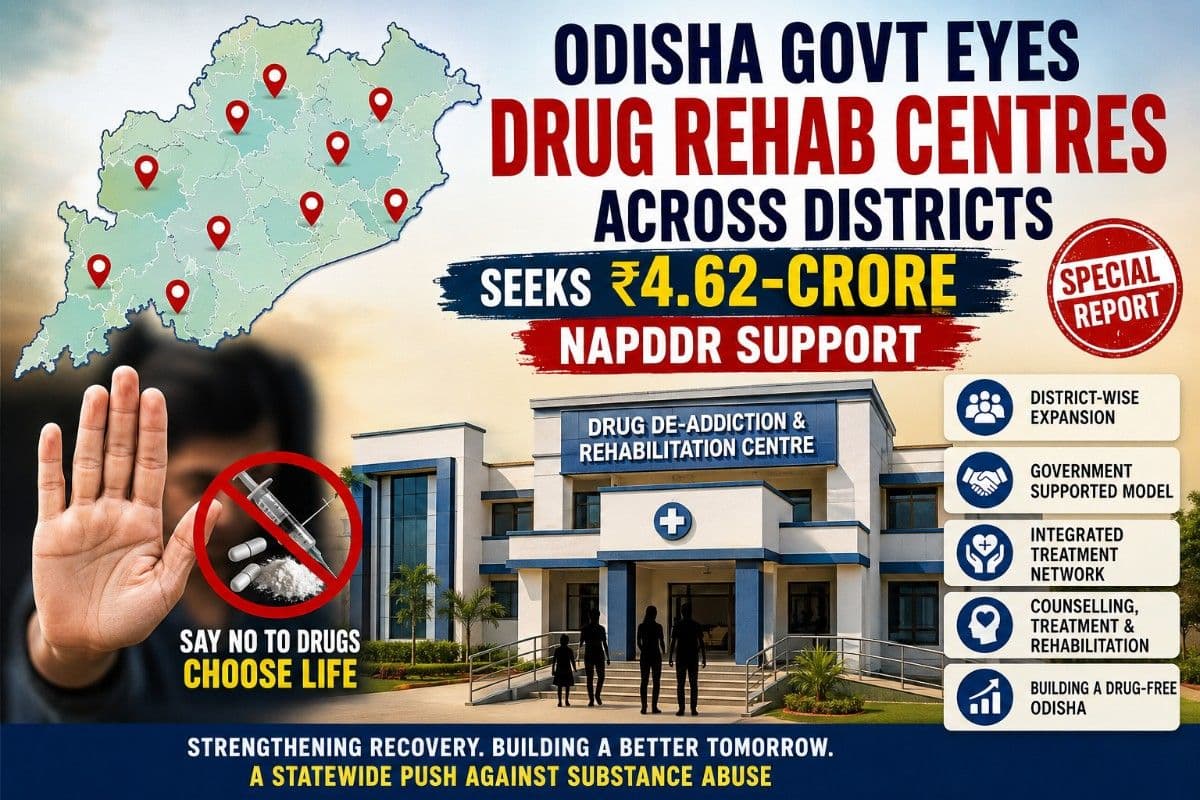
Odisha Govt Eyes Drug Rehab Centres Across Districts, Seeks ₹4.62-Crore NAPDDR Support| Special Report
Key Points
Public-NGO Partnership: The model leverages a public-private framework where the government provides oversight and funding, while NGOs manage daily operations to ensure rapid scalability.
Targeting Underserved Regions: The revised action plan prioritizes high-load and tribal districts like Nabarangpur, Malkangiri, and Angul to bridge the gap in rural treatment accessibility.
Bhubaneswar: The Odisha government has signalled a major expansion of its drug de-addiction and rehabilitation network by seeking Rs4.62 crore from the Centre under the National Action Plan for Drug Demand Reduction (NAPDDR) for 2026-27, indicating a renewed push to strengthen recovery infrastructure across the state.
According to an official communication dated July 10, 2026, the Department of Social Security & Empowerment of Persons with Disabilities (SSEPD) has submitted a Revised State Action Plan under NAPDDR to the Union Ministry of Social Justice & Empowerment, seeking approval for a financial outlay of Rs4.62 crore.
The proposal, sent by Additional Secretary Smt. Sonia Behera (OAS-SAG) to the Centre, is more than a routine financial request.
It reflects Odisha's strategy to significantly widen the reach of drug de-addiction services by establishing more government-supported rehabilitation centres through partnerships with experienced non-governmental organisations (NGOs).

📱 Get Argus News App
✨District-Wide Expansion on the Cards
Government sources indicate that Odisha is gradually expanding its DISHA (Drug De-addiction and Rehabilitation) programme, under which 11 recovery centres are already operational in districts including Bhubaneswar, Cuttack, Puri, Berhampur, Khordha, Balasore, Koraput, Kandhamal, Rourkela, Sambalpur and Keonjhar.
The long-term objective is to establish such facilities in every district over the next five years, creating a statewide rehabilitation network instead of concentrating services in a handful of urban centres.
Not Government-Run, But Government-Supported
Unlike conventional government hospitals, Odisha's de-addiction model relies on a public-NGO partnership framework.
Under the NAPDDR mechanism, the government provides financial support, infrastructure, monitoring and policy oversight, while Programme Implementing Agencies (PIAs) – primarily NGOs and specialised institutions – manage day-to-day treatment, counselling and rehabilitation services.
This model enables the state to rapidly scale rehabilitation facilities without directly recruiting large numbers of specialised staff.
Focus on High-Burden Districts
The revised action plan also aligns with Odisha's strategy of targeting districts witnessing higher demand for addiction treatment.
The SSEPD Department has already invited Expressions of Interest (EOIs) for agencies to operate centres in emerging high-load districts such as Nabarangpur, Malkangiri and Angul, while strengthening services in districts like Koraput, Kandhamal, Sambalpur, Rourkela and Keonjhar.
Officials believe this targeted approach will improve accessibility in tribal and rural regions where specialised treatment facilities remain limited.
Beyond Urban-Centric Rehabilitation
At present, a significant number of private and NGO-run rehabilitation centres remain concentrated in Bhubaneswar and the Khordha region, forcing patients from distant districts to travel long distances for treatment.
The government's revised funding proposal seeks to reduce this imbalance by expanding government-supported facilities into underserved districts.
The initiative also complements the national Nasha Mukt Bharat Abhiyaan (NMBA), which emphasises community-based prevention, counselling and rehabilitation.
Integrated Treatment Network
Odisha's de-addiction ecosystem currently includes multiple levels of intervention:
- Integrated Rehabilitation Centres for Addicts (IRCAs) providing residential rehabilitation.
- Outreach and Drop-in Centres (ODICs) for community counselling and early intervention.
- Government hospital-based treatment facilities, including the 30-bed Drug De-addiction Centre at the Mental Health Institute, SCB Medical College and Hospital, Cuttack.
- Emerging district-level initiatives such as the District De-addiction Centre in Malkangiri.
Rather than operating as standalone institutions, these facilities are increasingly being linked into an integrated referral network connecting outreach, medical detoxification and long-term rehabilitation.
More Than Infrastructure
Experts say the higher financial outlay is expected to support not only additional rehabilitation centres but also:
- Expansion of awareness campaigns in schools, colleges and vulnerable communities.
- Training of counsellors, healthcare workers and volunteers.
- Vocational training and livelihood support for recovering addicts.
- Better integration with national mental health and counselling services.
- Improved access to treatment in rural and tribal districts.
Why the Rs 4.62-Crore Proposal Matters
The revised State Action Plan indicates that Odisha is moving beyond a limited treatment approach towards building a comprehensive drug demand reduction system.
Instead of merely increasing the number of beds, the state aims to create a statewide safety net combining prevention, counselling, medical treatment, rehabilitation and social reintegration.
If approved
by the Centre, the proposal could accelerate Odisha's ambition of making
structured drug de-addiction and recovery services available across all
districts, significantly improving access for individuals struggling with
substance abuse in both urban and rural areas.
Also Read: 4th Narcotics Crackdown Ends, But Odisha's Drug Map Shows the Real Battle Is Yet to Be Won | Special Report