



44 Fast-Track Special Courts, Yet Convictions Keep Falling: Why Odisha’s Sexual Crime Cases Are Ending in Acquittals| Special Report
Key Points
Bhubaneswar: Four dozen Fast-Track Special Courts are functioning in Odisha to deal with some of the gravest crimes against women and children. Yet, the very system created to deliver swift justice is witnessing a disturbing collapse in convictions.
The numbers tell a story that is difficult to ignore.
Odisha has emerged as the sixth-highest state in the country in terms of the number of operational Fast-Track Special Courts (FTSCs), with 44 courts. But despite this sizeable judicial footprint, its conviction rate has been steadily deteriorating.
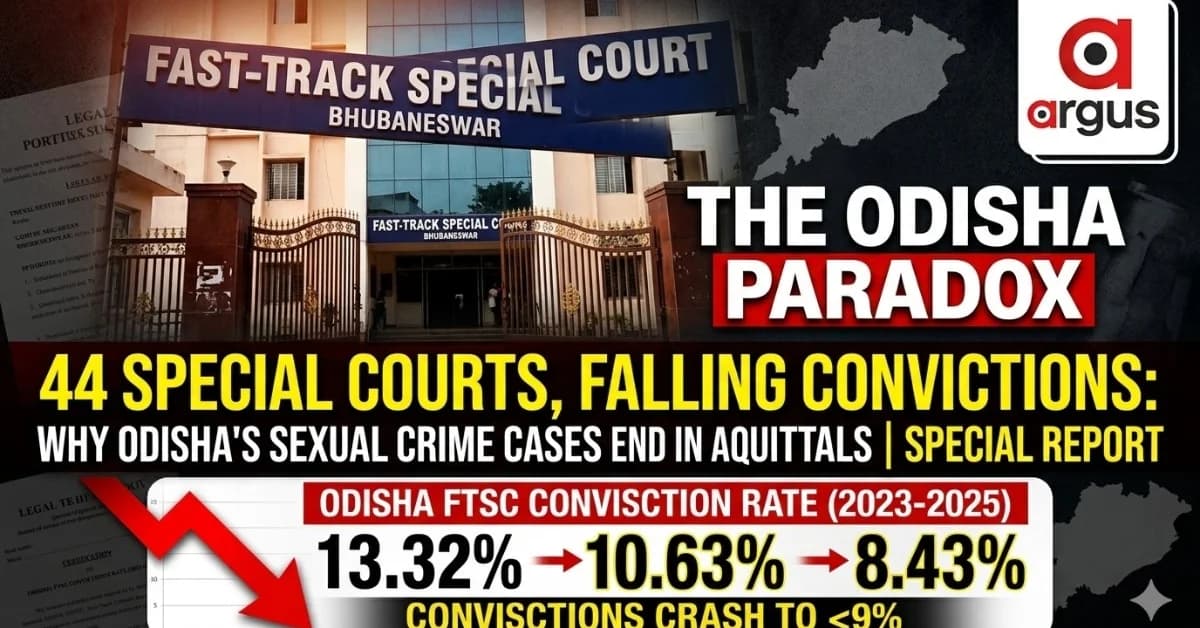
According to data of the Union Law Ministry tabled in the Rajya Sabha, Odisha's FTSC conviction rate has fallen from 13.32% in 2023 to 10.63% in 2024 and further to just 8.43% in 2025.

📱 Get Argus News App
✨In other words, for roughly every 100 cases taken to trial before these special courts in 2025, only about eight to nine ended in conviction. The overwhelming majority did not result in conviction.
Odisha's fast-track paradox: More courts, fewer convictions
|
Year |
Odisha FTSC conviction rate |
What it means |
|
2023 |
13.32%
Around 13 convictions per 100 cases
2024
10.63%
Around 11 convictions per 100 cases
2025
8.43%
Fewer than 9 convictions per 100 cases
The paradox is stark: the institutional machinery for fast-track justice has expanded, but the ability of that machinery to secure convictions has weakened.
And this raises a more uncomfortable question. If the probability of conviction in a sexual offence case is reduced to single digits, what deterrent effect does the fast-track system actually create?
A criminal does not merely respond to the existence of a special court. Deterrence ultimately depends on the certainty that a crime will be investigated properly, evidence will withstand scrutiny, witnesses will remain protected and the prosecution will be able to prove the case beyond reasonable doubt.
That is where Odisha's problem appears to run deeper than the number of courts.
Odisha vs Uttar Pradesh: What is the missing link?
The contrast with Uttar Pradesh is particularly revealing.
UP recorded a 25.22% FTSC conviction rate in 2025, almost three times Odisha's 8.43%. The comparison suggests that the issue cannot simply be explained by the number of cases or the existence of fast-track courts.
The critical difference lies in what happens before and around the trial – investigation, evidence management, prosecution coordination, witness continuity and administrative monitoring.
|
Operational pillar |
Odisha |
Uttar Pradesh |
Why it matters |
|
Conviction rate, 2025 |
8.43% |
25.22% |
UP's rate was nearly three times Odisha's |
|
Police-prosecution coordination |
More fragmented, with investigation and prosecution often operating separately |
Greater use of integrated digital/e-Prosecution mechanisms |
Weak links in a charge sheet can be identified before trial |
|
Case monitoring |
Greater dependence on the normal procedural system after cases enter FTSCs |
Dedicated monitoring mechanisms track progress and delays |
Administrative pressure can prevent cases from simply drifting |
|
Witness management |
Vulnerable witnesses can remain exposed to social and local pressure during prolonged trials |
Greater emphasis on witness notification, support and protection mechanisms |
A witness who remains consistent strengthens the prosecution case |
|
Forensic evidence |
Delays in DNA, medical and other forensic reports can weaken the evidentiary chain |
Greater emphasis on prioritising forensic processing in sensitive cases |
Scientific evidence can corroborate testimony and close evidentiary gaps |
|
Digital case tracking |
Less integrated case-flow management |
Stronger digital linkage between investigation and prosecution |
Prosecutors can identify evidentiary gaps before the case reaches the courtroom |
The larger lesson from UP is that a fast-track court is only the final component of a much longer justice pipeline.
If the investigation reaches the court with gaps, if the forensic report is delayed, if the prosecutor has not been adequately briefed or if the witness is vulnerable to pressure, speeding up the trial can have an unintended consequence: it can simply produce a faster acquittal.
The evidence chain matters more than the courtroom
A sexual offence prosecution is rarely won merely because a case has been assigned to a fast-track court.
It begins with the quality of the investigation.
The police must collect evidence correctly. Medical and forensic evidence must arrive on time. The investigating officer and prosecutor must understand the case in tandem. Witnesses, particularly children and vulnerable women, must be protected from intimidation and fatigue. And the prosecutor must be able to anticipate the defence's challenge to the evidence.
Any break in that chain can become decisive inside the courtroom.
This is why the argument that Odisha simply needs more fast-track courts risks missing the point.
As of June 30, 2026, Odisha had 44 operational FTSCs handling rape and POCSO cases, with 8,967 cases pending, while the state had zero regular Fast Track Courts.
The distinction matters. FTSCs dealing with rape and POCSO cases are part of the centrally supported special-court framework. Regular Fast Track Courts, by contrast, are established by states in consultation with their respective High Courts.
The problem, therefore, is not simply a shortage of buildings or benches. It is the efficiency of the entire evidence-to-conviction pipeline.
Odisha vs Tamil Nadu: Another warning from a high-conviction state
Tamil Nadu offers an even sharper comparison.
Its FTSC conviction rate stood at 31.35% in 2025, compared with Odisha's 8.43%. That means Tamil Nadu's rate was nearly four times Odisha's.
|
Structural pillar |
Odisha |
Tamil Nadu |
What Odisha needs to examine |
|
Conviction rate, 2025 |
8.43% |
31.35% |
Why are similar special-court mechanisms producing radically different outcomes? |
|
Victim/witness support |
Vulnerable victims can remain exposed to family and social pressure |
Greater emphasis on child-friendly environments and support persons |
Victim support has to continue throughout the trial, not merely at the FIR stage |
|
Police-prosecution coordination |
Investigation and prosecution can function in silos |
Greater emphasis on coordinated case preparation and digital tracking |
Prosecutors need access to complete case information well before hearings |
|
Forensic support |
Delays in scientific evidence can affect trials |
Greater emphasis on dedicated and expedited forensic processing |
DNA, medical and other scientific evidence must reach courts in time |
|
Trial preparedness |
Weak investigation or incomplete evidence can leave prosecution vulnerable |
Greater emphasis on preparing the evidentiary chain before trial |
Fast-track should mean faster justice, not faster disposal |
|
Victim continuity |
Prolonged proceedings can increase vulnerability to pressure |
Stronger institutional support for vulnerable witnesses |
Protecting testimony is central to protecting the prosecution |
The contrast with Tamil Nadu underlines the same point: the court is only as strong as the evidence pipeline feeding it.
The "speed versus quality" trap
There is a fundamental danger in measuring the success of fast-track courts merely by the number of cases disposed of.
A court can dispose of a case quickly. But if the investigation is weak, the forensic report is missing and the prosecution is poorly prepared, quick disposal does not necessarily mean quick justice.
It can mean quick acquittal.
That is perhaps the most important lesson emerging from Odisha's numbers.
The state's conviction rate has fallen consistently:
13.32% → 10.63% → 8.43%.
This is not a one-year statistical aberration. It is a three-year downward trajectory.
And the consequence extends beyond individual cases. In crimes where deterrence is critical, a persistently low conviction probability can weaken public confidence and potentially embolden offenders.
The bottomline: Odisha needs to look beyond the courtrooms
Odisha's answer cannot be to simply add more Fast-Track Special Courts.
The state needs to examine what reaches those courts.
It needs a tighter digital bridge between investigators and prosecutors; real-time monitoring of investigation and trial bottlenecks; faster forensic processing; stronger victim and witness protection; and accountability for gaps that surface repeatedly in sensitive cases.
On the digital and administrative side, Uttar Pradesh offers an important model to study. Its stronger integration of police, prosecution and case monitoring demonstrates how technology can be used not merely to record cases, but to identify weaknesses before they become courtroom failures.
Tamil Nadu, meanwhile, offers lessons in victim support, child-friendly processes and the institutional handling of vulnerable witnesses.
The message for Odisha is therefore straightforward:
44 FTSCs cannot guarantee justice if the evidence pipeline feeding those courts remains weak.
The state has built the fast-track courtroom. Now it needs to build a fast-track justice ecosystem around it.
Otherwise, the most worrying statistic may not be the number of cases pending before Odisha's special courts.
It could be
the shrinking number of cases ending in conviction.
Related Topics
Explore more stories