



4.05L Cases Stalled by Lawyers, 2.87L Frozen by Absconding Accused; Odisha's Backlog Crosses 20.37L to Rank 6th Nationally | Exclusive
Key Points
Bhubaneswar: Odisha's justice delivery system is facing an alarming crisis, with 20,37,643 cases pending across the Orissa High Court and subordinate judiciary. But the sheer volume of pendency tells only half the story.
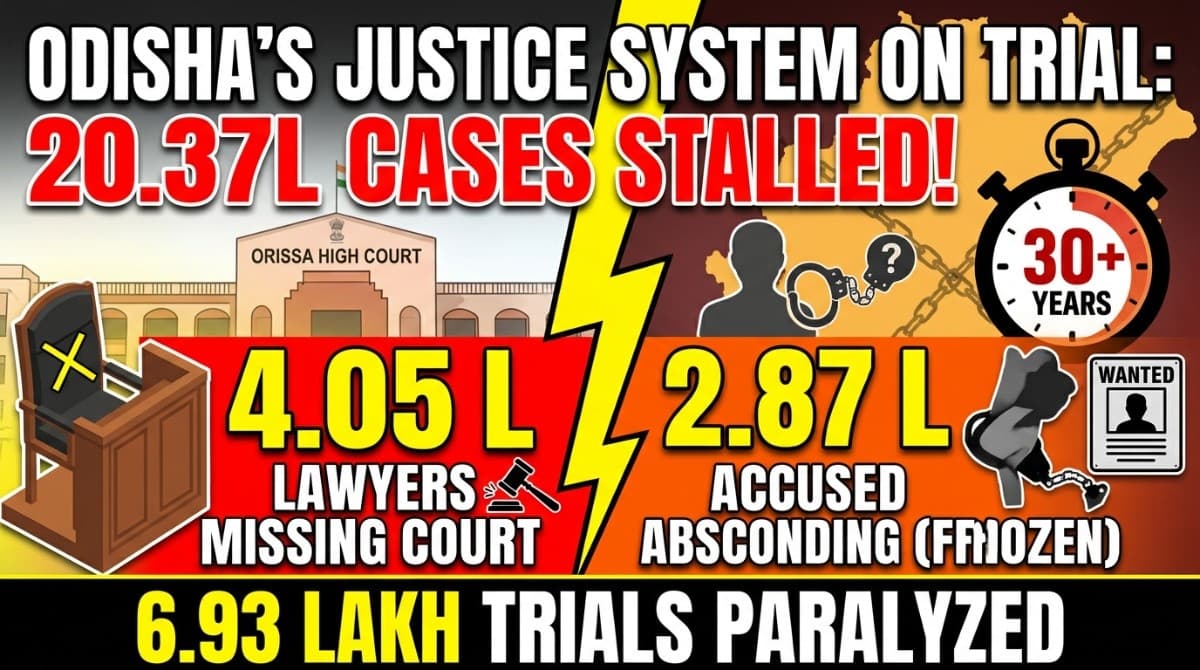
Data from the Ministry of Law and Justice and the National Judicial Data Grid (NJDG) reveals that two of the biggest reasons behind the state's mounting backlog are lawyers failing to appear in court and accused persons absconding, together stalling nearly 6.93 lakh criminal proceedings. The figures expose that the state's pendency crisis is as much about failures in the criminal justice system as it is about shortage of judges.
Odisha's pendency at a glance
|
Judicial Tier |

📱 Get Argus News App
✨Total Pending Cases
Cases Pending Over 5 Years
Cases Pending Over 30 Years
Orissa High Court
1,69,320
69,684
376
District & Subordinate Courts
18,68,323
7,66,177
4,441
Combined State Workload
20,37,643
8,35,861
4,817
The numbers show that nearly 92 per cent of Odisha's pending litigation is concentrated in the district and subordinate courts, where the trial process begins and where delays have become most acute.
Odisha among states with heavy judicial backlog
With more than 20 lakh pending cases, Odisha is among the states carrying a significant judicial burden, though still behind states such as Uttar Pradesh, Maharashtra and West Bengal, which report the country's largest pendency. At the other end of the spectrum, smaller states including Sikkim, Mizoram and Arunachal Pradesh have the lowest case backlogs owing to lighter litigation volumes.
What makes Odisha's position particularly worrying is the age of its pending cases. More than 8.35 lakh cases – around 41 per cent of the total backlog – have remained pending for over five years, making them priority cases for disposal.
Absconding accused freeze nearly three lakh criminal trials
One of the gravest revelations from the NJDG data is that 2,87,089 criminal cases in Odisha cannot proceed because the accused persons are absconding.
Unlike routine adjournments, these cases remain virtually paralysed until the accused is traced and produced before the court. The figure exposes a serious law enforcement challenge, reflecting failures in executing warrants, monitoring accused released on bail, and apprehending fugitives.
For victims, justice remains indefinitely delayed. For witnesses, memories fade and evidence weakens with every passing year. The data suggests that a substantial portion of Odisha's criminal pendency is rooted not inside courtrooms but in the inability of the enforcement machinery to bring accused persons before the courts. And above all, such huge absconding has a telling impact on the law and order of the State.
Lawyers' absence emerges as the single biggest cause of delay
If absconding accused represent the most serious law enforcement concern, absence of lawyers is the single largest procedural reason behind trial delays.
According to the NJDG, 4,05,839 criminal cases are pending because defence counsel or public prosecutors failed to appear or repeatedly sought adjournments.
The figure makes counsel non-availability the biggest individual cause of delayed criminal trials in Odisha, underscoring how routine courtroom disruptions have snowballed into a structural crisis affecting more than four lakh cases.
Nearly half the bottleneck linked to government machinery
The pendency data also points towards significant delays caused by lapses within government agencies.
As many as 49,974 cases are awaiting essential documents, including forensic science laboratory reports, police case diaries, ballistic reports and other official records.
Another 91,272 cases remain pending because witnesses have not been produced before the courts, despite it being primarily the responsibility of police authorities to serve summons and ensure their attendance.
Together, these account for 1,41,246 cases directly delayed by administrative or investigative shortcomings.
When these are combined with the 2,87,089 criminal cases stalled because accused remain absconding, the number of cases linked to executive and law enforcement failures rises to 4,28,335.
In effect, nearly half of Odisha's major criminal trial bottlenecks stem from failures outside the judiciary, indicating that reducing pendency will require stronger policing, faster investigations, timely forensic reports and more efficient prosecution alongside judicial reforms.
Criminal cases from the 1990s still await closure
The pendency figures also reveal that Odisha's courts continue handling criminal cases instituted in 1996, 1997 and 1998, meaning some litigants have remained trapped in the judicial process for nearly three decades.
Such prolonged pendency raises concerns over the quality of evidence, availability of witnesses and public confidence in the justice delivery system.
Trial courts remain the epicentre of the crisis
The NJDG's case-type analysis shows that the overwhelming share of Odisha's criminal backlog consists of main trial cases, while appeals and revisions account for only a small fraction.
The data indicates that meaningful reduction in pendency will depend primarily on speeding up original trials in district courts rather than focusing only on appellate reforms.
Total State Target Workload
The task before Odisha's judicial arrears committees is enormous.
A total of 8,35,861 cases—over 41 per cent of the state's entire backlog—have already crossed the five-year pendency mark and fall within the priority category for disposal.
|
Age of Pending Cases |
Orissa High Court |
District Courts |
Combined |
|
5–10 years |
30,818 |
4,58,961 |
4,89,779 |
|
10–20 years |
31,831 |
2,61,883 |
2,93,714 |
|
20–30 years |
6,659 |
40,892 |
47,551 |
|
Above 30 years |
376 |
4,441 |
4,817 |
|
Total Above 5 Years |
69,684 |
7,66,177 |
8,35,861 |
Bottom line
Odisha's judicial backlog is no longer merely a story of overburdened courts.
The data reveals a deeper criminal justice crisis where 4.05 lakh cases are stalled because lawyers fail to appear, while another 2.87 lakh criminal trials remain frozen because the accused have absconded.
Coupled with
delays in producing witnesses and submitting official documents, the figures
indicate that a significant share of the pendency is driven by failures in
policing, prosecution and government administration. Unless these systemic
weaknesses are addressed alongside judicial reforms, Odisha's backlog of 20.37
lakh pending cases is unlikely to see any meaningful reduction.
Also Read: Food Adulteration Rampant in Odisha: Why Zero Convictions Since last 3 years| Exclusive
Related Topics
Explore more stories