



Food Adulteration Rampant in Odisha: Why Zero Convictions Since last 3 years| Exclusive
Key Points
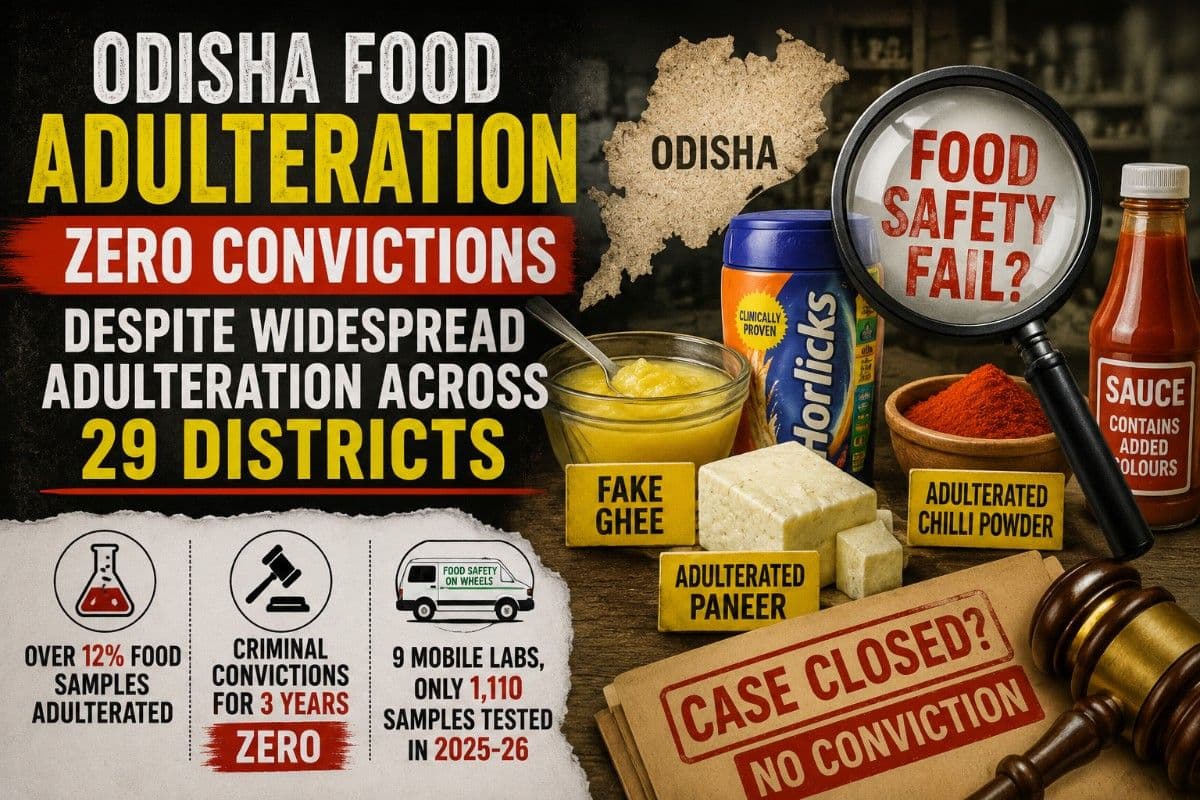
Bhubaneswar: Only in February this year, Odisha Health Minister Mukesh Mahaling informed the State Assembly that food adulteration is active and widespread across 29 districts, naming everyday essentials including ghee, paneer, Horlicks, chilli powder and sauce among products found adulterated.
The government has admitted that the food reaching consumers is compromised. But is it punishing anyone?
If a factory is caught using adulterated cooking oil or counterfeiting children's health drinks, what happens after the raid? Do the accused face penalties? Do the cases reach court? More importantly, are offenders ever convicted?
The answers emerging from data tabled in Parliament are startling.

📱 Get Argus News App
✨While enforcement agencies continue to publicise raids on adulteration units, Odisha's legal follow-up appears virtually non-existent. The latest data presented in the Lok Sabha indicates that despite repeated detection of adulterated food samples, the state has failed to secure a single criminal conviction for three consecutive financial years.
The figures raise uncomfortable questions. If food safety inspectors are detecting violations and registering cases, where are those cases ending? Why are raids not translating into punishments? And is the state's food safety enforcement stopping at media headlines?
Parliament Data Paints Grim Food Safety Picture
The Union Government's data tabled in Lok Sabha offers a comprehensive snapshot of food safety enforcement across the country, including Odisha.
For Odisha, the numbers reveal a worrying pattern.
|
Financial Year |
Samples Tested
Non-Conforming Samples
Adulteration Rate
2023-24
2,003
252
12.58%
2024-25
2,282
273
11.96%
2025-26*
1,110
61
5.49%
(*Provisional)
Although the percentage of adulterated samples appears to have declined in 2025-26, experts caution that the sharp fall coincides with an equally dramatic reduction in testing itself. The state tested barely half the samples it had analysed the previous year, making it difficult to conclude that food quality has genuinely improved.
What Makes Odisha's Numbers Even More Alarming
The Health Minister acknowledged that adulteration was detected across 29 districts involving multiple commonly consumed food items.
Yet Parliament records show that during 2025-26, Odisha detected only 61 non-conforming samples after testing merely 1,110 samples throughout the state.
The contradiction is difficult to ignore.
If adulteration is widespread enough for the government to publicly acknowledge its presence across almost the entire state, the low number of detected violations appears to reflect not a cleaner food market, but an inadequate surveillance system.
The data suggests that the state may simply not be testing enough food to uncover the actual scale of adulteration.
Odisha Among India's Worst in Per-Capita Food Testing
Population-adjusted testing intensity paints an even bleaker picture.
During 2025-26, Odisha tested only 24 food samples per million population, placing it 20th among 21 major states, ahead of only Bihar.
|
Correct Rank |
State / UT |
Population Projection (Millions) |
Samples Tested (2023–24) |
Samples Tested (2024–25) |
Samples Tested (2025–26) |
2025-26 Testing Per Million |
|
1 |
Tamil Nadu |
78.2 |
18,146 |
18,071 |
44,603 |
570.3 |
|
2 |
Jammu & Kashmir |
13.8 |
9,057 |
6,955 |
6,546 |
474.3 |
|
3 |
Kerala |
35.8 |
10,792 |
10,767 |
16,746 |
467.7 |
|
4 |
Punjab |
31.1 |
6,041 |
4,131 |
7,809 |
251.0 |
|
5 |
Himachal Pradesh |
7.6 |
1,618 |
1,587 |
1,589 |
209.0 |
|
6 |
Rajasthan |
83.6 |
18,536 |
13,840 |
17,325 |
207.2 |
|
7 |
Karnataka |
68.1 |
5,492 |
9,371 |
13,349 |
196.0 |
|
8 |
Gujarat |
71.5 |
15,841 |
12,387 |
11,903 |
166.4 |
| 9 | Uttarakhand |
11.7 |
1,998 |
1,509 |
1,937 |
165.5 |
| 10 | Uttar
Pradesh |
243.5 |
27,750 |
30,380 |
39,519 |
162.2 |
| 11 | West
Bengal |
104.2 |
5,948 |
14,502 |
||
| 12 | Madhya
Pradesh |
89.5 |
13,998 |
13,920 |
||
| 13 | Andhra
Pradesh |
53.5 |
6,439 |
5,984 |
||
| 14 | Telangana |
38.9 |
6,156 |
3,347 |
||
| 15 | Haryana |
30.2 |
3,485 |
2,233 |
||
| 16 | Chhattisgarh |
30.7 |
1,373 |
2,069 |
||
| 17 | Maharashtra |
129.5 |
5,087 |
5,403 |
||
| 18 | Assam |
36.3 |
1,139 |
1,705 |
||
| 19 | Jharkhand |
40.1 |
384 |
364 |
||
| 20 | Odisha |
46.2 |
2,003 |
2,282 |
||
| 21 | Bihar |
128.5 |
2,806 |
2,863 |
Tamil Nadu's food safety machinery is testing nearly 24 times more aggressively per citizen than Odisha.
For a state with a population exceeding 46 million, testing just over one thousand food samples in an entire year leaves vast sections of the food supply chain effectively unchecked.
Nine Food Safety Vans, Yet Only 1,110 Samples
Odisha cannot entirely blame lack of infrastructure.
The Food Safety and Standards Authority of India (FSSAI) has operationalised nine "Food Safety on Wheels" mobile food testing laboratories in the state.
These fully-equipped laboratories are designed to conduct on-the-spot testing, create public awareness and strengthen surveillance, particularly in rural and remote markets.
However, the parliamentary data indicates that Odisha analysed only 1,110 food samples during 2025-26.
That effectively means each mobile laboratory accounted for an average of around 123 samples during the entire year – roughly one sample every three days.
Considering the availability of mobile laboratories and the size of Odisha's food market, the utilisation of this infrastructure appears strikingly low.
More Than 12% Food Found Adulterated, Yet Zero Criminal Convictions
The biggest concern, however, lies not in testing but in enforcement.
Odisha's own data shows that nearly one out of every eight food samples tested during both 2023-24 and 2024-25 failed quality standards.
Yet the legal consequences have been almost absent.
|
Year |
Civil Cases Decided With Penalty |
Criminal Convictions |
|
2023-24 |
0 |
0 |
|
2024-25 |
27 |
0 |
|
2025-26* |
0 |
0 |
While Odisha recorded zero criminal convictions across all three years, several other states demonstrated far stronger enforcement.
Tamil Nadu secured 857 criminal convictions during 2025-26, the highest in the country, while Uttar Pradesh recorded 342 convictions alongside thousands of civil penalties. Nationally, 1,918 criminal convictions were recorded during 2025-26.
Against this backdrop, Odisha's enforcement record stands out not for low adulteration, but for the absence of legal closure.
The figures indicate that while adulterated food is being detected, prosecutions are either failing to conclude or not reaching conviction at all.
Bottom Line
The admission that food adulteration is prevalent across 29 districts should ordinarily trigger an aggressive enforcement campaign.
Instead, the latest parliamentary data presents a system struggling at multiple levels – limited surveillance, declining sample testing, weak utilisation of available infrastructure, negligible penalties and zero criminal convictions for three straight years.
Raids are alright, but unless investigations culminate in successful prosecution and meaningful punishment, deterrence remains absent.
For consumers, the larger question remains unanswered.
If adulterated
food is entering kitchens across Odisha, but not a single offender is
criminally convicted, who is truly paying the price for food adulteration?
Also Read: In a First, Odisha BJP Govt Adopts MP Fertiliser Model to Free Farmers from Private Dealers | Special Story
Related Topics
Explore more stories