



Green House Gas Emissions / World Environment Day 2026 Special| Why India's Carbon Footprint Tells a Very Different Story Than China's or America's
Key Points
* Despite being the world's third-largest emitter, India's emissions are driven largely by its population size.
* The latest global emissions report highlights the growing debate over climate equity, historical responsibility and sustainable development
Bhubaneswar: As the world marks World Environment Day 2026, climate discussions are once again dominated by the question of who bears the greatest responsibility for global warming.
At first glance, the answer appears straightforward. China, the United States and India rank among the world's largest greenhouse gas emitters. Critics often point to India's rapidly rising emissions as evidence that the country must shoulder a greater climate burden.
However, a closer examination of the latest global emissions data reveals a far more complex reality.
While India is now the world's third-largest greenhouse gas emitter in absolute terms, the average Indian contributes only a fraction of the emissions generated by an average American or Chinese citizen. This contrast highlights one of the central debates shaping global climate negotiations: should countries be judged by total emissions or emissions per person?

📱 Get Argus News App
✨The Numbers That Change the Narrative
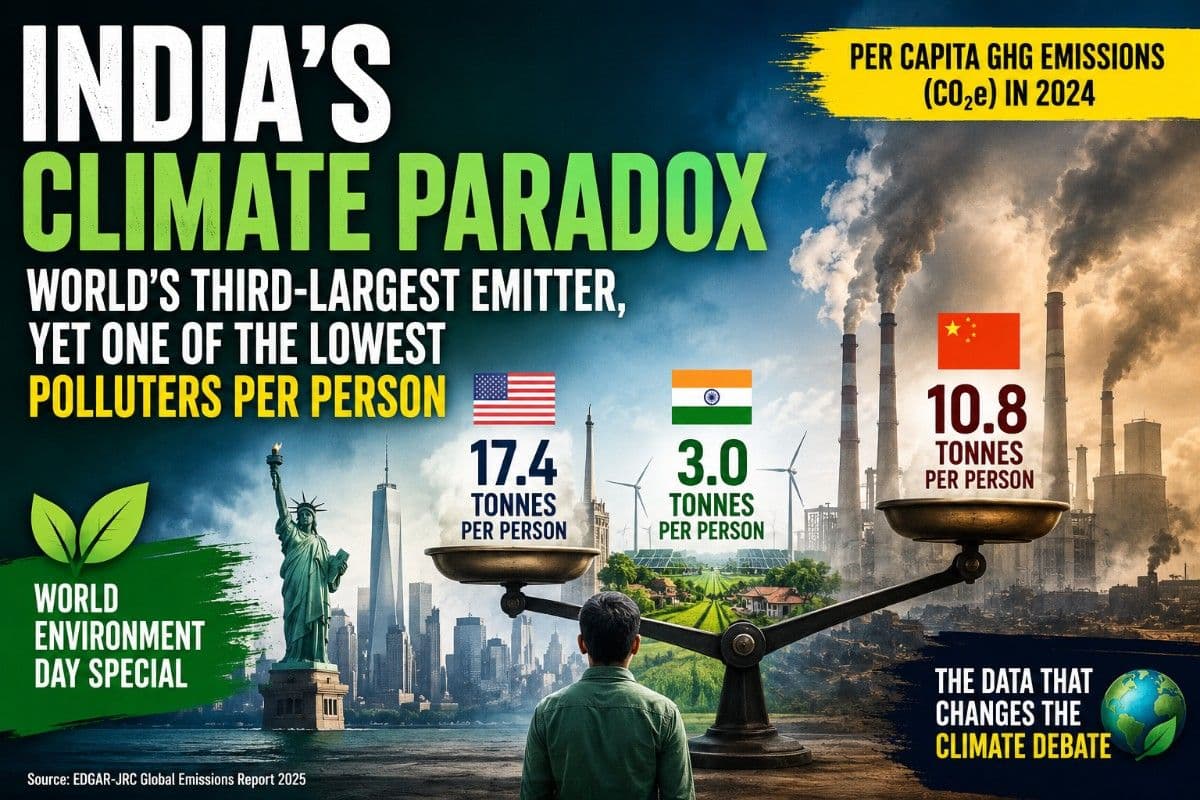
According to the latest "GHG Emissions of All World Countries 2025" report prepared by the European Commission's Joint Research Centre (JRC) and the EDGAR database, India accounted for about 8.2% of global greenhouse gas emissions in 2024, making it the third-largest emitter after China and the United States.
Yet India's per capita emissions stood at just 3.0 tonnes of CO₂ equivalent per person.
Compare that with:
- United States: 17.4 tonnes per person
- China: 10.8 tonnes per person
- European Union: 7.1 tonnes per person
- Russia: 18 tonnes per person
The implication is striking.
An average American emits nearly six times more greenhouse gases than an average Indian, while an average Chinese citizen emits more than three times as much.
Why India Looks Big in Total Emissions
India's ranking is largely a consequence of its population.
With more than 1.4 billion people, even relatively modest emissions per person add up to a large national total. The country's expanding economy, growing manufacturing base, urbanisation, rising electricity demand and increasing transport requirements have naturally pushed overall emissions upward.
The EDGAR
report notes that India's greenhouse gas emissions have nearly tripled since
1990 and increased by 3.9% in 2024 alone.
But unlike developed economies that industrialised over the past two centuries,
India is still navigating the challenge of lifting hundreds of millions of
people to higher living standards while simultaneously pursuing
decarbonisation.
The Development Gap Behind the Emissions Debate
Per capita emissions are often viewed as a measure of fairness in climate negotiations because they reflect the environmental impact of individual lifestyles.
The difference becomes obvious when comparing energy consumption patterns.
A typical American household uses significantly more electricity, owns larger homes, drives more vehicles, flies more frequently and consumes more goods than the average Indian household.
Similarly, China's industrial economy consumes enormous quantities of coal and energy-intensive materials to support its manufacturing dominance.
India, despite being the world's fastest-growing major economy, still has lower levels of vehicle ownership, lower residential energy consumption and lower historical emissions.
This is why India has consistently argued that climate responsibility should be viewed through the lens of equity and "common but differentiated responsibilities" under international climate agreements.
Historical Responsibility Still Matters
Another critical factor is cumulative emissions.
The greenhouse gases driving today's climate crisis accumulated over decades and centuries.
The United States and Europe built their prosperity during periods when environmental restrictions were minimal. Their industries emitted vast quantities of carbon long before climate change became a global concern.
India, by contrast, entered large-scale industrialisation much later.
As a result, its contribution to historical atmospheric carbon concentrations remains substantially lower than that of many developed nations despite its current population size.
This historical context remains a cornerstone of India's position in global climate talks.
The World Environment Day Takeaway
The latest global emissions data tells two stories simultaneously.
The first is that India's total emissions are rising and will continue to attract global scrutiny as the country's economy expands.
The second is that the average Indian remains among the lowest emitters among major economies.
For policymakers gathering at climate summits and for citizens reflecting on World Environment Day, this distinction is crucial.
India may be a large emitter because of its population, but it is not yet a high emitter because of its lifestyle.
That reality explains why the climate debate is increasingly shifting from "Who emits the most?" to a more nuanced question:
Who emits
the most per person, who emitted the most historically, and who should bear the
largest responsibility for fixing the problem?
Also Read: World Environment Day 2026: Odisha in Top-5 Environmental Performer Still Battling Extreme Heat, Dirty Air| Special Feature
Related Topics
Explore more stories