



Why Tiny Seychelles Matters to India in Its Big China Challenge | Special Story
Key Points
* By refitting the Seychelles Coast Guard vessel PS Zoroaster in Kolkata and escorting it back, New Delhi has engineered end-to-end asset co-dependence.
* PM Modi’s landmark "Guardian of the Blue Horizon" distinction recognizes India’s sustainable development alternative over debt-heavy infrastructure models
Bhubaneswar: At first glance, Seychelles appears too geographically modest to command global geopolitical headlines.
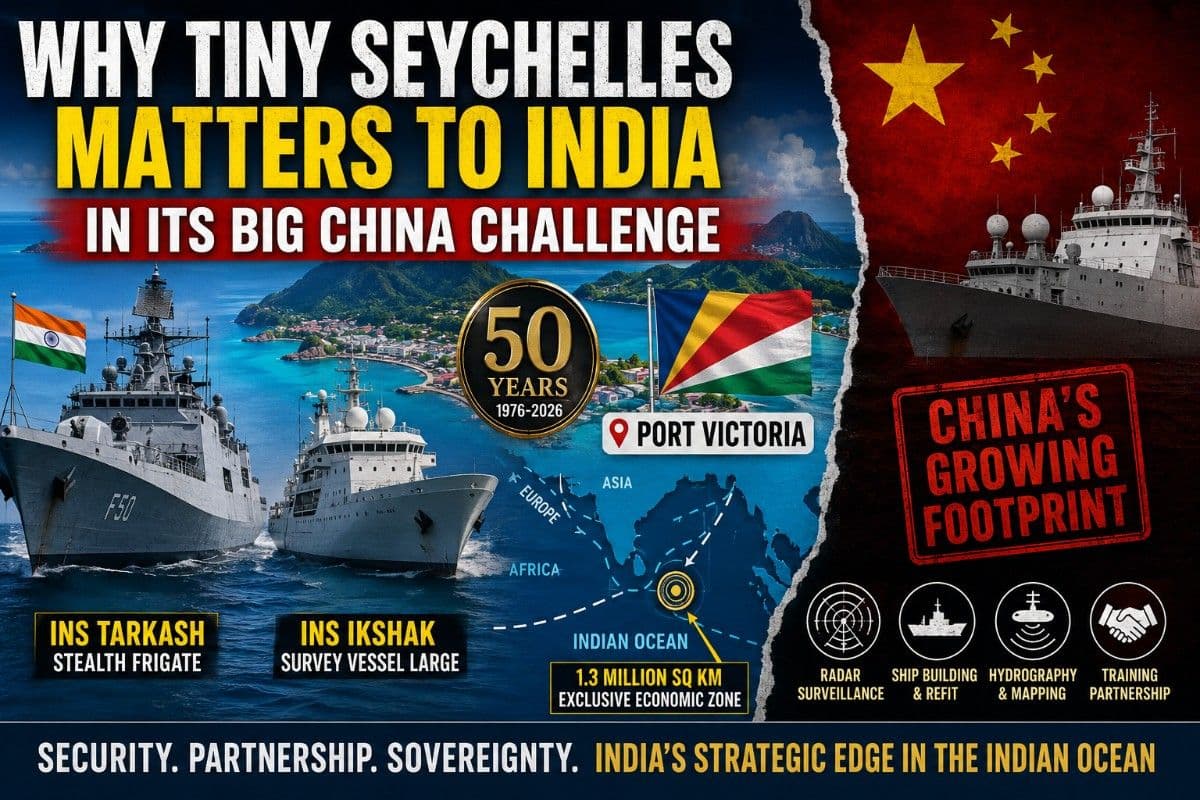
An archipelago of roughly 120,000 people scattered across the Western Indian Ocean, it occupies barely 459 square kilometers of land. Yet, its Exclusive Economic Zone (EEZ) swallows a massive 1.3 million square kilometers of ocean, sitting directly astride some of the world's busiest sea lanes connecting Asia, Africa, and Europe.
That immense maritime geometry explains why India has dispatched a high-profile naval pairing – the guided-missile stealth frigate INS Tarkash and the indigenous Survey Vessel Large INS Ikshak – to Port Victoria for Seychelles' Golden Jubilee Independence Day celebrations on June 29.
The dual deployment is far more than ceremonial diplomacy. It is the latest demonstration of India's long-term strategy to remain the principal security provider in the western Indian Ocean while quietly countering China's steadily expanding maritime footprint.

📱 Get Argus News App
✨The historical symmetry is impossible to miss.
Exactly fifty years ago, when Seychelles attained freedom on June 29, 1976, the Indian naval frigate INS Nilgiri was anchored in Victoria to secure the celebrations. Half a century later, India has returned – not with a single ship, but with a calculated combination representing both surface military deterrence and subsurface scientific dominance.
A Contest Beyond Military Bases
Unlike the Cold War competition for overseas military bases, the India-China contest in Seychelles revolves around something more sophisticated.
It is about who provides security, who maps the oceans, who trains the coast guard, who maintains the ships, who installs surveillance systems and ultimately who becomes indispensable.
For over two decades, New Delhi has meticulously constructed precisely such an ecosystem. Long before China's influence became a subject of international debate, India institutionalised defence cooperation with Seychelles through a Defence Cooperation MoU signed in 2003.
What began as localized capacity building quickly evolved into a fully integrated regional security architecture. India gifted the fast patrol vessel PS Topaz in 2005, followed by a specialized Dornier maritime surveillance aircraft in 2013. These were not isolated diplomatic gestures; they were the opening moves of a generational security lock.
Modi Era Changes the Scale
Prime Minister Narendra Modi's landmark state visit to Seychelles in March 2015 – the first by an Indian Prime Minister in 34 years – fundamentally transformed the scale of engagement. It marked India's structural shift from passive maritime assistance to aggressive defence integration.
The centrepiece of this transition was the Coastal Surveillance Radar System (CSRS). Rather than merely offloading hardware, India constructed a comprehensive radar chain across remote islands, illuminating a massive portion of the Western Indian Ocean transit corridors. New Delhi later backed this with a USD 4.7 million grant specifically to restore, upgrade, and modernize these radar stations, ensures unblinking maritime domain awareness.
For India, this surveillance network is a strategic necessity. For China –whose naval task forces and "dual-use" space-tracking research vessels continuously prowl the region – it strips away operational invisibility.
Hydrography: The Undersea Battlefield
Perhaps the most crucial, yet least understood, dimension of this maritime rivalry lies beneath the waves. This is where the newly arrived INS Ikshak changes the equation.
Unlike heavily armed warships, the indigenous Ikshak acts as a deep-data collector, utilizing multi-beam echo sounders, side-scan sonars, and autonomous underwater vehicles (AUVs) to map the seafloor. This bathymetric data forms the absolute baseline for safe navigation, underwater infrastructure, and, critically, submarine routing corridors.
Strategically, whoever possesses the most accurate charts of the ocean floor dictates subsurface warfare. Chinese scientific research vessels have increasingly blanketed the broader Indian Ocean, collecting data that naval analysts warn is explicitly intended to map acoustic and terrain profiles for People’s Liberation Army Navy (PLAN) attack submarines.
India has systematically moved to pre-empt this vulnerability by establishing itself as Seychelles’ exclusive hydrographic partner. Indian survey ships, including INS Darshak, have executed extensive bathymetric charting around Port Victoria, Praslin, and La Digue over successive deployments. By anchoring Ikshak at the Golden Jubilee, New Delhi reasserts its position as the trusted custodian of Seychelles' underwater domain.
INS Tarkash Projects the Hard Edge
While Ikshak handles deep-sea data diplomacy, INS Tarkash provides the visible kinetic muscle. The Talwar-class stealth frigate is armed with BrahMos supersonic cruise missiles and advanced anti-submarine weapon suites, bringing years of frontline anti-piracy and interdiction experience to the table.
Its presence sends a clear strategic message to extra-regional actors: the Indian Navy retains the capability to project high-end, combat-ready platforms to the South West Indian Ocean at a moment's notice. Alongside the ceremonial marching contingent on the ground, Tarkash is executing joint tactical training capsules with the Seychelles Defence Forces (SDF), striking a fine balance between assuring regional partners and demonstrating credible deterrence.
Controlling the Defense Lifecycle
A subtle but telling operational detail highlights India's deep-rooted institutional strategy. Recently, the Seychelles Coast Guard’s premier fast patrol vessel, PS Zoroaster –originally gifted by India – completed a comprehensive mid-life refit and modernization at Garden Reach Shipbuilders & Engineers (GRSE) in Kolkata. Upon completion, it was INS Tarkash that physically escorted the refurbished vessel back across the ocean to Port Victoria.
This loop demonstrates India's end-to-end control over Seychelles' sovereign naval lifecycle. India builds the platforms, finances them through lines of credit, refits them in Indian shipyards, trains their crews, and escorts them back into active deployment. This closed loop leaves virtually no room for competing foreign defense suppliers.
The Assumption Island Equation
No project better captures the volatile geopolitics of the region than the proposed infrastructure development on Assumption Island, triggered by a bilateral pact during PM Modi’s 2015 visit. While domestic political sensitivities and sovereignty anxieties within Seychelles later forced a recalibration of the project, the strategic intent remained clear.
Rather than chasing an aggressive, overt foreign military outpost, India sought a co-operational access hub within an established bilateral security framework. The intense domestic and international debate surrounding that single island underscored a broader reality: in the current era of great power competition, even the smallest geographic feature in the Indian Ocean has become high-stakes real estate.
'Guardian of the Blue Horizon': Recognizing India's Development Push
New Delhi's strategy deliberately diverges from Beijing’s infrastructure-led, debt-heavy model. Instead of prioritizing massive commercial megastructures, India has focused heavily on high-impact community development and green energy transition.
Seychelles became a founding member of the International Solar Alliance (ISA) under India's guidance. New Delhi has since funded extensive rooftop solar grids on government buildings, a 1 MW ground-mounted solar plant on Romainville Island, and solar-powered cold storage infrastructure on La Digue.
This developmental approach culminated in a major diplomatic victory when Prime Minister Modi was conferred with Seychelles’ unique presidential distinction—the "Guardian of the Blue Horizon"—marking the first time the honor has ever been awarded. The distinction serves as a powerful diplomatic shield, validating India’s focus on climate resilience and small island advocacy while successfully blunting any local narratives of regional hegemony.
The MAHASAGAR Doctrine in Action
The simultaneous presence of INS Tarkash and INS Ikshak represents the operational execution of India's modernized MAHASAGAR (Mutual and Holistic Advancement for Security and Growth Across Regions) doctrine.
An advanced evolution of the original SAGAR framework, MAHASAGAR fuses hard security, hydrographic science, climate adaptation, and economic development into a single, cohesive regional policy. It markets India not merely as an external naval force looking to balance power, but as a holistic, resident maritime partner.
For Seychelles, this yields highly customized security assistance, seabed charting, and sustainable infrastructure. For India, it secures an unshakeable geopolitical anchor at the Western gateway of the Indian Ocean.
The Unspoken Variable
In the official communiqués released out of Victoria and New Delhi, China is almost never mentioned by name. They do not need to be.
Every coastal radar station modernized, every hydrographic chart compiled, every naval hull refitted in Kolkata, and every joint military exercise like LAMITYE systematically shrinks the operational theatre available to competing external powers.
India's
answer to China's "String of Pearls" has not been an aggressive race
to build sovereign foreign bases. Instead, it has been the patient,
institutional weaving of absolute operational and technical co-dependence.
Geographically, Seychelles may be an island nation of tiny proportions – but in
the grand strategy of the Indian Ocean, it remains India’s indispensable
Western anchor.
Also Read: ‘He Looks Like an Angel, But He’s a Killer’: How Trump’s Remark May Be the Biggest Global Endorsement of PM Modi Yet| Analysis
Related Topics
Explore more stories