



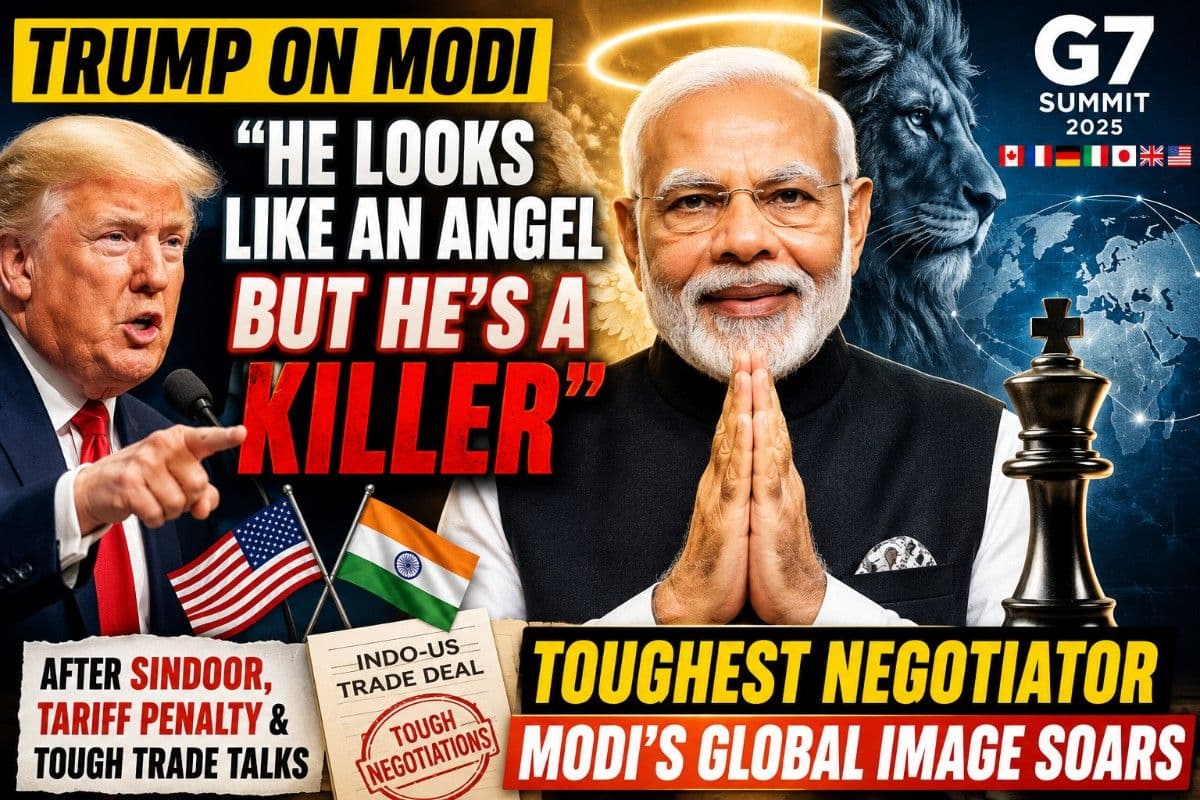
‘He Looks Like an Angel, But He’s a Killer’: How Trump’s Remark May Be the Biggest Global Endorsement of PM Modi Yet| Analysis
Key Points
* The praise comes months after strains over Operation Sindoor, tariff disputes and difficult India-US trade negotiations.
* Trump's comments signal growing recognition of India's strategic autonomy and Modi's rising stature on the world stage.
Bhubaneswar: "He looks like an angel. But actually, he's a killer."
Only Donald Trump could turn a diplomatic compliment into a headline. And only Narendra Modi could receive it with a smile.
At the G7 Summit, the US President's description of the Indian Prime Minister as a calm-faced but ruthless negotiator instantly grabbed global attention.
The remark was humorous, provocative and characteristically Trumpian. Yet beneath the theatrics lay something more significant: a public acknowledgement by the world's most transactional political leader that Modi is among the toughest negotiators he has dealt with.

📱 Get Argus News App
✨Coming after months of visible strain and uncertainty in India-US relations, Trump's "angel versus killer" metaphor may ultimately be remembered as a revealing assessment of how Modi is viewed in the highest circles of global diplomacy.
A Meeting Months in the Making
The Modi-Trump meeting at the G7 was not just another diplomatic photo opportunity.
The two
leaders had not met in person since February 2025 white House meet, a period
during which India-US relations navigated several sensitive moments. Trade
negotiations remained difficult. Discussions around tariffs and market access
generated friction. Political commentators in both countries questioned whether
the chemistry that defined the first Trump-Modi era could be recreated.
Even the recent US navy firing incident at Indian ship killing 3 Indian seafarers at the Starit of Hormuz made the bumpy realtionship nosedive further, with Indian Foreign Ministry summoning US Ambassador in India to lodge strong protest.
Adding to the symbolism also was the backdrop of Operation Sindoor, India's military response following the Pahalgam terror attack, when President Trump for umpteen times claimed that he brokered the Indo-Pak Ceasefire in contrary to Indian govt’s clear stand that Pakistan made a ceasefire request, and as India has accomplished all its military objectives, decided to accept the offer.
When Modi Preferred Odisha Over Trump: A clear Message
During the period of heightened tensions, Modi had sent a message that resonated strongly within India when he chose to prioritise domestic commitments, including a major public programme in Odisha, over an immediate engagement with Trump.
The message was subtle but unmistakable: India would pursue its strategic interests on its own terms.
Against that backdrop, the optics of Trump showering Modi with praise carried greater significance than routine diplomatic courtesies.
The Angel and the Killer
Trump's political language is rarely accidental.
When he called Modi an "angel" who is actually a "killer" in negotiations, he was describing a paradox that many world leaders have privately associated with the Indian Prime Minister for years.
Unlike
leaders who project aggression publicly, Modi's diplomatic style is often
marked by composure, restraint and carefully measured language. Public
confrontations are rare. Personal attacks are even rarer.
PM Modi didn't react to the provocation from US side post Operation Sindoor and during the US-India trade negotiations, even at the face of Congress led Indi Alliance's fierce attack in Parliament.
Yet behind the scenes, India under Modi has increasingly demonstrated a willingness to hold firm against pressure from major powers.
Whether dealing with Russia during the Ukraine conflict, balancing ties between Washington and Moscow, resisting external pressure on energy imports, or defending India's strategic autonomy, Modi has cultivated an image of a leader who listens patiently but ultimately decides independently.
Trump's metaphor captures precisely that contradiction.
The face is calm. The negotiating position is not.
Two Very Different Personalities
The Modi-Trump relationship has always been fascinating because the two leaders appear so different.
Trump is instinctive, outspoken and often confrontational. He dominates headlines through spontaneity.
Modi is disciplined, methodical and highly controlled in his public messaging. His speeches are carefully crafted and his diplomatic moves often unfold over longer timelines.
Yet both leaders share certain political traits.
Both cultivated outsider images despite eventually becoming dominant political figures. Both built direct emotional connections with voters. Both project strong nationalist narratives. And both place enormous emphasis on personal leadership.
Perhaps that explains the mutual respect.
At the G7, Trump jokingly contrasted himself with Modi, saying he was not calm and cool like the Indian Prime Minister. The humour carried an implicit acknowledgement: Modi's strength lies not in volume but in control.
Who Blinks First?
Trade negotiations provide the clearest context for Trump's comments.
India and the United States have spent years trying to bridge differences on tariffs, market access, digital regulations and manufacturing incentives.
Neither side has found it easy.
American administrations across party lines have often complained that India drives a hard bargain. Indian negotiators, meanwhile, have argued that protecting domestic economic interests is non-negotiable.
Trump's praise appears to come from direct experience.
The President has spent decades negotiating business deals and has repeatedly portrayed himself as a master negotiator. For such a leader to publicly describe Modi as one of the toughest negotiators he has encountered is notable.
In diplomatic language, it amounts to an admission that India is no longer approaching negotiations from a position of weakness.
The question "Who blinks first?" remains central to every trade discussion between New Delhi and Washington.
Trump's remarks suggest that Washington understands India is prepared to wait.
A New Global Image for Modi
For much of the last decade, Modi's international image has evolved through several phases.
Initially, he was seen primarily as a transformative domestic leader focused on economic development.
Then came the image of a global statesman who could engage simultaneously with Washington, Moscow, Paris, Tokyo and Gulf capitals.
After India's increasingly assertive foreign policy decisions, a third image began to emerge: Modi as a practitioner of strategic autonomy.
Trump's "angel versus killer" description arguably reinforces this latest version.
The metaphor portrays Modi not merely as a popular leader but as a formidable geopolitical actor capable of defending national interests while maintaining cordial relationships.
In international politics, that combination is rare.
Many leaders are either liked or feared.
Trump's remark suggests Modi may have achieved something more valuable: being respected by competitors while remaining trusted by partners.
More Than a Compliment
Diplomatic praise is often forgotten within days.
Trump's words may endure because they reveal how one of the world's most influential political figures interprets Modi's leadership style.
The compliment was not about charisma, popularity or electoral success.
It was about leverage.
It was about negotiation.
And it was about power exercised without raising one's voice.
For Indians, the "angel versus killer" metaphor for PM Modi will be seen as recognition that India now sits at the global high table with enough confidence to resist pressure from even its closest partners.
For critics, it may simply be another example of Trump's flair for dramatic language.
Either way, the remark has achieved what all memorable political phrases do: it distilled a complex reality into a single unforgettable image.
An angelic face.
A steel spine.
And,
according to Trump, one of the toughest negotiators in world politics.
Also Read: From France 24 to Le Monde: Why French Media Sees Modi as the Most Influential Non-G7 Leader at the Summit| Special Story
Related Topics
Explore more stories