



When NITI Aayog Data Shows India's Youth Advantage Peaks in 2030, Why PM Modi Is Pushing Demographic Dividend at NITI Meet| Special Report
Key Points
* PM Modi urged states to invest in skilling, education and MSMEs to convert demographic strength into economic growth.
* Global labour shortages offer India a historic opportunity—but the demographic window may start narrowing after 2030.
Bhubaneswar: Even as Prime Minister Narendra Modi placed renewed emphasis on India's demographic dividend at the 11th Governing Council meeting of NITI Aayog on Thursday, a recent NITI Aayog report has underscored why the issue has acquired a sense of urgency. The report suggests that India's much-celebrated demographic advantage is approaching its peak and could begin losing momentum after 2030.
Addressing Chief Ministers and Lieutenant Governors, Modi described India's youth population as its "greatest asset," noting that nearly 70 crore Indians are below the age of 25. Calling it a demographic dividend, he urged states to transform it into a "development dividend" through investments in education, skilling and capacity-building.
The Prime Minister also linked India's demographic strength to its growing role in the global economy. Referring to recently concluded trade agreements with several countries, Modi encouraged states to create new opportunities for youth and MSMEs, equip them to benefit from expanding market access, and actively attract investments from partner nations.
NITI Opens Up on Demographic Dividend Window

📱 Get Argus News App
✨The significance of Modi's message becomes clearer when viewed alongside NITI Aayog's latest report, States Framework on International Mobility, which paints a more time-sensitive picture of India's demographic future.
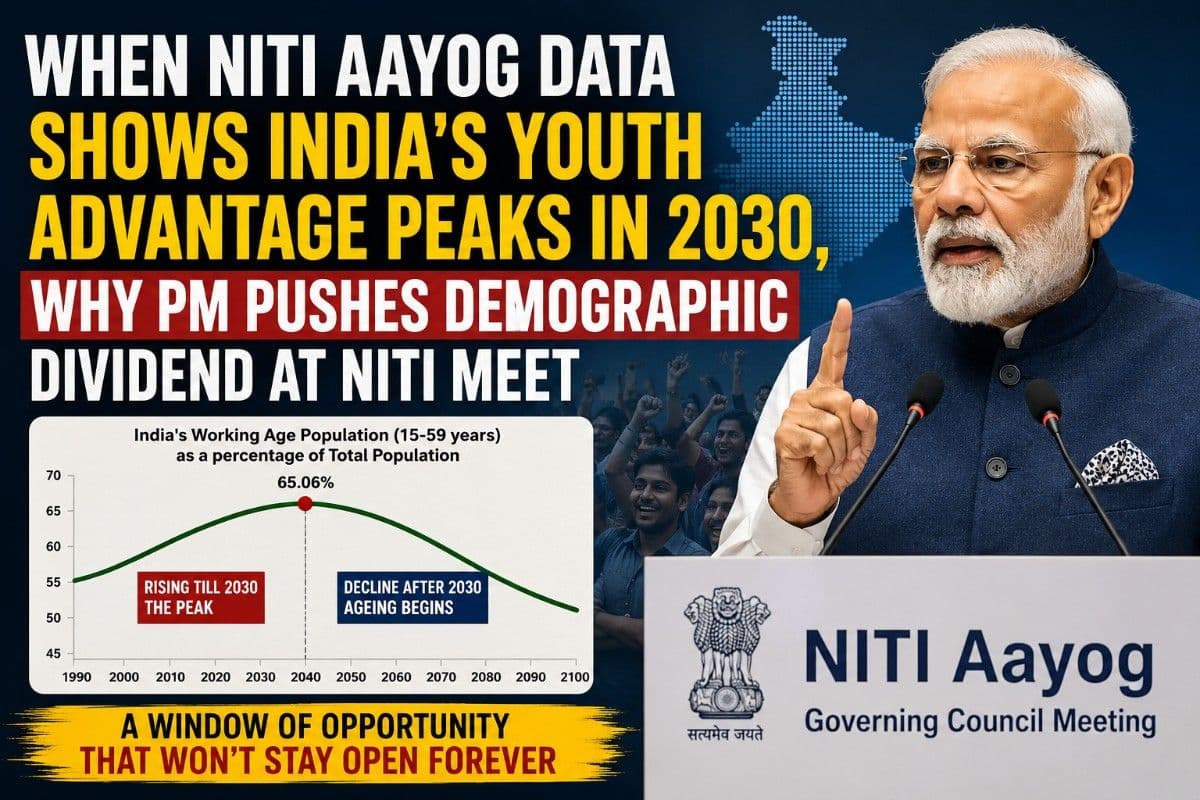
According to the report, India's working-age population (15-59 years) is projected to rise to 65.05 per cent of the total population by 2030 — the highest level in the country's history. Beyond that point, the share begins a gradual but sustained decline as population ageing gathers pace.
The report characterises India's demographic trajectory as a bell-shaped curve. The working-age population share rises steadily from around 55 per cent in 1990 to its projected peak of 65.06 per cent in 2030. Thereafter, the curve turns downward, falling to nearly 60 per cent by the mid-2050s, around 54 per cent by 2070 and close to 50 per cent by the end of the century.
In effect, the next five years may represent the final phase of India's demographic expansion before the country begins transitioning towards an ageing society.
What The Graph Reveals
The graph (displayed on the main image) accompanying the NITI Aayog report delivers three important messages.
First, 2030 is not the beginning of India's demographic dividend but its peak. Much of the political discourse treats the demographic dividend as a long-term structural advantage. The data, however, shows that the country is already approaching the summit of its youth bulge.
Second, while the decline after 2030 is gradual initially, it becomes more pronounced after 2040. India's working-age population share falls from about 65 per cent at its peak to nearly 54 per cent by 2070, steadily reducing the labour-force surplus that has fuelled expectations of long-term growth.
Third, by the end of the century, the working-age population is projected to account for only about 50 per cent of the total population. This implies increasing dependency burdens, with fewer workers supporting a larger elderly population, a challenge already confronting countries such as Japan, Germany and several European economies.
Why The Timing Matters
The demographic clock is ticking even as global labour markets are searching for workers.
The International Labour Organization has reported persistent workforce shortages across healthcare, manufacturing, transportation, construction, retail and information technology sectors in several advanced economies. Simultaneously, the World Economic Forum's Future of Jobs Report highlights growing demand for skills in artificial intelligence, cybersecurity, renewable energy, care services and advanced technologies.
For India, this creates a rare strategic opportunity. The country possesses the world's largest pool of young workers at a time when many developed economies are ageing rapidly and struggling to fill critical jobs.
Urgency Behind Modi's Message
Viewed in this context, Modi's emphasis on education, skilling and human-capital development is more than a developmental agenda. It is a race against a demographic clock.
The challenge before states is no longer merely to create jobs but to ensure that India's youth are equipped with globally relevant skills and can participate in emerging international labour markets. Failure to do so could mean that the demographic dividend peaks without being fully converted into economic gains.
Thursday's
NITI Aayog meeting may therefore be remembered not merely as a discussion on
human capital, but as a reminder that India's most celebrated economic asset
comes with a timeline. If the demographic dividend reaches its high point in
2030, the years leading up to it may determine whether India becomes the
world's workforce capital or misses one of the greatest opportunities in its
modern economic history.
Also Read: As PM Modi Enters Historic Phase, June 11 NITI Meet May Signal India's Shift Towards Human Capital-Led Growth | Exclusive Analysis
Related Topics
Explore more stories