



As PM Modi Enters Historic Phase, June 11 NITI Meet May Signal India's Shift Towards Human Capital-Led Growth | Exclusive Analysis
Key Points
* The four pillars of the meeting reveal the Modi government's emerging roadmap for achieving Viksit Bharat 2047 through people-centric growth.
* Odisha's World Skill Centre and international skilling ecosystem place the state at the centre of India's next development phase.
Bhubaneswar: As Prime Minister Narendra Modi chairs the 11th Governing Council Meeting of NITI Aayog on June 11 – just a day after becoming India's longest-serving Prime Minister – the gathering may offer more than a routine review of development priorities.
It could provide the clearest indication yet of what the next phase of the Modi government's development strategy will look like as India moves toward the Viksit Bharat 2047 goal.
The official agenda itself offers a clue.
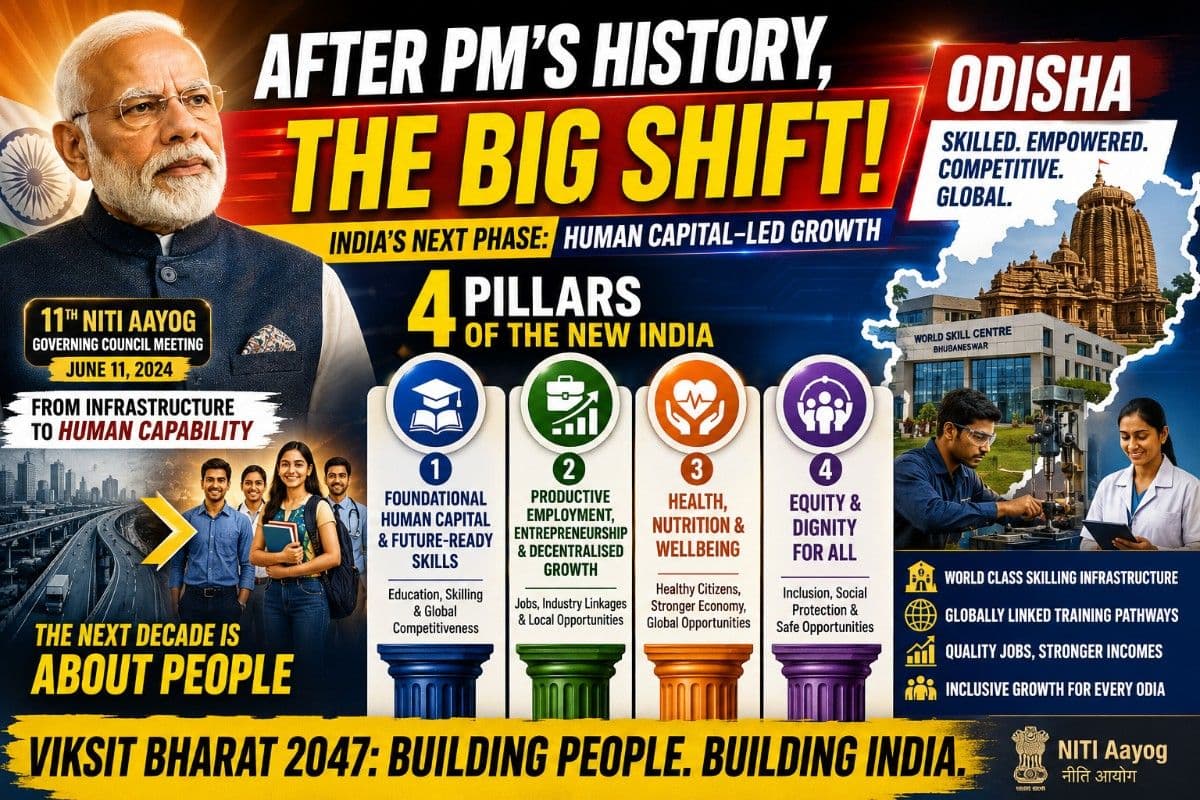
The meeting is anchored around four pillars: 1) Foundational Human Capital and Future-Ready Skills;2) Productive Employment, Entrepreneurship and Decentralised Growth;3) Health, Nutrition and Wellbeing; and 4) Equity and Dignity for All.

📱 Get Argus News App
✨Taken together, the themes suggest a subtle but significant shift in policy emphasis – from building physical infrastructure to building human capability.
From Infrastructure Decade to Human Capital Decade?
Over the past decade, the Modi government has invested heavily in highways, railways, airports, digital infrastructure, sanitation, housing and welfare delivery systems.
Those investments have helped create the foundations of a modern economy.
The next challenge is different.
Can India create enough skilled workers, entrepreneurs, healthcare professionals and productive jobs to sustain high growth over the next two decades?
The June 11 meeting appears designed to address precisely that question.
Recent NITI Aayog policy papers indicate growing concern that India's demographic advantage cannot be taken for granted. While India remains one of the world's youngest major economies, the demographic dividend window is finite. The focus is therefore increasingly shifting toward the quality of human capital rather than merely the size of the workforce.
Why Skills May Dominate Discussions
Among the four pillars, "Foundational Human Capital and Future-Ready Skills" is likely to emerge as a central theme.
A recent NITI framework on international mobility of skilled workers highlights how labour shortages are expanding across major economies, including Europe, the United States, Japan and Gulf countries, particularly in healthcare, engineering, construction, logistics, digital services and care sectors.
The document argues that India's skilling ecosystem must evolve from a domestic employment model to one that prepares workers for opportunities across both Indian and global labour markets.
The larger message is clear: future competitiveness will depend not only on creating jobs but also on creating globally employable talent.
Employment, Not Just Growth
The second pillar – productive employment, entrepreneurship and decentralised growth – may carry equal significance.
India's economy continues to expand, but policymakers increasingly face pressure to ensure that growth translates into quality employment opportunities.
NITI's recent work repeatedly stresses the importance of aligning training systems with actual labour market demand, strengthening industry linkages and improving workforce readiness.
The emphasis appears to be shifting from counting training certificates to measuring employment outcomes.
That transition is likely to feature prominently in discussions involving chief ministers, many of whom are confronting youth employment challenges despite economic growth.
Health as an Economic Asset
The inclusion of health, nutrition and wellbeing as a separate pillar also reflects changing policy thinking.
Traditionally viewed as a social sector issue, healthcare is increasingly being linked to economic productivity and workforce development.
NITI's international mobility framework notes that the world could face a shortage of more than 11 million health workers by 2030, with demand rising sharply across ageing economies.
For India, investments in medical education, nursing, allied healthcare and public health systems therefore serve a dual purpose – improving domestic health outcomes while creating opportunities in global labour markets.
Growth With Dignity
The fourth pillar – equity and dignity for all – may prove equally important.
The Centre's recent policy documents place considerable emphasis on inclusion, worker protections, safe migration pathways and expanding opportunities for vulnerable sections of society.
The underlying argument is that development cannot be measured solely through economic growth rates. The quality of opportunity and access to that opportunity matter equally.
This is particularly relevant for states with large populations of migrant workers, where issues of welfare, skills, income security and social protection remain important policy concerns.
Where Odisha Fits Into the Emerging Narrative
For Odisha Chief Minister Mohan Charan Majhi, the meeting presents an opportunity to position the state within this broader human-capital agenda.
The NITI framework cites multiple state-level models – including Kerala's NORKA system, Odisha's World Skill Centre, Madhya Pradesh's Global Skill Park, and migration-support initiatives in Karnataka, Telangana and Punjab – as examples of how states are responding to evolving workforce demands.
Odisha's inclusion in that list reflects growing recognition of its investments in advanced skilling infrastructure.
The state hosts one of the country's operational Skill India International Centres and has developed internationally linked training pathways through the World Skill Centre in Bhubaneswar.
However, the broader challenge remains.
Like many eastern states, Odisha must move beyond supplying labour to creating higher-value skills that generate better incomes, stronger employment outcomes and larger economic gains for households – to address the pillar numbers 2, 3 and 4
The state's future success will depend not merely on the number of people trained but on the quality of jobs they secure.
The Likely Message From the Prime Minister
If the four pillars are viewed together, a larger narrative emerges.
The Modi government appears to be moving toward a development framework where human capital occupies the same strategic importance that physical infrastructure held during the previous decade.
The message to states is likely to be straightforward:
· Build stronger schools and skills systems.
· Create productive jobs and entrepreneurs.
· Invest in health as a growth multiplier.
· Ensure that development remains inclusive and dignified.
The Net Inference
The June 11 Governing Council meeting is unlikely to produce a single headline-grabbing announcement.
Its significance may instead lie in signalling the direction of policy for the next decade.
A decade that focused on roads, railways, airports, digital platforms and welfare infrastructure may gradually give way to one centred on skills, employability, health, entrepreneurship and human capability.
As India pursues its Viksit Bharat 2047 ambition, the emerging message from NITI Aayog appears increasingly clear: the country's greatest development challenge is no longer merely building infrastructure.
It is building people.
And that may
well become the defining theme of the next phase of India's growth story.
Also Read: Nehru's 62-Year Record Falls: How Antyodaya Made Narendra Modi India's Longest-Serving Prime Minister| Analysis
Related Topics
Explore more stories