



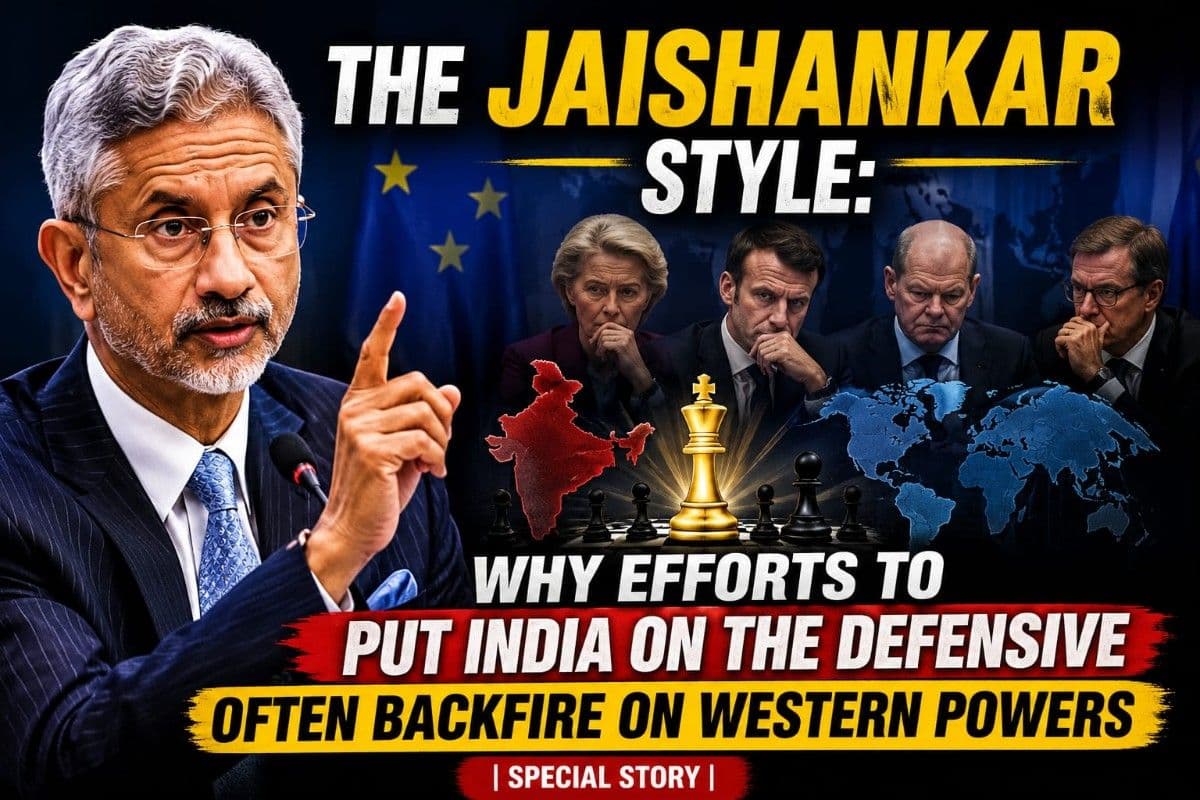
The Jaishankar Style: Why Efforts to Put India on the Defensive Often Backfire Western Powers| Special Story
Key Points
* India's Foreign Minister famously challenged the mindset that Europe's problems are automatically the world's problems.
* His assertive diplomatic style reflects a confident, modern India guided strictly by its own national interests.
Bhubaneswar: Kultaranta was the venue. The hall was packed with top-tier strategists and thinkers from the Europe and the western nations. The atmosphere inside the European forum was charged.
A familiar question was put to India's External Affairs Minister, Dr. S. Jaishankar. Why was India continuing to buy Russian oil while Europe sought to isolate Moscow over the Ukraine conflict?
The expectation was predictable. Many anticipated the standard diplomatic response – cautious, nuanced and carefully worded.
Instead, Jaishankar delivered something entirely different in his inimitable style. He is known as a diplomat who Doesn't Blink.

📱 Get Argus News App
✨Calmly leaning forward, he dismantled the premise of the question itself.
He reminded his audience that international relations are driven not by rhetoric but by national interests.
When Europe reduced its dependence on Russian energy, he argued, it did not reduce consumption. Rather, European nations shifted their buying power to alternative suppliers, particularly in the Middle East, creating intense competition for energy resources that countries like India depended upon.
"You changed your preferences and began competing with us for the same sources of energy," he effectively argued, framing India's actions not as defiance but as a response to market realities.
Then came the sharper intervention.
Addressing straightforward to the Western double standards, Jaishankar pointed out that India had never threatened Europe's security, while Europe often overlooked the historical realities of weapons and strategic decisions that had directly affected India's security interests.
The room fell silent. Many squirmed in the packed hall.
What began as a challenge to India's policy ended as a lesson in geopolitical realism. Within hours, clips of the exchange spread across social media platforms, earning praise from whole of India and foreign neutral observers, who viewed it as another example of India's increasingly confident voice on the global stage.
For seasoned observers, however, it was not an isolated moment. It was classic Jaishankar.
The Rise of India's Most Unscripted Diplomat
Few contemporary diplomats possess a communication style as distinctive as S. Jaishankar.
A career diplomat who spent nearly four decades in the Indian Foreign Service before entering politics, Jaishankar combines deep institutional knowledge with an unusual willingness to challenge established narratives publicly.
Unlike many foreign ministers who rely heavily on diplomatic ambiguity, Jaishankar has developed a reputation for responding directly to loaded questions, often by exposing assumptions hidden within them.
His style is deceptively simple.
Rather than becoming defensive, he reframes the debate.
Instead of answering the question on its own terms, he challenges the premise behind it.
The result is often a dramatic reversal where the questioner finds himself defending assumptions that previously went unchallenged.
This approach has become one of the defining characteristics of India's foreign policy communication in the Modi era.
The Art of Turning the Tables
Jaishankar's style rests on three pillars.
First: Facts Before Emotions
Whether discussing energy security, trade disputes or geopolitical alignments, he rarely allows debates to remain in the realm of moral arguments alone.
He prefers statistics, historical context and strategic realities.
When critics question India's energy purchases, he responds with numbers. When India's neutrality is questioned, he invokes precedents from international history.
The goal is to move discussions from emotion to evidence.
Second: Calling Out Double Standards
Perhaps no theme appears more frequently in Jaishankar's speeches than the issue of inconsistency in global affairs.
He has repeatedly argued that countries which pursued their own interests for decades cannot suddenly expect developing nations to sacrifice theirs without question.
This willingness to confront perceived hypocrisy resonates strongly with audiences across the Global South, where similar frustrations often exist.
Third: Strategic Plain Speaking
Diplomacy traditionally rewards caution.
Jaishankar often rewards clarity.
His answers are rarely confrontational in tone, yet they frequently carry an unmistakable edge. Critics may disagree with his positions, but even they acknowledge his ability to articulate them with precision.
Other Defining Moments
The Europe exchange joins a long list of memorable Jaishankar interventions.
When questioned repeatedly about India's refusal to align fully with Western sanctions against Russia, he famously remarked that Europe needed to move beyond the mindset that Europe's problems are the world's problems, while the world's problems are not Europe's problems.
On another occasion, when asked about India's strategic autonomy, he rejected the notion that countries must choose sides in a multipolar world, arguing that sovereign nations have the right to pursue multiple partnerships simultaneously.
He has also defended India's democratic credentials in Western forums, countering criticism by pointing to India's electoral scale, institutional resilience and vibrant public debate.
Each episode follows a familiar pattern: a challenging question, a calm response and a reversal of the narrative.
Face of a More Assertive India
Jaishankar's popularity extends beyond diplomatic circles because many here see in him a reflection of a changing national self-image.
For decades, India was often perceived as a cautious power, reluctant to push back against major global narratives.
Today's India seeks to project something different – confidence without aggression, independence without isolation and engagement without subordination.
Jaishankar has emerged as one of the most effective communicators of that vision.
His exchanges frequently go viral not merely because they are sharp, but because they symbolize a broader shift in how India sees itself and how it wishes to be seen by the world.
More Than Viral Moments
The latest exchange in Finland may dominate headlines, but reducing Jaishankar to a collection of viral clips misses the larger story.
His significance lies not in the applause lines but in the consistency of the message.
Whether speaking in Washington, Brussels, London or Singapore, he projects the same core principle: India's foreign policy will be guided by Indian interests, not external expectations.
That message may unsettle some audiences.
But it has become the hallmark of a diplomat who has transformed difficult questions into opportunities to redefine the conversation itself.
And in an
increasingly fractured global order, that ability has been one of India's most
valuable diplomatic assets.
Also Read: SIPRI Report: India’s Move Toward a Ready Nuclear Posture Signals a New Strategic Era| Analysis
Related Topics
Explore more stories