



SIPRI Report: India’s Move Toward a Ready Nuclear Posture Signals a New Strategic Era| Analysis
Key Points
* Agni-V MIRV capability and the induction of INS Aridhaman are strengthening India's nuclear triad and second-strike deterrence.
* China's rapid nuclear expansion and evolving regional security dynamics are driving India's strategic modernization efforts.
Bhubaneswar: India's nuclear arsenal has grown only modestly in numerical terms, but the latest assessment by the Stockholm International Peace Research Institute suggests something potentially far more consequential than the addition of warheads.
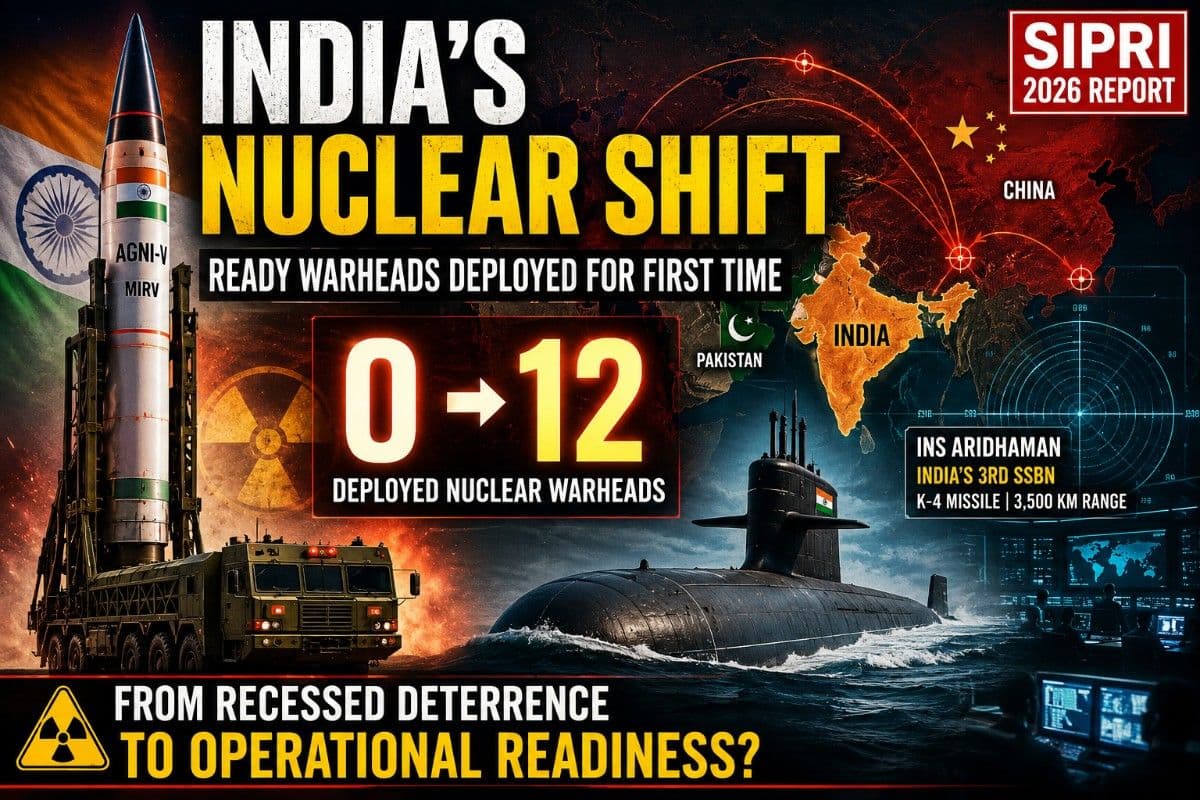
For the first time since becoming a declared nuclear weapons state, India appears to have moved beyond its long-standing peacetime practice of keeping nuclear warheads and delivery systems completely separated. SIPRI's 2026 assessment estimates that India now has 12 deployed nuclear warheads, compared with none in 2025, while its total stockpile has risen from 180 to 190 warheads.
|
Category |
2025 |

📱 Get Argus News App
✨2026
Deployed Warheads
0
12
Stored Warheads
180
178
Total Military Stockpile
180
190
On paper, the increase may appear modest. Strategically, however, it marks one of the most important shifts in India's nuclear posture since the adoption of its doctrine of credible minimum deterrence.
From Recessed Deterrence to Operational Readiness
For decades, India maintained what strategic analysts often described as a "recessed deterrent" posture. Nuclear warheads were believed to be stored separately from missiles and aircraft, reducing the risks of accidental launch while preserving retaliatory capability.
The appearance of deployed warheads indicates that India may now be moving toward a limited ready-force posture, enabling faster response times during crises.
This evolution does not necessarily imply a departure from India's declared No First Use policy. Rather, it reflects the realities of an increasingly volatile security environment in which warning times are shrinking and adversaries are modernizing their own nuclear forces at unprecedented rates.
The shift suggests that New Delhi is seeking to enhance deterrence credibility without abandoning strategic restraint.
The China Challenge Is Driving the Transformation
Behind India's modernization drive lies a strategic reality that increasingly dominates defence planning: China.
According to SIPRI estimates, China now possesses around 620 nuclear warheads and is rapidly expanding its arsenal through large-scale missile silo construction, advanced missile systems and a growing sea-based deterrent.
For Indian planners, the challenge is no longer simply maintaining parity with Pakistan. It is ensuring that India retains a survivable and credible deterrent against a far larger and technologically sophisticated Chinese arsenal.
This explains New Delhi's heavy investment in long-range delivery systems capable of reaching strategic targets deep inside China.
Agni-P and the Move Toward Rapid Deployment
A key development is the maturation of the indigenous Agni missile family.
The Agni-Prime (Agni-P), with a range of approximately 1,000–2,000 kilometres, completed critical operational testing in late 2025. Unlike earlier systems, Agni-P is canisterised and designed for rapid deployment through mobile launchers.
Its architecture significantly reduces launch preparation time and supports the operational flexibility associated with a more responsive nuclear force.
Agni-V and MIRV Capability
India's strategic reach is further strengthened by the Agni-V, whose range exceeds 5,000 kilometres, bringing virtually all of China within reach.
More importantly, India has successfully demonstrated Multiple Independently Targetable Re-entry Vehicle (MIRV) technology on the Agni-V platform.
MIRVs allow a single missile to carry multiple warheads capable of striking separate targets. This capability complicates missile defence calculations and places India among a small group of countries possessing advanced strategic missile technologies.
For Beijing, India's MIRV breakthrough signals a qualitative improvement in deterrent capability rather than a mere quantitative increase in warhead numbers.
Lessons from the 2025 India-Pakistan Crisis
While China remains the primary driver of long-term modernization, Pakistan continues to shape India's operational thinking.
The brief but intense India-Pakistan military confrontation in May 2025 exposed the fragility of traditional deterrence assumptions.
During the conflict, Indian forces reportedly targeted Pakistani air and missile facilities believed to be associated with strategic capabilities. Even if nuclear thresholds were never crossed, the episode demonstrated how quickly conventional operations can approach nuclear red lines.
For decades, South Asian stability rested on the belief that neither side would risk actions against assets linked to nuclear infrastructure.
That assumption now appears considerably weaker.
Strategic planners in New Delhi, Islamabad and Beijing are increasingly confronting a reality in which conventional and nuclear domains can overlap during crises, heightening risks of escalation and miscalculation.
Strengthening the Most Survivable Leg: The Sea-Based Deterrent
Perhaps the most consequential development is unfolding beneath the oceans.
India's nuclear-powered ballistic missile submarine programme, operated under the highly classified Advanced Technology Vessel project, is steadily maturing into a credible sea-based deterrent.
INS Aridhaman Expands India's Nuclear Triad
In April 2026, the Indian Navy quietly inducted INS Aridhaman, the country's third indigenous nuclear-powered ballistic missile submarine.
The vessel joins INS Arihant and INS Arighat, giving India three operational SSBNs for the first time.
Unlike the earlier boats that primarily carried the shorter-range K-15 missile, Aridhaman is configured to deploy the longer-range K-4 submarine-launched ballistic missile with a range of approximately 3,500 kilometres.
The significance is profound.
Sea-based nuclear forces are widely regarded as the most survivable component of any deterrent because submarines can remain hidden and operational even after a surprise attack. A larger SSBN fleet therefore strengthens India's assured second-strike capability—the foundation of credible deterrence.
Still a Long Way from China's Nuclear Scale
Despite these advances, India's modernization should not be mistaken for an arms race aimed at numerical parity.
China's strategic forces remain substantially larger and more sophisticated.
Beijing operates six Type-094 Jin-class ballistic missile submarines and is developing next-generation platforms armed with intercontinental-range JL-series missiles capable of striking targets thousands of kilometres away.
India's three-boat SSBN fleet represents significant progress but remains a fraction of China's undersea deterrent.
This disparity explains why New Delhi is focusing on survivability, mobility and technological sophistication rather than simply increasing warhead numbers.
The Strategic Significance
The most important takeaway from SIPRI's latest assessment is not that India possesses ten additional warheads.
It is that India appears to be transitioning from a purely recessed deterrent toward a more operationally responsive nuclear posture.
The emergence of deployed warheads, the induction of a third ballistic missile submarine, the operationalisation of canisterised Agni systems and the maturation of MIRV technology together point toward a broader strategic shift.
India is preparing for an era in which deterrence must function under conditions of simultaneous pressure from two nuclear-armed adversaries, shrinking decision timelines and rapidly evolving military technologies.
The numbers remain relatively small. The signal, however, is unmistakably large.
New Delhi's
nuclear posture is becoming more ready, more survivable and more sophisticated –
reflecting a strategic environment that is increasingly unforgiving and far
less predictable than the one in which India's original nuclear doctrine was
conceived.
Also Read: Nehru's 62-Year Record Falls: How Antyodaya Made Narendra Modi India's Longest-Serving Prime Minister| Analysis
Related Topics
Explore more stories