



Rs 5.6 Billion Spent, USD 381.8 Billion Received: PM Modi's Foreign Diplomacy Delivers Massive Economic Multiplier, Parliament Data Shows | Exclusive
Key Points
Bhubaneswar: From travel bills to trade deals, India's diplomatic outreach appears to have generated returns far exceeding its operational costs, suggesting that modern foreign visits are increasingly functioning as strategic economic investments rather than ceremonial engagements.
For years, expenditure on Prime Ministerial foreign visits has often triggered political debate. Critics have questioned whether overseas diplomacy justifies the public money spent.
But fresh data tabled in Parliament paints a different picture – one where diplomatic travel is increasingly viewed as a strategic investment aimed at unlocking trade, technology, investment and geopolitical partnerships rather than merely a protocol exercise.
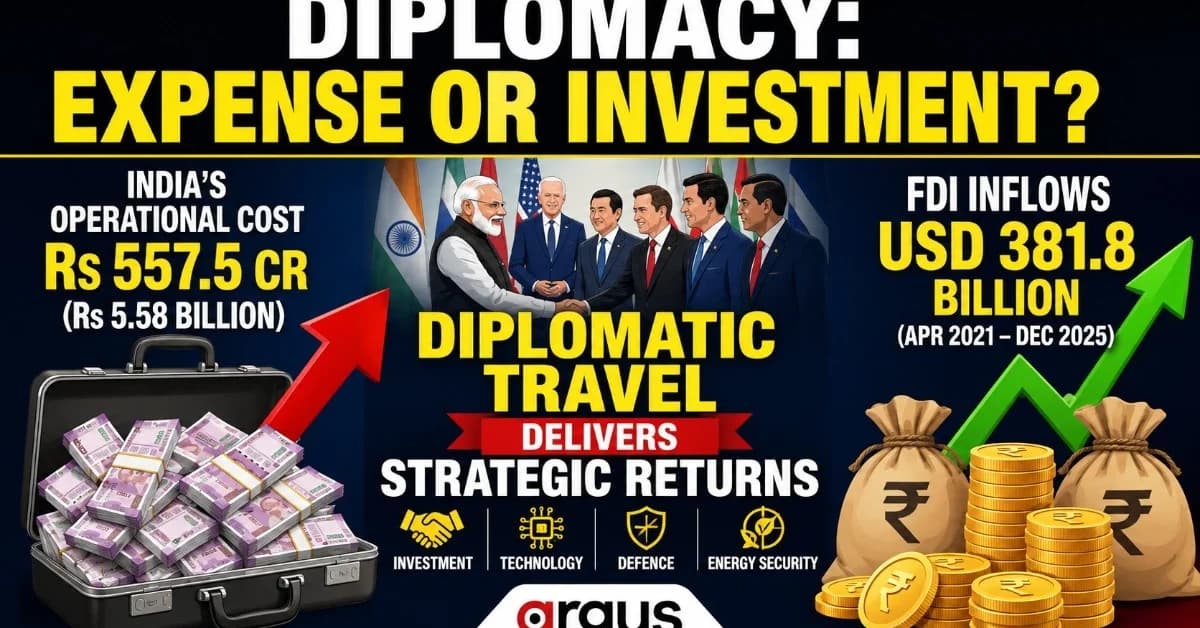
An official reply by the Ministry of External Affairs in the Rajya Sabha on Thursday shows that India spent around Rs 557.51 crore or Rs 5.57 billion on Prime Minister Narendra Modi's foreign visits between 2021 and the ongoing 2026 calendar year (partial), while India received USD 381.8 billion in Foreign Direct Investment (FDI) during April 2021 to December 2025.

📱 Get Argus News App
✨The Ministry states that high-level visits help strengthen partnerships across technology, trade, investment, defence, energy and resilient supply chains, detailing hundreds of agreements concluded during these engagements.
Diplomacy Beyond Optics
In diplomatic practice, overseas visits are no longer assessed merely by the number of meetings held or photographs taken.
Increasingly, they are judged by measurable strategic outcomes – investment commitments, technology partnerships, defence cooperation, digital connectivity, energy security and institutional agreements.
Viewed through this prism, India's recent diplomatic engagements represent what foreign policy analysts often describe as economic diplomacy, where foreign travel serves as an instrument for expanding national economic interests.
One analytical way of understanding this is through a Diplomatic Efficiency Ratio, a conceptual metric comparing the financial outlay on official visits with the scale of economic and strategic outcomes facilitated by those engagements.
Diplomatic Efficiency Ratio
Capital Gained (FDI & Strategic Outcomes)
÷
Capital Spent (Foreign Visit Expenditure)
Using the figures available in Parliament:
- Total expenditure (2021-2026 partial): Rs 557.51 crore
- FDI received (April 2021-December 2025): USD 381.8 billion
The comparison illustrates that the economic inflows associated with India's broader international engagement dwarf the operational expenditure incurred on diplomatic travel.
While the parliamentary reply does not attribute all FDI solely to these visits, it explicitly notes that such engagements strengthen partnerships in investment, technology, trade and other strategic sectors.
Year-wise Spending
|
Year |
Expenditure |
|
2021 |
Rs 36.11 crore |
|
2022 |
Rs 55.83 crore |
|
2023 |
Rs 93.63 crore |
|
2024 |
Rs 109.51 crore |
|
2025 |
Rs 187.83 crore |
|
2026* |
Rs 74.59 crore (partial; some bills pending) |
Total: Rs 557.51 crore (approx., with 2026 figures still provisional for some visits)
The data show a steady increase in expenditure over the years, reflecting not only inflation but also the growing complexity of multi-country tours and larger official delegations.
Why Costs Have Increased
Unlike earlier eras, diplomatic missions increasingly involve multiple countries in a single itinerary.
The MEA data show several examples:
- Five-country European tour (2026)
- Five-country Africa-Latin America tour (2025)
- France-USA dual engagement (2025)
- UAE-Netherlands-Sweden-Norway-Italy circuit (2026)
Such clustered diplomacy naturally increases logistical expenditure but also enables multiple strategic outcomes within a single travel window.
Historic Comparison
The MEA also cited expenditure from earlier Prime Ministerial visits for reference:
|
Historical Visit |
Cost |
|
USA (2011) |
Rs 10.74 crore |
|
France (2011) |
Rs 8.33 crore |
|
Russia (2013) |
Rs 9.96 crore |
|
Germany (2013) |
Rs 6.02 crore |
In contrast, several recent individual visits – including France, the United States, Italy and Norway – l have exceeded these nominal figures, underscoring the expanded scale and ambition of contemporary diplomacy.
Note: The Ministry notes these historical figures (former PM visits) are provided without adjusting for inflation or currency fluctuations.
The Strategic Returns
The Parliament document lists an extensive catalogue of agreements across sectors. Broadly, the outcomes fall into six strategic pillars:
1. Investment & Manufacturing
The diplomatic engagements supported partnerships spanning semiconductors, electronics, critical minerals, advanced manufacturing and industrial collaboration.
Among notable initiatives are semiconductor ecosystem partnerships with countries such as the Netherlands, Singapore and Malaysia, including cooperation involving Tata Electronics and ASML for the Dholera fabrication ecosystem.
2. Digital India Goes Global
India's Digital Public Infrastructure emerged as a recurring theme.
The agreements include expansion or interoperability involving:
- UPI
- NPCI International
- Cross-border remittance systems
- India Stack
- Digital payment connectivity
Countries featuring such cooperation include France, UAE, Israel, Maldives, Cyprus, Seychelles and Guyana, among others.
3. Defence & Strategic Security
Several agreements relate to:
- Defence industrial cooperation
- Maritime security
- Intelligence protection
- Cyber security
- Missile cooperation
- Strategic petroleum reserves
The partnerships span Italy, UAE, Indonesia, France and other strategic partners.
4. Energy Security
Energy diplomacy features prominently through:
- Strategic petroleum reserves
- LNG supply
- Renewable energy
- Nuclear cooperation
- Critical minerals
- India-Middle East-Europe Economic Corridor (IMEC)
These initiatives aim to diversify energy sources and improve supply-chain resilience.
5. Technology Diplomacy
Several MoUs focus on emerging technologies:
- Artificial Intelligence
- Semiconductors
- Quantum communications
- Space cooperation
- Digital sciences
- Research collaboration
The emphasis reflects India's push to position itself as both a technology partner and a destination for high-value investment.
6. Healthcare & Human Development
The agreements also cover:
- Generic medicines
- Health research
- Medical regulation
- Janaushadhi cooperation
- Biosafety laboratories
- Health data collaboration
This reflects an expanding use of health cooperation as an instrument of foreign policy.
France and UAE: India's Most Active Strategic Partners
A reading of the Parliament Data suggests that France and the United Arab Emirates emerge as among India's most frequently engaged partners during the period.
Their cooperation spans defence, AI, semiconductors, energy, fintech, digital payments, space, railways, startups, critical minerals and trade facilitation, illustrating the broadening agenda of India's bilateral diplomacy.
Reading the 'Efficiency Ratio'
The Diplomatic Efficiency Ratio is best understood as an analytical framework, not an official government index. It compares the scale of quantifiable economic and strategic outcomes with the relatively modest operational cost of conducting high-level diplomacy.
By this measure, the expenditure on official visits represents a small financial outlay relative to the scale of partnerships, investment flows and strategic agreements that India has secured during the same period.
The Bottom Line
The parliamentary data suggest that India's foreign policy has increasingly shifted from ceremonial diplomacy to transaction-oriented strategic engagement.
Today's state visits are designed not only to deepen political ties but also to attract capital, secure technology, diversify energy sources, strengthen defence cooperation and expand India's digital ecosystem overseas.
Measured purely in terms of expenditure, foreign travel may appear expensive.
Measured against the broader architecture of economic partnerships, strategic agreements and sustained foreign investment highlighted in the MEA's reply, the operational costs constitute only a small fraction of the potential economic and geopolitical dividends.
That
distinction is at the heart of the debate over the efficiency of contemporary
diplomatic outreach.
Also Read: How PM Modi's New Zealand Pacts Could Transform Odisha's Coast from Paradip to Puri with Technology India Doesn't Yet Have| Exclusive
Related Topics
Explore more stories