



RBI Monetary Policy / India GDP Surges 7.7% in FY 26, RBI Holds Rates: What Does It Mean for Your EMI, FDs, Fuel Bill and Daily Expenses?| EXPLAINER
Key Points
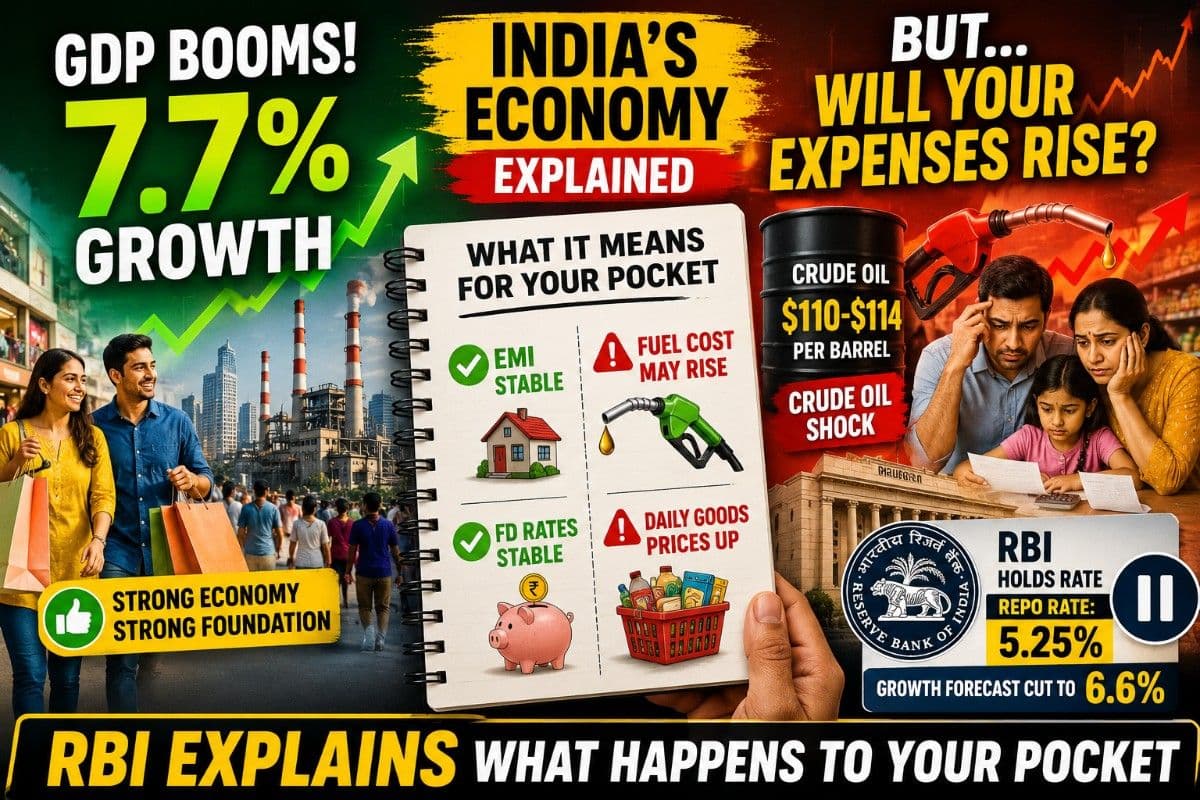
* RBI kept the repo rate unchanged at 5.25%, ensuring no immediate increase in home loan and car loan EMIs.
* Rising crude oil prices and global geopolitical tensions could put upward pressure on fuel, transport and everyday commodity prices.
Bhubaneswar: India has just delivered one of its strongest economic performances in recent years. The economy grew by 7.7% in 2025-26, faster than previously estimated, according to the latest GDP data.
But at the same time, the Reserve Bank of India (RBI) is warning that the road ahead may not be as smooth.
A prolonged conflict in West Asia, rising crude oil prices and concerns over rainfall have prompted the central bank to lower its growth outlook for the current financial year to 6.6%, while keeping interest rates unchanged.
For most Indians, the obvious question is: What do these numbers actually mean for my household budget, business and loans?

📱 Get Argus News App
✨First, Why Is 7.7% GDP Growth Being Celebrated?
Think of GDP as the country's income report card.
A growth rate of 7.7% means businesses produced more goods and services, consumers spent more money and investments remained strong.
The impact was visible on the ground:
- More people bought cars, bikes and smartphones.
- Shopping and consumer spending remained strong.
- Factories increased production.
- Transport, trade and financial services expanded rapidly.
- Urban job markets remained relatively stable.
In simple terms, 2025-26 was a year when India's economic engine ran at full speed.
So Why Is RBI Suddenly Becoming Cautious?
Because the biggest risks are now coming from outside India.
The conflict in West Asia has disrupted major shipping routes and pushed global crude oil prices sharply higher.
India imports nearly 85% of its crude oil requirement. When global oil prices rise, the impact eventually reaches Indian households.
The chain reaction usually looks like this:
Higher crude oil prices leads to Higher transport costs to Higher manufacturing costs to Higher prices in shops
This means everything from vegetables and packaged food to consumer goods could become costlier if elevated oil prices persist.
What Could Become More Expensive?
The impact may not be immediate, but economists expect pressure on:
- Transport and logistics costs
- Packaged food products
- Consumer goods
- Industrial products
- Air travel and freight services
Businesses facing higher fuel and raw material costs often pass a part of those expenses to consumers.
Why Did RBI Keep Interest Rates Unchanged?
The RBI's Monetary Policy Committee decided to keep the Repo Rate at 5.25%.
The Repo Rate is the interest rate at which banks borrow money from the RBI. It influences the rates banks charge customers on loans.
By keeping rates unchanged, the RBI is trying to strike a balance:
- Support economic growth.
- Prevent inflation from rising too fast.
What Does This Mean for Home Loan Borrowers?
For people with floating-rate loans, the biggest takeaway is simple:
Your EMI is unlikely to increase immediately.
Since the RBI did not raise rates:
- Home loan EMIs should remain stable.
- Car loan rates are likely to stay where they are.
- Personal loan borrowers may not see major changes.
However, those hoping for cheaper EMIs will have to wait longer because the RBI has also not cut rates.
What About Fixed Deposits?
For savers, the decision is largely positive.
Since interest rates remain unchanged:
- FD rates are expected to remain broadly stable.
- Senior citizens can continue to enjoy current deposit rates.
- Banks are unlikely to make major reductions in deposit returns immediately.
Why Did RBI Cut the Growth Forecast?
The central bank now expects India's economy to grow by 6.6% in 2026-27, down from last year's 7.7%.
That does not mean the economy is heading for trouble.
Instead, RBI believes three major risks could slow growth:
1. Costlier crude oil imports.
2. Global geopolitical uncertainty.
3. Weather-related disruptions, including concerns over rainfall and agriculture.
Even at 6.6%, India would remain among the world's fastest-growing major economies.
Should Ordinary Indians Be Worried?
Not immediately.
The RBI's message is not that a crisis is coming. Rather, it is preparing the economy for a more uncertain global environment.
One major comfort factor is India's foreign exchange reserve stockpile of about $682 billion. These reserves act like an emergency savings account for the country and help protect the rupee from excessive volatility during global shocks.
The Bottom Line
The latest GDP figures show India entered 2026-27 from a position of strength after a robust 7.7% growth year.
But rising oil prices, global conflicts and weather uncertainties are creating fresh risks.
For households, the immediate takeaway is straightforward:
· Your home loan EMI is likely to stay unchanged for now.
· Fixed deposit returns should remain stable.
· Fuel and transport costs need close monitoring.
· Prices of some everyday goods could face upward pressure if global oil prices remain elevated.
In short,
India is still growing fast, but the RBI has decided that this is the time for
caution.
Also Read: Inflation Early Warning System / Will Your Monthly Budget Change? What India’s Shift from WPI to PPI Means for Everyday Consumers
Related Topics
Explore more stories