



Election Results / Not Just Rejection, But a Tectonic Shift: Inside Tamil Nadu’s ‘Vijay’ Moment
·5 months ago·4 min read
Key Points
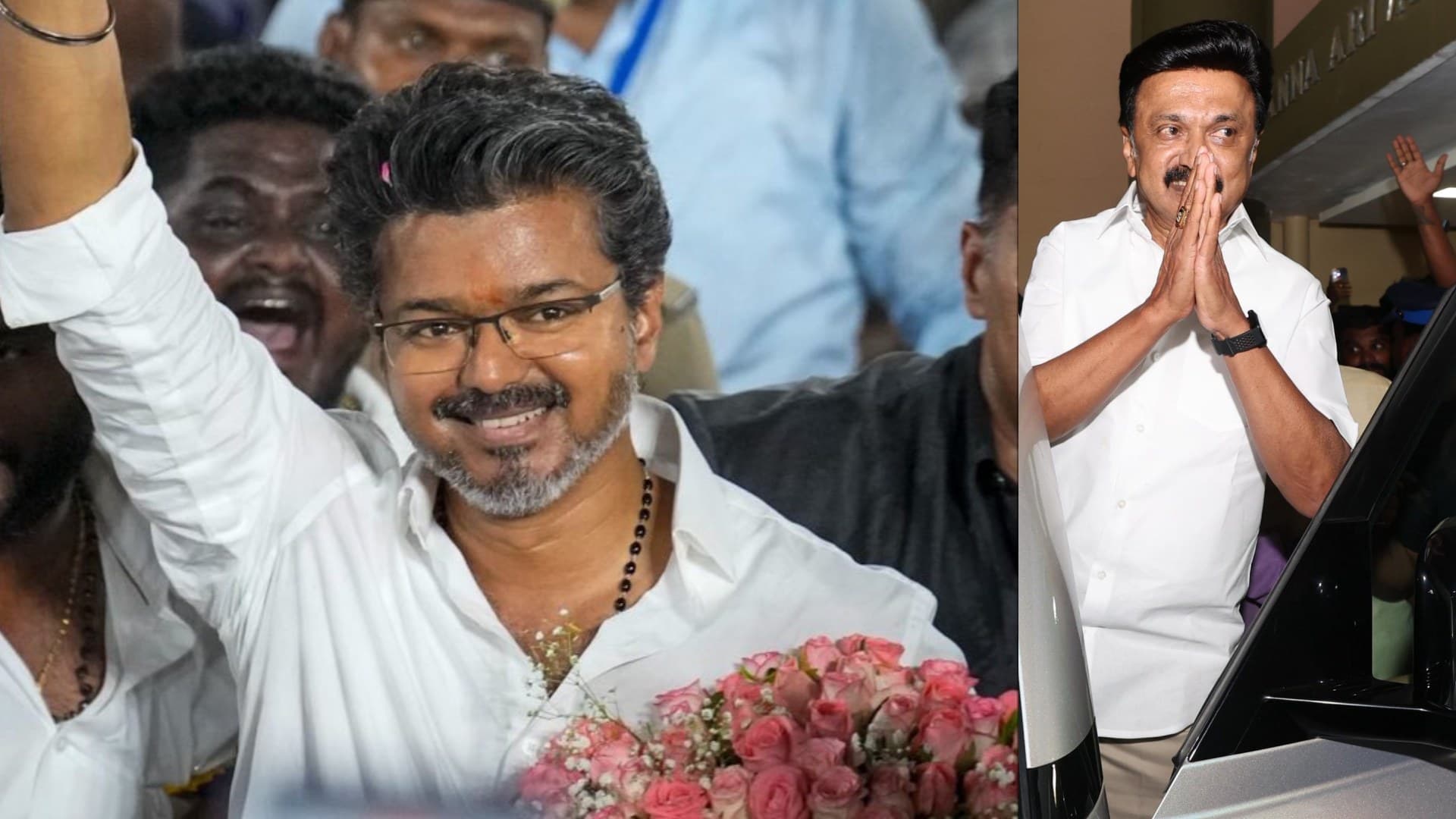
TVK chief Vijay's party secured 108 seats in Tamil Nadu, fracturing the Dravidian duopoly as DMK (59) and AIADMK (47) trailed.
Chennai, May 5: In a coastal state like Tamil Nadu, cyclones build when vacuums appear due to a dip in air pressure. Yesterday's verdict carries a similar signal — a political vacuum had formed, and TVK's storm moved in with force.
As results firmed up through Monday, quiet but steady activity built up around TVK chief Vijay’s Panayur residence. At 108 seats, the Tamilaga Vettri Kazhagam (TVK) remains just short of the halfway mark. Yet, with the Dravida Munnetra Kazhagam (DMK) and the All India Anna Dravida Munnetra Kazhagam (AIADMK) winning 59 and 47 seats respectively, the message is clear -- the ground beneath Tamil Nadu’s long-standing political order has shifted.
This is not just an electoral performance. It signals that, for a section of voters, who you are may now matter as much as what you stand for -- a pattern seen earlier with the Aam Aadmi Party and the All India Trinamool Congress, which carved political space beyond rigid ideological moulds.
Why Dravidian Duopoly Failed?
For the first time in decades, Tamil Nadu’s two dominant Dravidian parties have faced not just a setback, but something quieter -- a shift in voter behaviour.
As results firmed up through Monday, quiet but steady activity built up around TVK chief Vijay’s Panayur residence. At 108 seats, the Tamilaga Vettri Kazhagam (TVK) remains just short of the halfway mark. Yet, with the Dravida Munnetra Kazhagam (DMK) and the All India Anna Dravida Munnetra Kazhagam (AIADMK) winning 59 and 47 seats respectively, the message is clear -- the ground beneath Tamil Nadu’s long-standing political order has shifted.
This is not just an electoral performance. It signals that, for a section of voters, who you are may now matter as much as what you stand for -- a pattern seen earlier with the Aam Aadmi Party and the All India Trinamool Congress, which carved political space beyond rigid ideological moulds.
Why Dravidian Duopoly Failed?
For the first time in decades, Tamil Nadu’s two dominant Dravidian parties have faced not just a setback, but something quieter -- a shift in voter behaviour.

📱 Get Argus News App
✨📰 60 Word News🎬 Argus Podcast📺 Live TV and Breaking News🔔 Free Notification Alerts
Download Free:
This was not marked by loud anti-incumbency or visible rejection during campaigning. Instead, it surfaced in patterns across regions and demographics, particularly in urban belts.
For some voters, the DMK appeared too entrenched -- a party of governance, but also of consolidation. For others, the AIADMK was still regaining organisational confidence after the passing of J Jayalalithaa.
The result is not a rejection of Dravidian politics itself, but of its present custodians. In that space, Vijay’s entry found traction.
To understand how Vijay's popularity as a film star translated into votes, one has to look at the life he built before 2026.
How Did Vijay Turn The Tides In Just Two Years?
For years, C Joseph Vijay was a political “what if”. This verdict has ended that ambiguity.
First things first. Vijay is not MG Ramachandran. MGR emerged from within the Dravidian movement before branching out. Vijay, by contrast, entered without that ideological scaffolding.
For some voters, the DMK appeared too entrenched -- a party of governance, but also of consolidation. For others, the AIADMK was still regaining organisational confidence after the passing of J Jayalalithaa.
The result is not a rejection of Dravidian politics itself, but of its present custodians. In that space, Vijay’s entry found traction.
To understand how Vijay's popularity as a film star translated into votes, one has to look at the life he built before 2026.
How Did Vijay Turn The Tides In Just Two Years?
For years, C Joseph Vijay was a political “what if”. This verdict has ended that ambiguity.
First things first. Vijay is not MG Ramachandran. MGR emerged from within the Dravidian movement before branching out. Vijay, by contrast, entered without that ideological scaffolding.
Parallel to his film career, Vijay had been building a steady public connect through 'Vijay Makkal Iyakkam', carrying out welfare activities across Tamil Nadu. When he formally launched the Tamilaga Vettri Kazhagam (TVK) in 2024, the transition appeared less abrupt than it seemed. His announcement that 'Jana Nayagan' would be his final film further underlined that shift.
His campaign, however, broke convention. By most accounts, he spent barely 13-14 days in major on-ground campaigning outside Chennai, avoiding the exhaustive, district-by-district outreach typical of Tamil Nadu elections. What appeared as absence to critics translated into a kind of calibrated visibility for supporters — seen just enough, withheld just enough.
Also Read: TN Polls Stunned: TVK Candidate Triumphs in Tiruppattur, Wins Tamil Nadu Polls Seat by Just One Vote
How Vijay Became 'Thalapathy'?
Born on June 22, 1974, C Joseph Vijay began as a child artist in 'Vetri' (1984), debuting as a lead in 'Naalaiya Theerpu' (1992) without success. Early films kept him afloat until 'Poove Unakkaga' (1996) changed his trajectory. With 'Kadhalukku Mariyadhai', 'Ghilli' and 'Pokkiri', he rose to mass stardom, later sustaining it through 'Thuppakki', 'Mersal' and 'Leo', turning “Thalapathy” into enduring recall.
Long before he asked for votes, Vijay had built familiarity — not through political messaging, but through repeated cultural presence. This election result suggests that, for many, that familiarity was enough to convert into political trust.
Chennai Verdict Summarises Polls
If one geography captures the scale of disruption, it is Chennai.
In 2021, the DMK swept all 16 seats in the city. This time, that dominance has fractured. The TVK has secured most of Chennai, leaving the DMK with only a handful of constituencies, such as Chepauk and Harbour.
Seats like Anna Nagar, T Nagar, Villivakkam and Velachery -- once predictable -- turned into competitive battlegrounds.
Urban voters, particularly younger and aspirational groups, appear to have driven this shift. Vijay’s appeal cut across segments that do not always move together, such as the first-time voters, sections of women, floating urban voters, and even a section of older electors.
This was less a mandate for a detailed manifesto and more a vote shaped by possibility. Tamil Nadu has not abandoned its political memory, but it has shown a willingness to look beyond its familiar script.
His campaign, however, broke convention. By most accounts, he spent barely 13-14 days in major on-ground campaigning outside Chennai, avoiding the exhaustive, district-by-district outreach typical of Tamil Nadu elections. What appeared as absence to critics translated into a kind of calibrated visibility for supporters — seen just enough, withheld just enough.
Also Read: TN Polls Stunned: TVK Candidate Triumphs in Tiruppattur, Wins Tamil Nadu Polls Seat by Just One Vote
How Vijay Became 'Thalapathy'?
Born on June 22, 1974, C Joseph Vijay began as a child artist in 'Vetri' (1984), debuting as a lead in 'Naalaiya Theerpu' (1992) without success. Early films kept him afloat until 'Poove Unakkaga' (1996) changed his trajectory. With 'Kadhalukku Mariyadhai', 'Ghilli' and 'Pokkiri', he rose to mass stardom, later sustaining it through 'Thuppakki', 'Mersal' and 'Leo', turning “Thalapathy” into enduring recall.
Long before he asked for votes, Vijay had built familiarity — not through political messaging, but through repeated cultural presence. This election result suggests that, for many, that familiarity was enough to convert into political trust.
Chennai Verdict Summarises Polls
If one geography captures the scale of disruption, it is Chennai.
In 2021, the DMK swept all 16 seats in the city. This time, that dominance has fractured. The TVK has secured most of Chennai, leaving the DMK with only a handful of constituencies, such as Chepauk and Harbour.
Seats like Anna Nagar, T Nagar, Villivakkam and Velachery -- once predictable -- turned into competitive battlegrounds.
Urban voters, particularly younger and aspirational groups, appear to have driven this shift. Vijay’s appeal cut across segments that do not always move together, such as the first-time voters, sections of women, floating urban voters, and even a section of older electors.
This was less a mandate for a detailed manifesto and more a vote shaped by possibility. Tamil Nadu has not abandoned its political memory, but it has shown a willingness to look beyond its familiar script.
Related Topics
Explore more stories