



104 Attacks on Indians Abroad: Is the Trump Factor Behind the US Surge, Why UAE Ranks 2nd?| Special Report
Key Points
Bhubaneswar: For Indians living, working or studying abroad, the geography of risk appears to be changing.
Data presented by the Ministry of External Affairs (MEA) in Parliament shows that reported attacks involving Indian nationals have risen sharply in some of the countries with the largest Indian diasporas, even as incidents have fallen dramatically in others.
The United States emerges as the biggest concern.
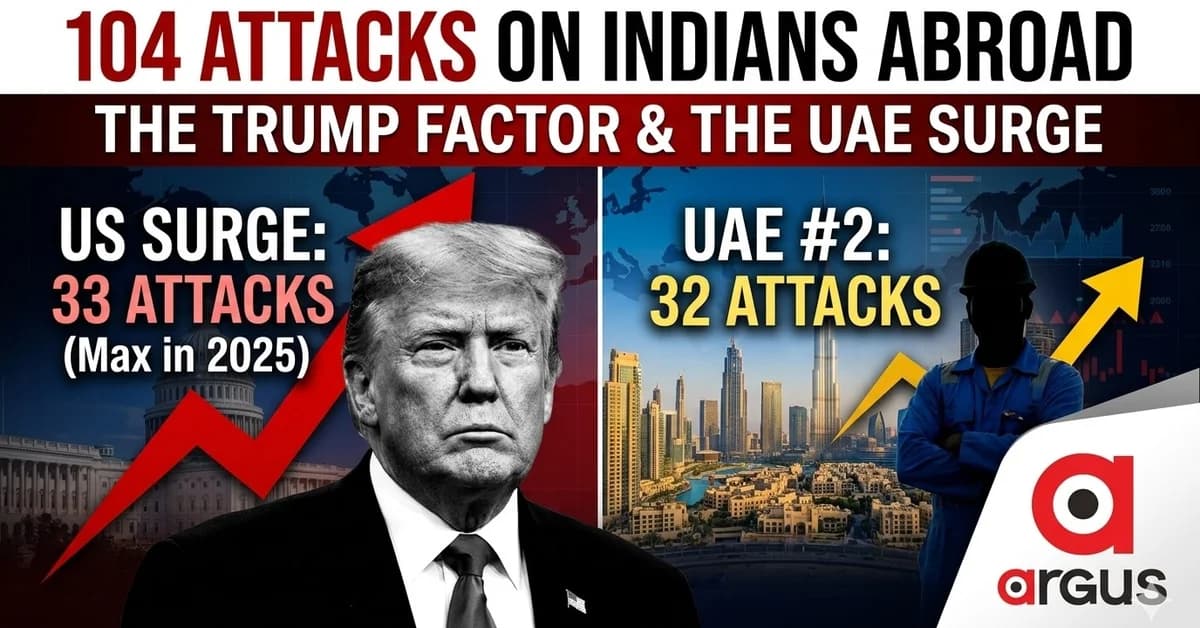
Between 2021 and 2025, the US recorded 33 reported attacks on Indians, the highest cumulative figure among countries listed by the MEA. The UAE followed closely with 32, while the UK recorded 31, Canada 30 and Ireland 24.

📱 Get Argus News App
✨But the more revealing number is the trajectory.
In the US, reported incidents jumped from just one in 2021 to 14 in 2025. The UAE too witnessed a sharp rise, reaching 12 cases in 2025. Germany, in contrast, dropped from 12 incidents in 2024 to just four in 2025.
So what is driving the divergence?
Is there a Trump factor behind the US rise?
The timing is difficult to ignore, although the MEA data by itself does not establish a direct causal link between the Trump administration and individual attacks.
Donald Trump's return to the White House in January 2025 brought immigration back to the centre of America's political discourse. Importantly for the Indian community, the debate has increasingly extended beyond illegal immigration to legal, skills-based migration – particularly the H-1B system through which thousands of Indian professionals enter the US workforce.
That has created a combustible political environment.
Indian technology workers, once widely associated with the American technology boom, are increasingly caught in arguments over jobs, wages and outsourcing. Online narratives portraying foreign professionals as "job stealers" have provided a ready-made target for anti-immigrant and far-right rhetoric.
The problem is that political rhetoric does not remain confined to Washington or social media.
When an immigrant community is repeatedly portrayed as an economic or cultural threat, that hostility can translate into street-level harassment, racial abuse, vandalism and, in extreme cases, physical violence.
The Indian-American community's growing economic visibility may also paradoxically have made it more conspicuous. Indians are among America's most economically successful immigrant groups. That success, amid layoffs and anxiety over employment, can feed resentment in sections of society.
There is therefore a plausible Trump-era political climate effect – but it would be misleading to describe every attack in the MEA database as a direct consequence of Trump's policies.
Why is UAE No. 2?
The UAE presents an entirely different story.
With 32 incidents between 2021 and 2025, the country is almost level with the US despite having a very different political and migration environment.
The explanation lies partly in the composition of the Indian diaspora.
A large proportion of Indians in the Gulf work in blue-collar, low-skilled or semi-skilled occupations. Many live on temporary employment arrangements and remain dependent on employers for visas, documentation and continued employment.
That creates a different form of vulnerability.
Documentation problems, visa compliance, workplace disputes, recruitment scams and disputes with employers can quickly turn into serious difficulties for migrant workers. In a tightly regulated environment with extensive identity and immigration monitoring, workers who fall outside the legal framework can find themselves with limited room to manoeuvre.
Thus, while an Indian professional in America may face racial or political hostility, a vulnerable worker in the UAE may face a combination of employment insecurity, legal vulnerability and workplace-related risks.
The high number of incidents should therefore not automatically be interpreted as evidence of widespread anti-Indian violence in the UAE. The nature of the incidents matters as much as their number.
Germany's 2024 spike hides an important clue
Germany provides perhaps the clearest warning against reading the numbers without context.
The country recorded 12 incidents in 2024, placing it among the highest that year. But the figure collapsed to four in 2025.
A major reason is the December 20, 2024 Magdeburg Christmas-market attack, in which an Indian group was among those affected and seven Indian nationals were injured. A single mass-casualty incident can significantly alter a relatively small annual dataset when incidents are counted by victims.
That makes Germany's 2024 figure an outlier rather than necessarily evidence of a sustained deterioration in the safety of Indians.
The 2025 fall consequently shows why annual comparisons need to be treated cautiously.
The bigger warning hidden in the numbers
The five-year ranking is striking:
|
Rank |
Country |
Attacks, 2021–25 |
Peak year |
|
1 |
US |
33 |
2025 — 14 |
|
2 |
UAE |
32 |
2025 — 12 |
|
3 |
UK |
31 |
2023 — 11 |
|
4 |
Canada |
30 |
2025 — 8 |
|
5 |
Ireland |
24 |
2025 — 10 |
|
6 |
Russia |
23 |
2023 — 12 |
|
7 |
Germany |
19 |
2024 — 12 |
|
8 |
Philippines |
13 |
2023 & 2025 — 5 |
|
9 |
Mali |
11 |
2025 — 11 |
|
10 |
Malaysia |
10 |
2025 — 4 |
One pattern stands out: 2025 produced sharp increases or peaks in several countries simultaneously.
That suggests Indians abroad are facing multiple, country-specific vulnerabilities rather than one universal phenomenon.
In the US, the concern increasingly intersects with immigration politics and racial hostility. In the Gulf, it is more closely connected to migrant-worker vulnerability and enforcement. In Europe, isolated mass-casualty events can dramatically distort annual numbers.
For Indian families, students and professionals abroad, the lesson is therefore more nuanced than simply asking which country is "unsafe".
The real question is: what kind of vulnerability does an Indian face in that particular country?
And in
America's case, the sharp jump from one reported incident in 2021 to 14 in
2025 makes the question of whether an increasingly polarised immigration
debate is spilling over into the everyday lives of Indian Americans impossible
to ignore.
Also Read: Odisha Ranks 5th in India in Child Adoptions: What Is Driving the State’s High Numbers?
Related Topics
Explore more stories