



Odisha Ranks 5th in India in Child Adoptions: What Is Driving the State’s High Numbers?
Key Points
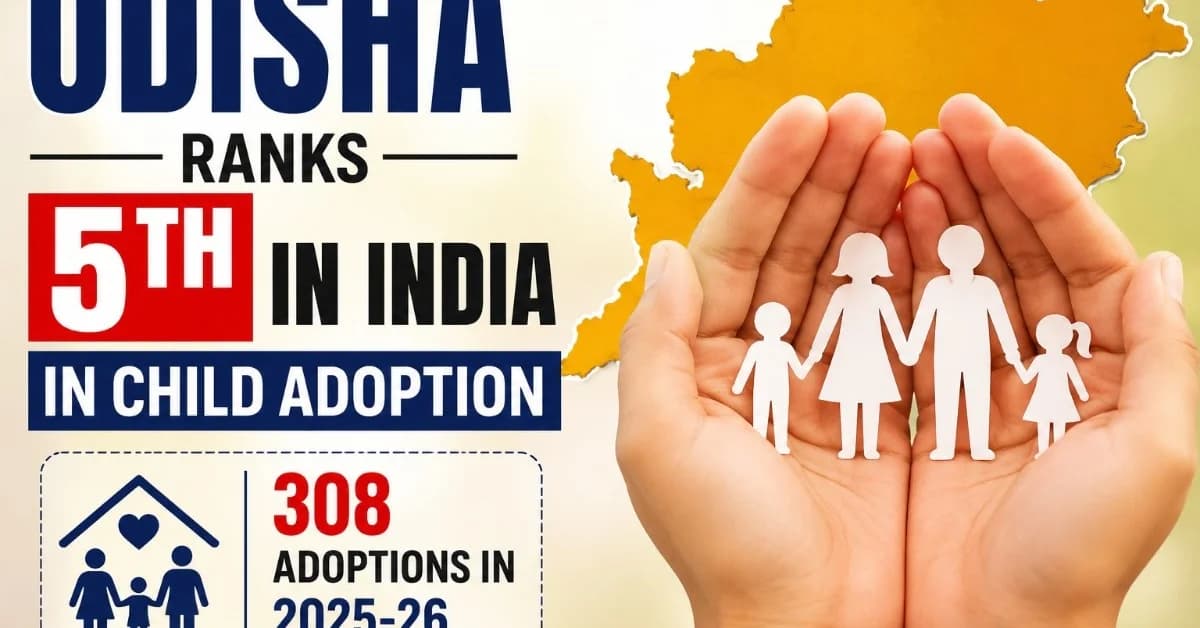
Bhubaneswar: Odisha has emerged as one of India’s leading states in legal child adoption, recording 308 adoptions through the Central Adoption Resource Authority (CARA) in 2025-26 and securing fifth position nationally.
The latest figures were provided by the Union Ministry of Women and Child Development in a Rajya Sabha reply on August 12, 2026.
Maharashtra topped the list with 792 adoptions, followed by Gujarat with 547, Tamil Nadu with 501 and Karnataka with 377. Odisha’s 308 adoptions put it ahead of Telangana, which recorded 307, as well as Madhya Pradesh, Uttar Pradesh and West Bengal.
Why is Odisha’s adoption number so high?

📱 Get Argus News App
✨The first point is that the adoption figure does not simply measure how many families in a state want to adopt. It also depends on the number of children who enter the legal adoption system, are declared legally free for adoption and become available for matching with prospective adoptive parents.
The Union government itself says that the waiting period for prospective adoptive parents depends on the availability of children declared legally free for adoption by Child Welfare Committees.
This makes Odisha’s relatively high number of completed adoptions significant. The state has a substantial child-protection ecosystem through which vulnerable children can enter institutional care and, where legally eligible, the adoption process.
At the same time, though, the available government data does not establish that poverty, tribal population, natural disasters or other social factors directly caused Odisha’s fifth-place adoption ranking, these factors do create vulnerable children ready for adoption.
The bigger factor: a system designed to move faster
One major change in India's adoption system has been the transfer of adoption-order powers to District Magistrates.
Under the Juvenile Justice Act and Adoption Regulations, District Magistrates are empowered to issue adoption orders. The Centre has also prescribed timelines for different stakeholders involved in the process.
This has reduced the dependence on the earlier court-driven process and brought the final stage closer to district administration.
For Odisha, effective use of this decentralised system would mean that eligible adoption cases can move faster at the district level instead of remaining stuck in a prolonged judicial process.
Digital tracking has changed the game
Another important reason behind the higher adoption numbers is the shift towards an end-to-end digital system.
CARA has
digitised the adoption process through the Adoption Module under the Mission
Vatsalya portal. The system allows referral, matching and documentation to
be processed digitally, while real-time dashboards are used for monitoring at
the Centre and State levels.
This matters because adoption is not a single transaction. A child has to be
identified, placed under the appropriate child-protection mechanism, declared
legally free where applicable, referred and matched with prospective parents,
followed by documentation and the adoption order.
Reducing delays at each stage can increase the number of cases completed within a year.
Odisha's adoption network matters
The Mission Vatsalya framework also supports Specialised Adoption Agencies (SAAs), where adoptable children below six years of age are provided residential care. The Centre has advised states and Union Territories to establish at least one SAA in every district.
The national system had 795 approved SAAs as of July 29, 2026, with all SAAs mandated to join the integrated CARINGS-Mission Vatsalya system.
Odisha's performance therefore needs to be seen as part of this larger institutional network: the faster children move through the legal and digital adoption pipeline, the greater the possibility of completing more adoptions.
The real achievement behind the fifth spot
Odisha's 308 adoptions are not the highest in the country. But the fifth-place ranking shows that the state has built an adoption system capable of processing a sizeable number of cases.
The numbers also reveal how competitive the field is. Odisha was only one adoption behind Telangana, which recorded 307. That makes the state's fifth position a narrow but notable achievement.
The broader lesson is that high adoption numbers require more than prospective parents. They require children to be legally available, functioning child-protection institutions, specialised adoption agencies, timely decisions and a digital system capable of connecting children with families.
For Odisha, the 308 adoptions and fifth rank therefore tell only the visible part of the story. The more important story is the administrative pipeline behind those 308 cases — identifying eligible children, completing the legal process and ensuring that they reach permanent families through the regulated CARA system.
Related Topics
Explore more stories