



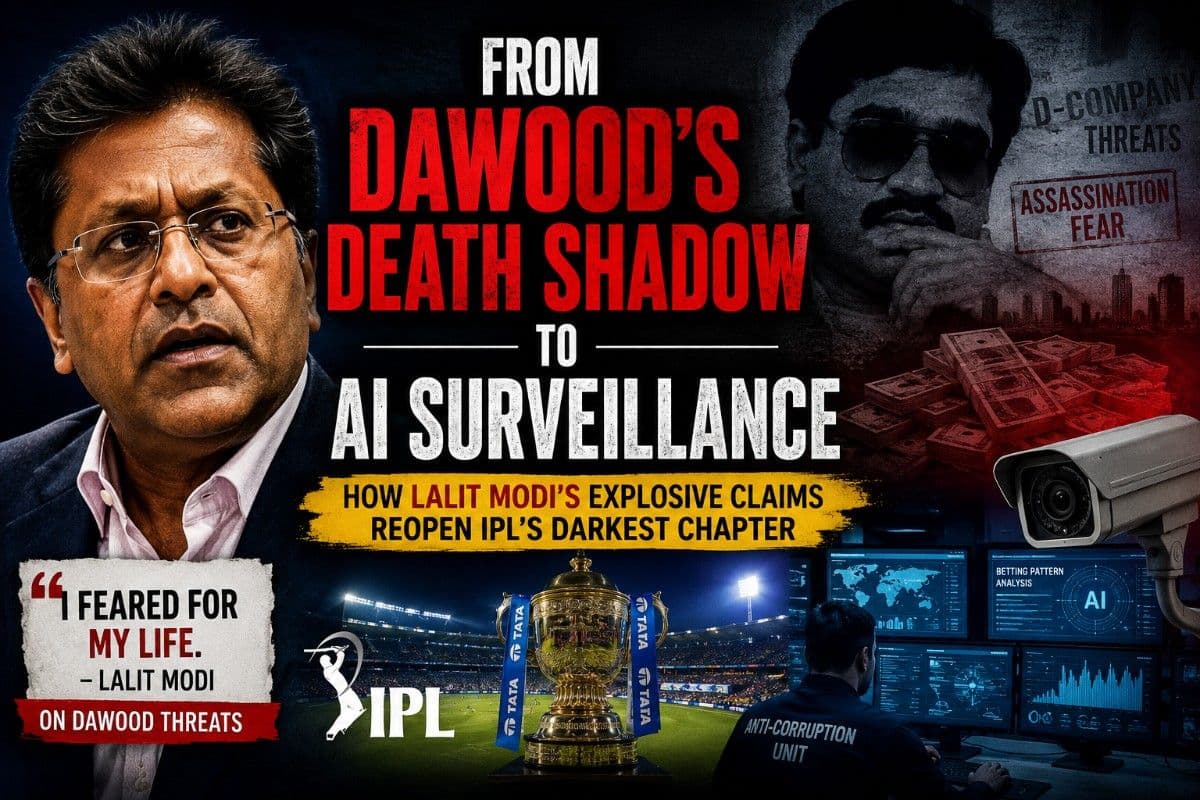
IPL Cricket Story / From Dawood's Death Shadow to AI Surveillance: How Lalit Modi's Explosive Claims Reopen IPL's Darkest Chapter
Key Points
Bhubaneswar: When the Indian Premier League (IPL) was launched in 2008, it was projected as cricket's biggest commercial revolution. But according to former IPL Chairman Lalit Modi, the league's spectacular rise came with a lethal price.
In explosive remarks this week to ANI, Modi claimed he became a target of fugitive gangster Dawood Ibrahim's D-Company after refusing to allow alleged underworld interests to gain influence over the IPL's vast betting ecosystem. Modi suggested the threats went beyond intimidation and created a genuine fear of assassination, ultimately becoming the biggest reason behind his departure from Indian cricket administration.
While the allegations have reignited debate over one of cricket's most controversial eras, they also reopen a larger question: how vulnerable was the IPL in its formative years to organized crime, and how did the world's richest cricket league transform itself from an alleged underworld target into one of the most heavily monitored sporting competitions on the planet?
If Modi's claims are accurate, they reveal that the battle for control of the IPL was never merely about cricket administration.
At stake was access to a rapidly expanding betting market worth billions of rupees, where every ball, wicket and boundary represented an opportunity for bookmakers and criminal syndicates like the D-Company. The fear factor described by Lalit Modi therefore becomes more than a personal story –it becomes a window into the hidden war that accompanied the IPL's explosive rise.
Why IPL Became the Perfect Target
When the IPL launched in 2008, it created something cricket had never seen before.
A fast-paced format, multiple betting events per over, enormous television audiences, celebrity ownership, and unprecedented cash flows combined to create a multi-billion-dollar ecosystem almost overnight.
For illegal betting networks, the IPL represented an ideal marketplace.
Unlike traditional cricket, where outcomes evolved slowly over several days, T20 cricket offered dozens of micro-events every hour – wickets, boundaries, no-balls, wides, powerplays, run rates, and over-by-over outcomes. Each became a betting opportunity.
According to Lalit Modi's latest claims, organized crime groups quickly recognized the commercial potential and allegedly attempted to gain influence over the league's functioning. Whether or not all aspects of the allegations are independently verified, they reinforce a reality that investigators would later uncover: the IPL had become a prime battlefield between sporting integrity and betting syndicates.
2013: When Cricket's Worst Fears Came True
The warnings became reality in 2013.
The arrest of Rajasthan Royals players S. Sreesanth, Ajit Chandila, and Ankeet Chavan in the IPL spot-fixing scandal exposed how deeply bookmakers had penetrated cricket's ecosystem.
Investigators alleged that players were paid to manipulate specific moments of matches rather than final results – a practice known as spot-fixing. The scandal eventually widened to include bookmakers, intermediaries, and individuals linked to organized criminal networks.
The significance of the case was evident when authorities invoked provisions designed to tackle organized crime rather than merely sporting misconduct.

📱 Get Argus News App
✨For the first time, the IPL's integrity crisis was no longer viewed as a disciplinary issue. It became a national law-enforcement challenge.
The IPL of 2010 Is Not the IPL of 2026
The most striking takeaway from Lalit Modi's revelations may be how dramatically the league has changed.
Today's IPL operates under layers of monitoring that did not exist during its formative years.
Every player, support staff member, franchise official, and accredited personnel undergo anti-corruption briefings. Communication patterns, suspicious approaches, unusual betting movements, and integrity risks are continuously monitored.
The league now works alongside anti-corruption units, cybersecurity specialists, data analysts, and international betting-monitoring agencies.
Artificial intelligence tools track irregular betting activity across global markets. Data analytics systems identify unusual wagering spikes that may indicate insider information leaks or manipulation attempts.
Simply put, infiltrating the modern IPL is significantly harder than it was a decade ago.
The Real Legacy of Lalit Modi's Claims
Beyond the sensational headlines about Dawood Ibrahim and underworld pressure, Lalit Modi's remarks highlight a larger truth.
The IPL's early years were not merely a success story of commercial innovation. They were also years of institutional stress-testing, when cricket administrators, law-enforcement agencies, bookmakers, and criminal syndicates were all trying to shape the future of a rapidly expanding sports economy.
The 2013 spot-fixing scandal forced cricket authorities to confront vulnerabilities that many had underestimated.
Ironically, those crises may have strengthened the league.
The IPL that began as a lucrative target for betting syndicates has evolved into one of the world's most scrutinized sporting competitions. Yet Modi's allegations serve as a reminder that wherever billions of dollars, global audiences, and betting markets intersect, the contest between sporting integrity and organized crime never truly ends.
Conclusion
Lalit Modi's explosive allegations are less about revisiting old controversies and more about understanding how the IPL survived them. The league's journey from alleged underworld pressure and spot-fixing scandals to AI-driven integrity monitoring reflects one of the most significant governance transformations in modern sport.
The real question in 2026 is no longer whether the betting mafia wanted a piece of the IPL. It is whether cricket's most valuable tournament can stay one step ahead of increasingly sophisticated threats in the years ahead.
Related Topics
Explore more stories