



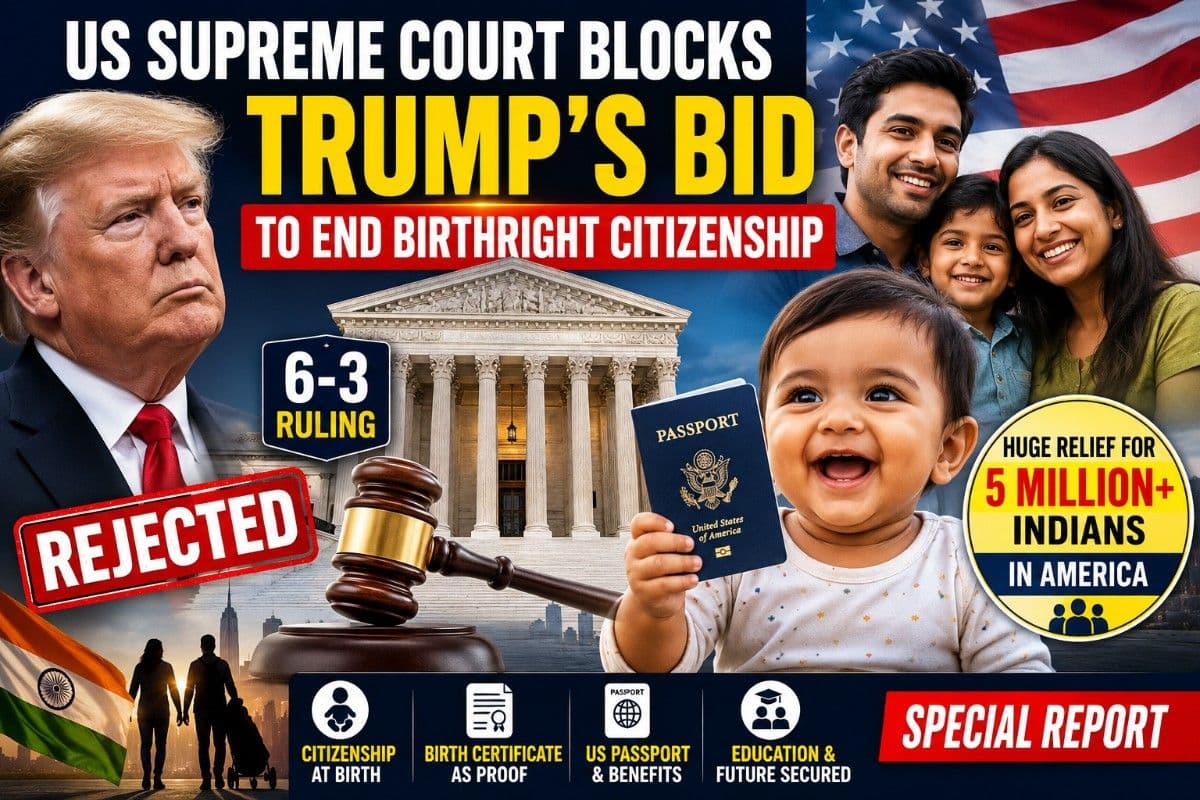
US Supreme Court Blocks Trump's Bid to End Birthright Citizenship: Huge Relief for Over 5 Million Indians Living in America| Special Report
Key Points
* Ensures that children born to Indian IT professionals, healthcare workers, and international students during decades-long Green Card backlogs remain U.S. citizens at birth.
* The historic 6-3 decision confirms that a sitting President cannot alter over 125 years of legal precedent and constitutional guarantees via executive fia
Washington/Bhubaneswar: In a landmark judgment with far-reaching consequences for millions of immigrants, the US Supreme Court on Tuesday rejected President Donald Trump's attempt to end birthright citizenship through an executive order, preserving a constitutional guarantee that has stood for more than 125 years.
The 6-3 ruling not only safeguards the rights of children born on American soil but also comes as a massive relief for one of the largest immigrant communities in the United States – the Indian diaspora.
Why This Matters for Indians
The proposed executive order had specifically targeted children born to temporary visa holders, including foreign students, tourists and professionals working in the US without permanent residency.

📱 Get Argus News App
✨For Indians, this was particularly significant because they constitute the largest pool of high-skilled temporary workers and international students in America.
According to official US estimates:
- More than 5.4 million people of Indian origin live in the United States.
- Nearly 800,000 Indians currently hold H-1B visas, directly or as dependents.
- Around 2.2 lakh (220,000+) Indian students are enrolled in American universities, making India the largest source of international students.
- Nearly 10 lakh Indians are estimated to be stuck in employment-based Green Card backlogs, with waiting periods stretching well beyond a decade in many categories.
For these families, children born during their long wait for permanent residency will continue to receive automatic US citizenship.
A Massive Relief for H-1B Families
The biggest beneficiaries are Indian professionals working in sectors such as information technology, healthcare, engineering and finance.
Many Indian workers spend 10-20 years in the United States on temporary work visas because of country-wise Green Card quotas.
Had Trump's executive order survived judicial scrutiny, babies born during this waiting period would have been denied automatic US citizenship despite being born in America.
The Supreme Court's verdict ensures these children will continue to receive:
- US citizenship at birth
- Birth certificates recognised as proof of citizenship
- US passports
- Social Security Numbers
- Access to education and federal benefits without additional immigration hurdles.
Statelessness Risk Averted
Legal experts say one of the most serious consequences avoided by the ruling concerns the possibility of "stateless" children.
India does not recognise unrestricted dual citizenship and has specific legal procedures governing citizenship for children born abroad.
Without automatic US citizenship, some children born to Indian temporary visa holders could have found themselves in a legal grey zone until their nationality was formally established.
The Supreme Court's decision effectively eliminates that uncertainty by ensuring citizenship from birth.
Indian Students Also Protected
The verdict also offers certainty to the more than 2.2 lakh Indian students studying in American universities.
Trump's executive order had explicitly included children born to foreign students among those who would not automatically qualify for citizenship.
With the court preserving the existing legal framework, Indian researchers, doctoral scholars and graduate students can continue planning their careers and families without fears that their children would face uncertain legal status.
No New Documentation Burden
The Trump administration had planned an entirely new verification system requiring authorities to determine parents' immigration status before granting citizenship-related documents.
Immigration advocates warned this could have created a cumbersome bureaucratic process affecting every newborn.
The ruling preserves the long-standing practice whereby a hospital-issued birth certificate remains sufficient proof of citizenship for babies born in the United States.
Historic Constitutional Protection
Chief Justice John Roberts, writing for the majority, reaffirmed that citizenship remains "the right to have rights" and that the Fourteenth Amendment guarantees citizenship to those born on American soil.
The ruling also upholds the landmark 1898 Supreme Court precedent in United States v. Wong Kim Ark, which established that children born in the US to non-citizen parents are entitled to citizenship.
Legal Debate May Continue
While the verdict represents a decisive setback for Trump's executive order, legal scholars note that one aspect of the judgment leaves room for future debate.
Justice Brett Kavanaugh sided with the majority primarily because of current federal law (codified in 1940), rather than a strict interpretation of the Constitution itself.
This means that while the President cannot end birthright citizenship by executive fiat, the door remains technically open for a future Congress to attempt to rewrite citizenship laws – though that would require a massive legislative majority.
The Bottom Line
For now, the Supreme Court's ruling provides legal certainty to millions of Indian-origin families who have built their lives in America while navigating one of the world's longest immigration backlogs.
Thousands of
Indian babies born each year in the United States will continue to receive
automatic American citizenship, sparing families from legal uncertainty,
additional bureaucracy and the risk of their children being left without a
clearly recognised nationality.
Also Read: ‘He Looks Like an Angel, But He’s a Killer’: How Trump’s Remark May Be the Biggest Global Endorsement of PM Modi Yet| Analysis
Related Topics
Explore more stories