



US-China AI Rivalry Enters New Phase as India-Japan Alliance Aims to Build Alternative Tech Supply Chain for Global AI Boom | Exclusive Analysis
Key Points
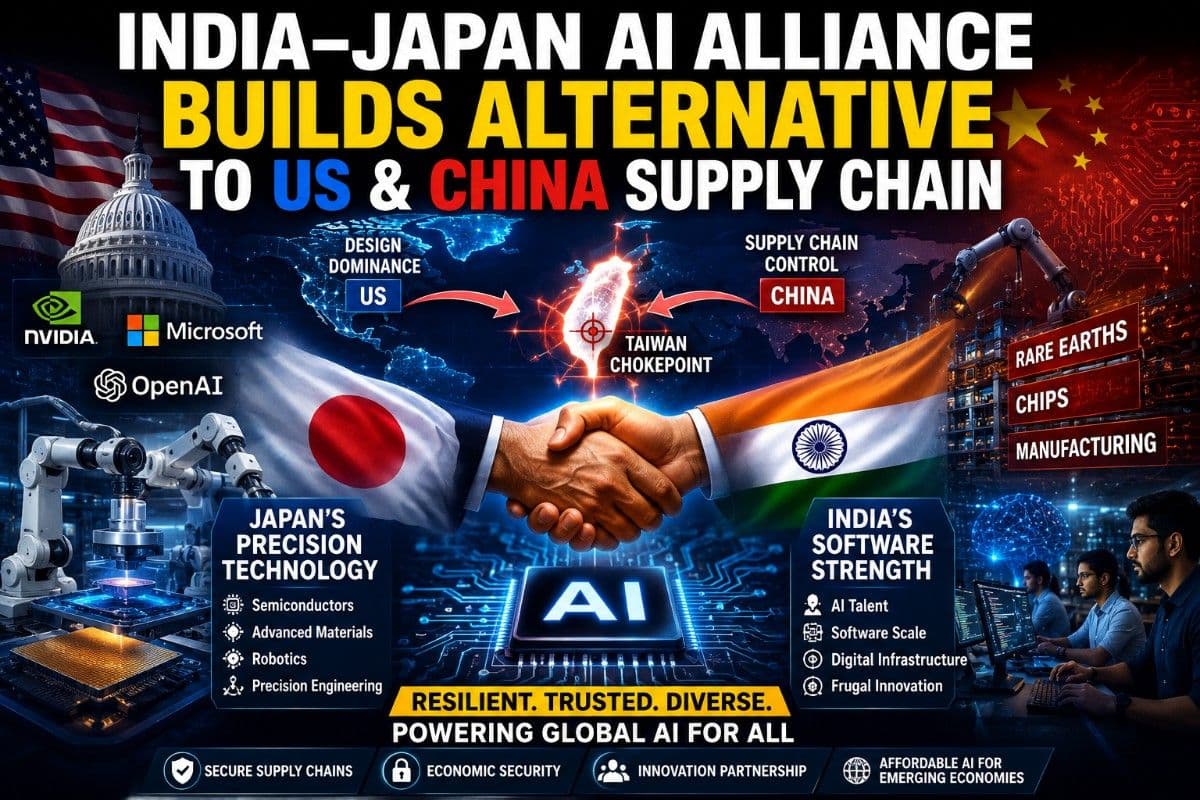
* The alliance combines Japan's semiconductor precision with India's software expertise to create resilient AI supply chains.
* The partnership aims to make AI more secure, affordable and accessible for emerging economies worldwide.
Bhubaneswar: At a time when the world is witnessing an unprecedented Artificial Intelligence (AI) revolution, one pivotal but innocuous paragraph in Prime Minister Narendra Modi's address after the India-Japan Annual Summit may well turn out to be one of the most consequential geopolitical announcements of the decade.
"Our technology partnership will become the strongest pillar of our cooperation... The confluence of Japan's precision technology and India's software capabilities will infuse new momentum and strength into global AI development," Modi declared while announcing a Joint Statement on Artificial Intelligence and multiple agreements between leading AI institutions of both countries.
Behind those carefully chosen diplomatic words lies a much larger strategic objective: creating a trusted India-Japan AI ecosystem capable of reducing the world's overwhelming dependence on technology supply chains dominated by the United States, Taiwan and China.
While the headline geopolitical rivalry continues to revolve around Washington and Beijing, Tokyo and New Delhi appear to be quietly building what experts describe as a third strategic AI corridor – one based on trusted partnerships, diversified semiconductor ecosystems and complementary technological strengths.

📱 Get Argus News App
✨More Than AI Cooperation: It Is About Technology Sovereignty
The India-Japan AI partnership is not merely about jointly developing chatbots or software applications.
It is an attempt to redesign how future AI systems are built – from semiconductor materials and advanced manufacturing to AI algorithms, industrial robotics, cloud infrastructure and enterprise applications.
Today's AI economy depends on two critical ingredients:
- Advanced semiconductor chips
- Intelligent software capable of processing massive datasets
Neither can exist without the other.
Japan and India together possess complementary strengths that few countries can match.
Japan contributes:
- Semiconductor manufacturing equipment
- Advanced materials
- Robotics
- Precision engineering
- Industrial automation
- High-end electronics
India contributes:
- One of the world's largest software engineering talent pools
- AI developers
- Data engineering expertise
- Digital Public Infrastructure
- Rapidly growing AI startup ecosystem
- Massive domestic AI deployment opportunities
PM Modi's phrase – “Japan's precision technology and India's software capabilities" – therefore represents far more than diplomatic rhetoric.
It describes a blueprint for an integrated AI value chain.
Why Are India and Japan Looking for an Alternative Supply Chain?
The answer lies in one word:
Vulnerability.
Today's global AI industry is concentrated within a few geographical chokepoints.
The US Dominates AI Design
American companies such as NVIDIA, AMD, Microsoft, OpenAI, Google and others lead AI model development and chip design.
Taiwan Dominates Manufacturing
Nearly all cutting-edge AI chips are manufactured by Taiwanese fabrication facilities, particularly TSMC.
A military conflict or major disruption in the Taiwan Strait could severely impact global AI production.
China Controls Critical Segments
China dominates several downstream supply chains including:
- Rare earth processing
- Critical minerals
- Legacy semiconductor manufacturing
- Large-scale industrial electronics
- AI-enabled manufacturing capacity
This concentration creates enormous geopolitical risks.
Any sanctions, export controls, military conflict or supply disruption could affect every country dependent on AI infrastructure.
India's Software Meets Japan's Hardware
This is precisely where the India-Japan partnership becomes strategically significant.
Rather than competing directly with either the US or China, both countries are combining their respective comparative advantages.
Japan excels in building the physical backbone of AI.
India excels in creating the digital intelligence.
Together they can build what many technology strategists describe as Cyber-Physical AI – where intelligent software controls advanced machines.
Examples include:
- Autonomous factories
- Smart manufacturing
- Industrial robotics
- Intelligent logistics
- AI-driven healthcare devices
- Precision agriculture
- Smart transportation systems
Instead of importing complete AI ecosystems from elsewhere, India and Japan seek to jointly create them.
Economic Security Is Now National Security
Another major announcement made during the summit was the adoption of a Joint Roadmap on Economic Security.
Its inclusion alongside the AI partnership is significant.
Modern AI depends upon uninterrupted access to:
- Semiconductors
- Advanced packaging
- Computing infrastructure
- Data centres
- Software talent
- Critical materials
Any disruption can stall entire industries.
The India-Japan framework therefore aims to create resilient supply chains where democratic partners can depend upon each other rather than a single vulnerable geography.
This approach reflects the broader global trend of friend-shoring – relocating critical technology supply chains to trusted strategic partners.
Institutional Partnerships Make the Difference
Unlike many international technology declarations that remain aspirational, the summit also witnessed agreements between leading AI institutions from both countries.
This creates an operational pipeline:
Research → Innovation → Commercialisation → Global Deployment
Indian institutes, startups and AI developers are expected to collaborate directly with Japanese research organisations, universities and technology companies.
Such partnerships accelerate:
- Joint research
- Industrial AI
- Startup collaboration
- Talent mobility
- Technology transfer
- Commercial deployment
The partnership therefore moves beyond government announcements into ecosystem integration.
Solving Each Other's Structural Weaknesses
The partnership also addresses major domestic challenges in both countries.
Japan faces:
- Ageing population
- Acute software engineer shortage
- Need for AI talent
India possesses:
- Young workforce
- Massive engineering base
- Expanding AI research ecosystem
- Large-scale digital deployment experience
The AI partnership effectively connects Japan's capital and hardware capabilities with India's human capital.
This creates mutual strategic advantages instead of one-sided dependence.
What Does "Global AI Development" Actually Mean?
Perhaps the most important phrase in PM Modi's speech was his assertion that the partnership would "infuse new momentum and strength into global AI development."
This does not simply mean developing better AI models.
It signals a broader ambition.
1. Diversifying Global AI Supply Chains
Instead of depending upon a few technology hubs, countries worldwide could source AI hardware, software and industrial solutions through a diversified India-Japan ecosystem.
That reduces geopolitical risk while improving supply resilience.
2. Affordable AI for Emerging Economies
Western AI systems often remain expensive.
India's expertise in frugal innovation, combined with Japan's engineering precision, could produce affordable AI solutions for sectors such as:
- Healthcare
- Agriculture
- Manufacturing
- Education
- Public services
This is particularly relevant for developing economies across Asia, Africa and Latin America.
3. Trusted AI Infrastructure
The partnership also promotes AI development based on transparency, trusted supply chains, secure infrastructure and rules-based technological cooperation.
In an era increasingly shaped by concerns over cyber security, data protection and technology governance, these principles carry growing strategic importance.
A Quiet Shift in the Global AI Balance
Although the AI race is often portrayed as a contest between the United States and China, the India-Japan partnership suggests another possibility.
Rather than attempting to replace either superpower, New Delhi and Tokyo are positioning themselves as builders of an alternative AI ecosystem – one that combines Japanese manufacturing excellence with India's software scale, talent and digital innovation.
If successfully implemented, the partnership could gradually reduce global dependence on highly concentrated technology supply chains while creating a new trusted corridor for AI innovation.
That is why PM Modi's brief reference to the convergence of Japan's precision technology and India's software capabilities may ultimately be remembered as more than diplomatic optimism.
It could
mark the beginning of a strategic effort to reshape the architecture of the
global AI economy itself – where resilience, trusted partnerships and
diversified supply chains become as important as breakthroughs in algorithms.
Also Read: The Jaishankar Style: Why Efforts to Put India on the Defensive Often Backfire Western Powers| Special Story
Related Topics
Explore more stories