



Trump's Iran Moment? Leaked Draft Revives Comparisons With Obama-Era Nuclear Deal| Special Story
Key Points
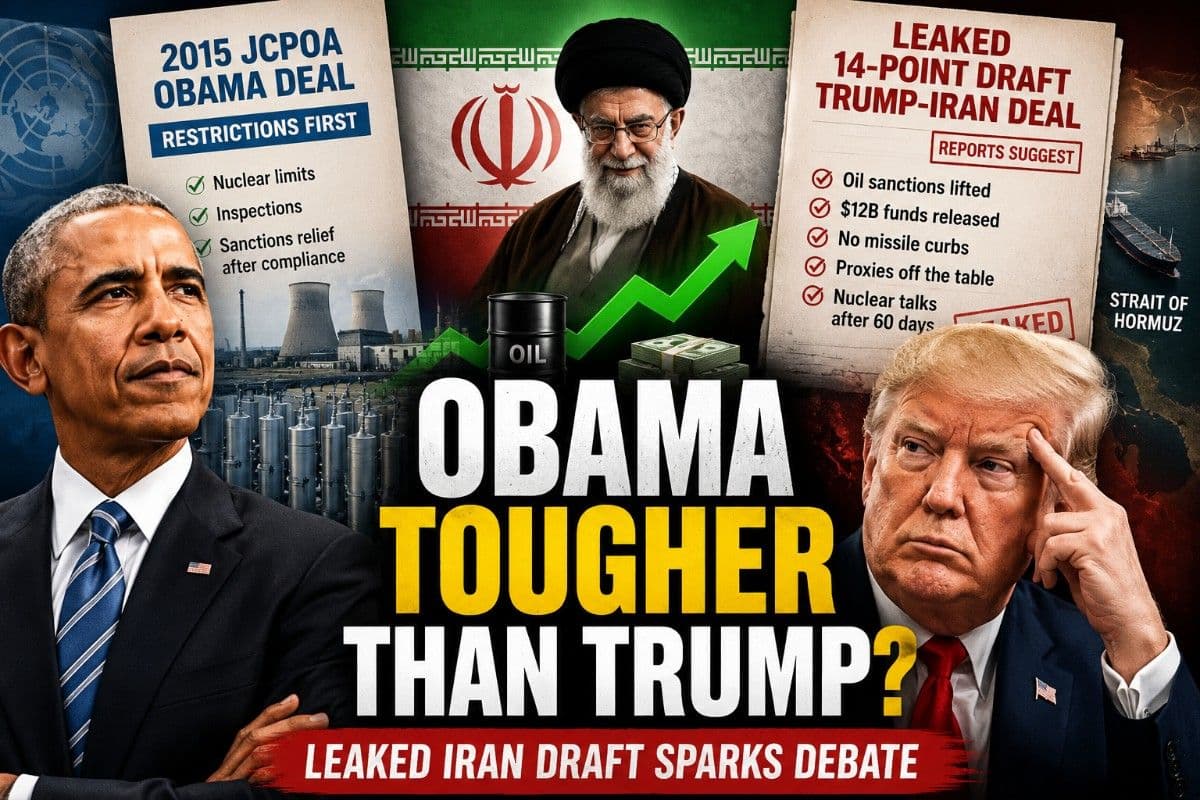
* Iran's missile programme and regional proxy network reportedly remain outside the scope of final negotiations.
* The framework appears primarily to prioritize oil market stability and regional de-escalation over immediate nuclear concessions.
Bhubaneswar: Few foreign policy battles defined the rivalry between President Barack Obama and President Donald Trump more than the Iran nuclear agreement.
When Obama unveiled the Joint Comprehensive Plan of Action (JCPOA) in 2015, Republicans denounced it as a historic concession to Tehran. No critic was louder than Donald Trump, who repeatedly called it "one of the worst deals ever negotiated."
Three years later, Trump withdrew the United States from the agreement, reimposed sanctions and promised a tougher, broader and stronger deal that would force Iran to curb not only its nuclear ambitions but also its ballistic missile programme and regional influence.
Now, more than a decade after the original accord, a leaked 14-point draft MoU reportedly negotiated between Washington and Tehran is reviving an uncomfortable question in diplomatic circles:

📱 Get Argus News App
✨Could Trump ultimately end up accepting terms that look less demanding than the deal he once condemned?
Obama's Deal: Restrictions First, Relief Later
The 2015 JCPOA was built around a straightforward bargain.
Iran accepted strict limits on uranium enrichment, slashed its stockpile of enriched uranium, reduced the number of operating centrifuges and opened its facilities to extensive international inspections. In return, the United States, European Union and United Nations lifted major sanctions.
The agreement did not eliminate Iran's nuclear programme altogether. Nor did it address Tehran's missile programme or support for regional proxy groups.
Those omissions became the central argument used by Trump and his allies against the deal. Trump argued the agreement merely delayed Iran's nuclear ambitions while allowing it to strengthen economically and militarily.
Trump's Promise: A Better Deal
When Trump withdrew from the JCPOA in 2018, he promised a tougher approach.
The White House argued that any future agreement must address Iran's ballistic missile programme, regional activities and long-term nuclear capabilities. Trump repeatedly described the JCPOA as a "one-sided" arrangement that gave Tehran economic benefits without permanently ending the threat.
The expectation among Trump's supporters was clear: if a new deal emerged, it would extract greater concessions from Iran than Obama managed to secure.
Leaked Draft MoU Changes the Narrative
That expectation is now facing scrutiny.
According to details published by Iranian media Mehr News Agency, the emerging framework would reportedly suspend oil sanctions, release billions of dollars in blocked Iranian funds and reopen maritime trade routes before final negotiations on Iran's nuclear programme are completed.
More significantly, the report further suggests Iran's ballistic missile programme and support for regional resistance groups have been removed from the negotiating agenda altogether.
If accurate, that would represent a striking contrast with the objectives Trump himself outlined when abandoning the JCPOA.
The very issues he cited as fatal flaws in Obama's agreement would remain unresolved.
Why Obama May Suddenly Look Tougher
This is where the political irony emerges.
Obama was heavily criticized for offering sanctions relief. Yet his agreement required Iran to first accept detailed nuclear restrictions and intrusive monitoring mechanisms before sanctions were lifted. International inspectors verified Iranian compliance during the period the deal remained operational.
The leaked Trump-era framework, by contrast, appears to prioritize de-escalation, energy stability and economic normalization while postponing the most difficult disputes for future negotiations.
In simple terms, Obama demanded nuclear concessions before major economic rewards.
The leaked framework appears to offer significant economic relief before final nuclear settlements are reached.
That distinction could become politically explosive in Washington.
The Energy Factor
The explanation may lie in circumstances rather than ideology.
Obama negotiated during a period when preventing nuclear proliferation was the overwhelming objective.
Trump is negotiating amid regional warfare, disruptions in the Strait of Hormuz, pressure on global energy markets and fears of a broader Middle East conflict.
The White House may have concluded that stabilizing oil flows and preventing a wider war is now more urgent than forcing immediate concessions on missiles or proxies.
If seen from that perspective, the leaked framework reflects pragmatism rather than weakness.
Critics, however, will argue that Washington is surrendering leverage before securing meaningful guarantees.
Verdict Is Not Yet Written
The leaked memorandum remains unverified. Major political obstacles remain in Washington, Tehran and among US regional allies.
Yet the draft has already produced one remarkable outcome.
For years, Republicans argued that Obama's Iran deal gave away too much for too little.
If the leaked text survives largely intact, Trump may find himself defending a framework that critics could portray as even more accommodating than the agreement he once dismantled.
That does not automatically mean Obama negotiated the better deal.
But it does
mean the debate over who was actually tougher on Iran may be begin afresh.
Also Read: No Oil Sanctions, No Missile Curbs: Why the Leaked US-Iran Deal Looks Like a Strategic Victory for Tehran| Analysisthe
Related Topics
Explore more stories