



Geopolitics / Trump’s AI Map Claims Canada, Greenland, Venezuela as US Territory
Key Points
- Trump posts AI map showing US expansion.
- Greenland, Canada, Venezuela included as US territory.
- EU and NATO allies condemn territorial claims.
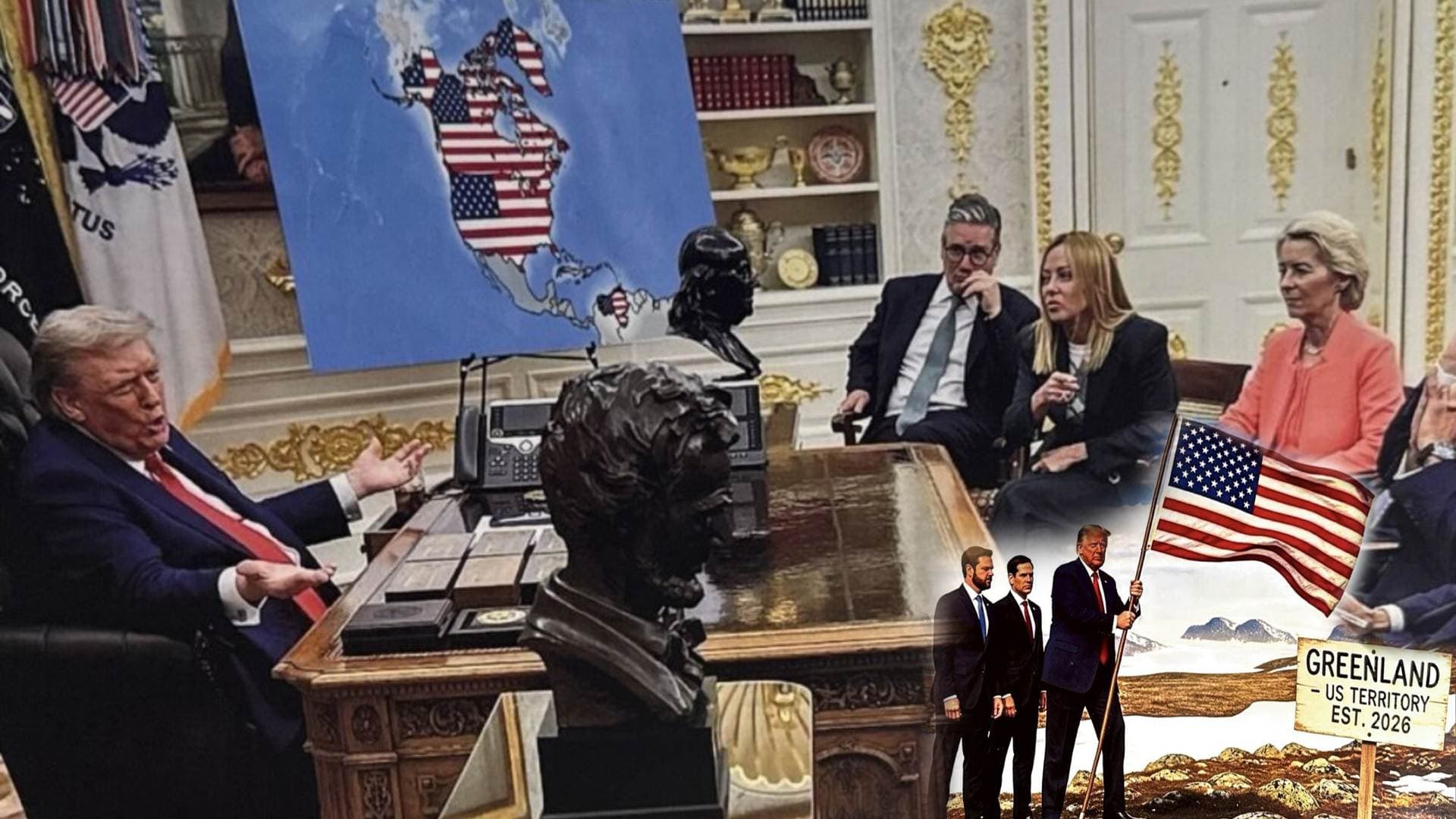
Washington, Jan 20: US President Donald Trump ignited fresh controversy on Tuesday after posting an AI-generated map on his Truth Social platform that depicted Canada, Greenland, and Venezuela as part of US territory.
The striking visual, which appeared to be created using artificial intelligence, immediately drew global attention and intensified tensions with European allies already wary of Trump’s renewed push to acquire Greenland.

📱 Get Argus News App
✨Shortly after, Trump shared another image of himself
planting the American flag in Greenland alongside Vice President JD Vance and
Secretary of State Marco Rubio, captioned: “Greenland US Territory Est 2026.”
The post reinforced his aggressive rhetoric about expanding US territorial
control.
Also read: Who Is the Lion of ‘The 50’? Ajay Devgn Responds
Trump Zeroes In on Greenland
Trump’s interest in Greenland is not new, but his tone has become more forceful in recent weeks. He has repeatedly argued that the United States needs Greenland for “national security,” despite already maintaining a military presence on the island under defence agreements with Denmark.
In a letter to Norway’s Prime Minister, Trump expressed frustration over being overlooked for the Nobel Peace Prize, declaring he no longer felt obliged to think “purely of peace.” He claimed Denmark lacked the ability to defend Greenland against Russia or China and suggested the US should assert “complete and total control” over the territory.
Analysts warn that such remarks have strained relations with NATO allies and raised alarm in European capitals, particularly as Trump has threatened new tariffs against countries opposing his Greenland plan.
Canada under Trump’s Strategic Lens
The AI-generated map also included Canada, echoing Trump’s earlier suggestion to make Canada the 51st US state. That proposal was swiftly rejected by Ottawa, which responded with a bitter trade dispute. Including Canada in the map appears to be a symbolic gesture reinforcing Trump’s territorial ambitions, though it carries no legal or diplomatic legitimacy.
Trump’s Bold Move in Venezuela
Perhaps most provocative was the map’s inclusion of Venezuela. In early January, US forces captured Venezuelan President Nicolas Maduro and his wife in Caracas, flying them to New York to face drug and narco-terrorism charges. Trump later declared that the United States would “run” Venezuela and that American companies would control its vast oil reserves — the largest proven in the world.
International observers have criticized these claims as far exceeding diplomatic norms, even as Trump’s administration insists the operation was a lawful strike against organized crime.
Allies Resist Trump’s Expansionist Rhetoric
Trump’s actions have triggered sharp rebukes from EU and NATO partners. Greenland’s Prime Minister reaffirmed the territory’s alignment with Denmark, NATO, and the European Union, rejecting Trump’s pressure. European leaders condemned his tariff threats, warning that such tactics could weaken alliances and embolden rivals like Russia and China.
Even NATO’s secretary-general has been drawn into the debate, with Trump insisting Greenland’s strategic importance is vital to Western security.
The Bigger Picture
Trump’s AI-generated map and accompanying rhetoric represent a bold, unconventional form of foreign policy signalling. By visually depicting territorial expansion, he amplifies geopolitical claims that lack any basis in international law.
While the United States continues to wield military and
economic influence globally, normalizing territorial control over sovereign
nations such as Canada, Denmark’s Greenland, or Venezuela marks a significant
shift in messaging. The strong reactions from allies underscore that Trump’s
approach is creating friction rather than consensus among long-standing
partners.
Related Topics
Explore more stories