



From France 24 to Le Monde: Why French Media Sees Modi as the Most Influential Non-G7 Leader at the Summit| Special Story
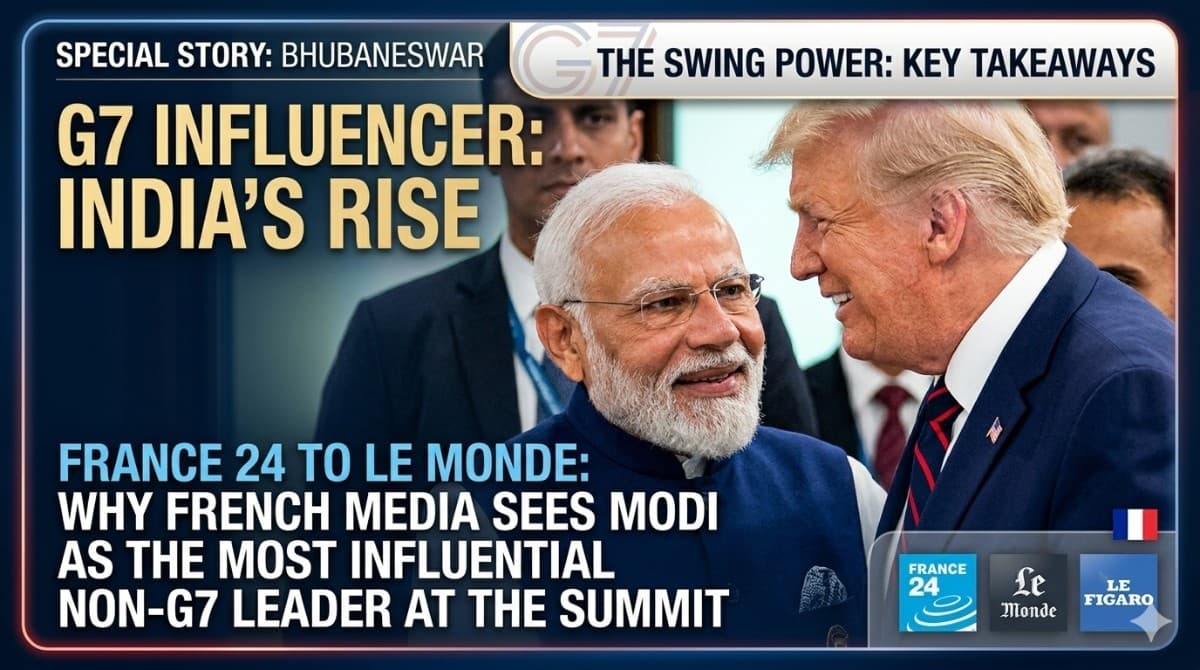
Key Points
* Le Monde portrays India as a global swing power capable of bridging rival geopolitical camps.
* French media sees the Modi-Macron partnership as central to Europe's Indo-Pacific strategy
Bhubaneswar: As world leaders gather for the 52nd G7 Summit in Évian-les-Bains, France, Prime Minister Narendra Modi is attracting an unusual degree of attention from French media.
Across television networks, newspapers and policy commentary platforms, India is being portrayed not merely as an invited guest but as a pivotal power whose cooperation is increasingly essential for addressing global economic, security and geopolitical challenges.
Coverage by leading outlets including France 24, Le Monde, Le Figaro and Radio France Internationale (RFI) reveals a common theme: India has emerged as one of the most consequential non-G7 countries in the world, capable of influencing discussions that extend far beyond the formal membership of the grouping.
From representing the aspirations of the Global South to balancing relations with competing global powers, Modi's engagements with French President Emmanuel Macron and US President Donald Trump have become key storylines of the summit.

📱 Get Argus News App
✨France 24 Focuses on Modi-Trump Optics Amid Strategic Friction
One of the most closely watched moments at the summit has been the interaction between Modi and Trump.
Analysis aired by France 24 has framed the meeting as more than a routine diplomatic encounter. Commentators noted that the visibly warm public interaction contrasted with nearly sixteen months of tensions surrounding trade negotiations, tariffs and market-access issues between New Delhi and Washington.
The French broadcaster suggested that the cordial optics served an important diplomatic purpose: reassuring investors and strategic partners that the broader India-US relationship remains stable despite ongoing economic disagreements.
According to French analysts, both leaders had compelling reasons to project continuity. For Washington, India remains a critical partner in the Indo-Pacific and in efforts to diversify global supply chains away from China. For New Delhi, maintaining strong ties with the United States remains central to its economic and strategic calculations.
Yet French commentary has also pointed out that India's growing ties with Europe—particularly France—have strengthened New Delhi's bargaining position in dealing with Washington.
Le Monde Sees India as the World's Emerging Swing Power
French daily Le Monde has focused on a broader geopolitical trend: India's transformation into a global "swing power."
The newspaper's analysis highlights India's unique ability to maintain constructive relationships simultaneously with the United States, Europe, Russia and the developing world. In an increasingly fragmented international system, this diplomatic flexibility has become one of New Delhi's greatest strategic assets.
Le Monde's coverage suggests that India is now occupying a space once reserved for a handful of major powers—countries capable of engaging with competing geopolitical camps without fully aligning with any of them.
That positioning has become particularly relevant as G7 leaders grapple with the ongoing war in Ukraine, instability in West Asia and efforts to reshape global trade networks.
French commentators increasingly view India's support as critical to achieving broader international consensus on major geopolitical issues.
France's 'Special Strategic Partnership' With India Takes Centre Stage
If the Modi-Trump meeting generated headlines, Modi's engagement with President Emmanuel Macron has been viewed in France as the summit's most strategically significant bilateral interaction.
French media have repeatedly highlighted what Paris describes as a "special strategic partnership" with India—one that extends beyond defence sales into technology, innovation, maritime security and industrial cooperation.
Le Figaro, in particular, has devoted considerable attention to the evolution of Indo-French ties, portraying India as France's most important long-term partner in the Indo-Pacific region.
French diplomatic sources quoted across multiple media platforms have emphasized that the relationship is increasingly viewed as an "equal-to-equal" partnership rather than a traditional buyer-seller arrangement.
That distinction has become especially important as India pushes for greater domestic manufacturing under its "Make in India" initiative and seeks technology transfers alongside major defence acquisitions.
French commentators note that future cooperation around the Rafale fighter programme, defence production and advanced military technologies is expected to incorporate deeper industrial collaboration within India itself.
Maritime Security and the Indo-Pacific Dimension
French strategic analysts have also focused on growing maritime cooperation between Paris and New Delhi.
With both countries maintaining significant interests in the Indian Ocean, discussions on maritime security, freedom of navigation and energy supply routes have featured prominently in summit-related commentary.
Several French observers have highlighted proposals for closer coordination in protecting critical sea lanes, including those linked to the Strait of Hormuz and the broader Indo-Pacific region.
For France, which maintains overseas territories and military assets across the Indo-Pacific, India is increasingly seen as a natural partner in preserving regional stability.
RFI Highlights India's Role as the Voice of the Global South
Beyond bilateral diplomacy, French media have devoted significant attention to India's role as a representative of developing nations.
Radio France Internationale (RFI) and other French commentators have highlighted Macron's decision to invite countries such as India, Brazil, South Korea and Kenya as part of a broader effort to connect G7 deliberations with concerns emerging from the Global South.
In this context, Modi's participation is being portrayed as particularly important.
French observers argue that India does not simply represent its own interests at such forums. Instead, it increasingly articulates concerns shared across developing economies—from debt sustainability and energy security to climate financing and reforms of international financial institutions.
As the world's most populous nation and one of its fastest-growing major economies, India is viewed by many French analysts as uniquely positioned to bridge the divide between advanced industrial economies and emerging powers.
Innovation, Technology and the Future of the Partnership
Another recurring theme in French coverage is technology cooperation.
Coinciding with the India-France Year of Innovation 2026, media reports have highlighted efforts by Macron and Modi to deepen collaboration in artificial intelligence, digital infrastructure, startups and advanced technologies.
French economic commentators view these initiatives as evidence that the Indo-French partnership is evolving beyond defence and security into areas likely to shape global competitiveness over the coming decades.
Particular attention has been paid to innovation platforms and technology partnerships that are expected to receive further momentum ahead of India's participation in major French technology events, including VivaTech in Paris.
More Than a Guest at the G7
The most striking conclusion emerging from French coverage is that India is no longer being discussed as an outsider invited to participate in global conversations.
Instead, commentators increasingly portray New Delhi as a power whose voice carries weight on issues ranging from trade and technology to security and diplomacy.
For France, India represents a crucial pillar of a more multipolar world order. For Europe, it is a partner capable of balancing economic opportunity with strategic autonomy. And for the United States, it remains an indispensable Indo-Pacific partner despite occasional disagreements.
The message running through much of the French media's G7 coverage is clear: India may not be a formal member of the G7, but it is rapidly becoming one of the countries whose support is essential for the success of any major global initiative.
At
Évian-les-Bains, Prime Minister Modi is not merely attending the summit. In the
eyes of many French observers, he is helping shape its outcome.
Also Read: The Modi-Cyprus Selfie Moment: How 'Selfie Diplomacy' is Rewriting Global Diplomacy| Special Story
Related Topics
Explore more stories