



Geopolitics / Donald Trump, Xi Jinping Agree to Establish AI Communication Channel
Key Points
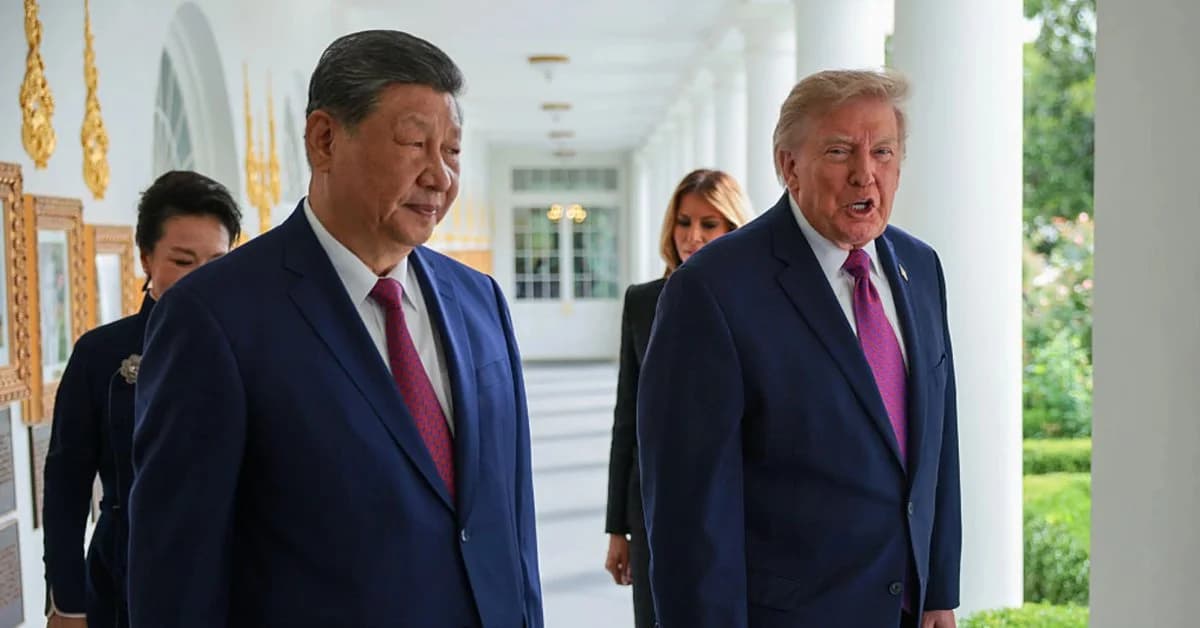
US President Donald Trump and Chinese President Xi Jinping agreed to launch a “Super Intelligence” dialogue, address Iran’s nuclear ambitions, and advance trade and energy cooperation during Xi’s landmark Washington summit.
Washington, Sep 26: In Washington this week, the world’s two most powerful leaders sought to redefine the language of technology and diplomacy.
US President Donald Trump and Chinese President Xi Jinping not only agreed to create a direct communication channel for incidents tied to artificial intelligence, but also moved to rebrand the field itself as “super intelligence.”
The decision, announced by the White House after their summit, reflects both the urgency of managing emerging technologies and Trump’s insistence that intelligence should never be described as “artificial” or “fake.”
Also read: Donald Trump Rolls Out Red Carpet for Xi Jinping in Washington

📱 Get Argus News App
✨According to a fact sheet released after the meeting, the two leaders launched the U.S.–China Super Intelligence Dialogue to exchange views on risks and benefits associated with SI.
“The two countries established the U.S.–China Super Intelligence (SI) Dialogue to exchange views on risks and benefits related to SI,” the document stated, adding that the next exchange will take place by November 2026, coinciding with the Asia‑Pacific Economic Cooperation summit in Shenzhen.
Trump has insisted on the new terminology, arguing that “artificial” makes intelligence sound “fake,” and directed that all U.S. documents use “super intelligence” instead.
The summit also addressed pressing global concerns, including North Korea, Russia, and Iran. While details on North Korea were not disclosed, the leaders agreed that Iran “can never have a nuclear weapon” and that “no country or institution can be allowed to impose tolls on international waterways.”
This comes amid Tehran’s assertion of control over the Strait of Hormuz, a vital shipping route for oil and gas. Trump further urged Xi to increase production of refined petroleum products to stabilize global supply, citing concerns over high energy prices ahead of US midterm elections.
Emphasizing cooperation, the fact sheet noted that both sides aim to foster peace and prosperity “to enhance confidence for businesses and consumers around the world.” The leaders agreed to build a constructive relationship based on “respect, fairness, and reciprocity.”
Economic mechanisms were also advanced. The bilateral Board of Trade and Board of Investment, chartered during their May summit in Beijing, were operationalized.
Under the Board of Trade, consensus was reached on favourable tariff treatment for US$30 billion worth of nonsensitive goods in each direction, alongside a working group to address agricultural market access barriers. China also committed to importing at least 10 million metric tonnes of US coal in 2027 and 2028.
On critical minerals, both sides pledged to work on U.S. concerns over supply chain shortages, aiming to restore shipment levels.
Xi concluded his three‑day state visit to Washington on Friday, his first in over a decade. This summit marked the third in‑person meeting between Trump and Xi since Trump’s return to office, following earlier engagements in Busan last October and Beijing in May.
(IANS)
Related Topics
Explore more stories