



What Is Odisha Waiting For As Chhattisgarh, Maharashtra, Gujarat Ban Analogue Paneer?| Special Report
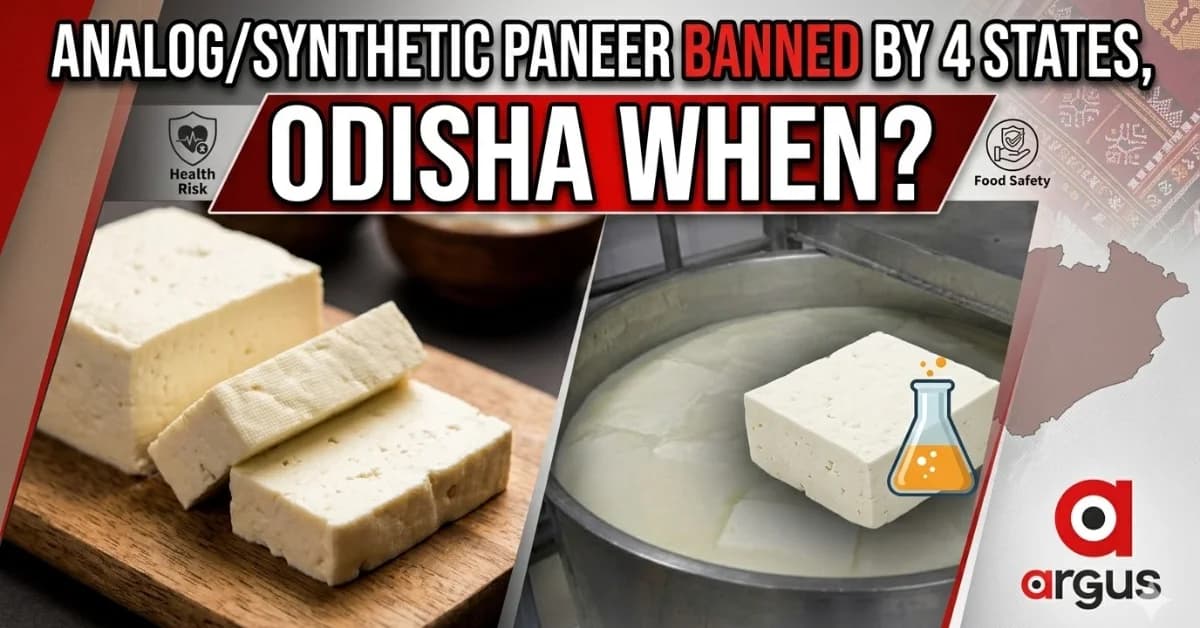
Key Points
Bhubaneswar: A major raid against adulterated paneer (cottage cheese) in Cuttack has once again thrown the spotlight on a growing food-safety concern in Odisha.
The Cuttack Municipal Corporation (CMC), in a joint operation by its Health Department and Food Safety Department teams, seized around 70 quintals, or 7,000 kg, of suspected adulterated paneer and destroyed the stock at the Sati Choura dumping yard.
With the festive season looming, the raid comes at a time when the Food Safety and Standards Authority of India (FSSAI) has already stepped up its scrutiny of dairy analogues and adulterated food, after warning in April that cheese analogues cannot be passed off as “paneer” and calling for strict enforcement against violations.
The April 22 public notice specifically said that selling cheese analogue as paneer constitutes a grave violation of law.

📱 Get Argus News App
✨Consumers in Odisha have also been raising their voice against the sale and use of analogue paneer, often described in the market as synthetic paneer.
Reports suggest that the cost differential is prompting some hotels, restaurants and food businesses to use non-dairy substitutes, with Cuttack and Bhubaneswar emerging as major consumption centres.
Wednesday’s CMC raid – and the destruction of 70 quintals of suspected adulterated paneer – has brought the scale of the problem sharply back into focus.
But the larger question is: how long can Odisha rely on reactive raids when the chorus for a more systemic response is growing?
While Odisha continues to seize and destroy suspect stocks after they enter the market, Chhattisgarh, Maharashtra and Gujarat have moved a step further by restricting or banning non-standard analogue paneer. Madhya Pradesh has now joined that group too.
Analogue paneer: From a cost-cutting substitute to a national food-safety question
The analogue paneer controversy is no longer confined to isolated raids on sweet shops or restaurants. It has evolved into a national debate over what consumers are actually being served in the name of paneer.
The attraction is straightforward: genuine paneer is a milk-based product, while an analogue can replace some or all milk constituents with non-milk ingredients such as vegetable fats, plant proteins, starches, stabilisers and emulsifiers. The economics can therefore make it attractive to commercial kitchens looking to reduce input costs. But the legal issue arises when such a product is presented to consumers as ordinary dairy paneer.
FSSAI's April 22 notice made precisely this distinction. It did not simply declare every dairy analogue illegal; rather, it said that a cheese analogue sold as “paneer” is a grave violation and directed manufacturers and food businesses to ensure accurate product identification.
That distinction is important because “analogue” and “adulterated” are not automatically synonymous. A properly identified analogue is one issue; a product containing unauthorised or unsafe substances, or one deliberately sold as genuine paneer, is another.
Yet enforcement data from other states has exposed why regulators are worried.
In Maharashtra, the FDA tested 308 paneer and dairy-analogue samples between April 2025 and March 2026; 109, or about 35.4%, failed to meet prescribed standards. The state subsequently imposed a one-year ban on the manufacture, processing, storage, distribution and sale of analogue/non-dairy paneer.
The National Human Rights Commission's intervention has added another layer to the issue, with the national debate now moving beyond food labelling to questions of consumer health, nutritional transparency and regulatory accountability.
What other states are doing — and where Odisha stands
The contrast is becoming difficult to ignore.
|
State |
Regulatory response |
What it means |
|
Chhattisgarh |
One-year prohibition on non-standard dairy analogues, including manufacture, processing, storage, transportation, distribution and sale |
Moves beyond raids to attack the supply chain itself |
|
Maharashtra |
One-year statewide ban on analogue/non-dairy paneer, including manufacture, storage, transport, distribution and sale |
Hotels, restaurants, caterers and cloud kitchens have also been directed to stop using it |
|
Gujarat |
Statewide ban on manufacture, storage, transportation, distribution and sale of unauthorised analogue paneer, cheese and butter |
Followed extensive sampling and testing by the state regulator |
|
Madhya Pradesh |
Has now joined the states banning analogue paneer |
Becomes the fourth state in the latest wave of state-level restrictions |
|
Odisha |
No comparable statewide blanket ban; enforcement has largely centred on raids, seizure, destruction and action against adulteration/mislabeling |
The CMC's 70-quintal seizure is a major enforcement action, but remains essentially reactive |
There is a significant legal nuance here. Odisha cannot simply equate every analogue product with adulterated food.
FSSAI's framework recognises dairy analogues as a category, subject to proper identification and labelling.
The states that have acted more aggressively have used their powers under the Food Safety and Standards Act to impose temporary restrictions on non-standard or unauthorised analogues.
Chhattisgarh's order, for instance, invoked Sections 18 and 30 of the 2006 Act and specified a one-year prohibition, or until final FSSAI regulations come into force, whichever is earlier.
That is precisely where Odisha's policy question begins: whether repeated raids are enough when the supply chain itself is becoming the problem.
Adulterated paneer vs analogue paneer: Do not mix the two
This distinction is central to the debate.
Traditional paneer is a milk product. It is produced by coagulating milk with a permitted acidifying agent and pressing the resulting curds.
Analogue paneer, on the other hand, is formulated to resemble a dairy product but may use non-milk constituents such as vegetable fats, plant proteins, starches, stabilisers and emulsifiers. Its mere existence does not automatically make it illegal. The problem starts when consumers are not clearly told what they are buying, or when the product does not comply with applicable food-safety requirements.
Adulterated or unsafe paneer is a different proposition. If a product contains prohibited substances, unsafe chemicals or fails prescribed safety standards, the issue is adulteration/food safety rather than merely whether it is an analogue.
That distinction makes the CMC seizure significant – but also demands caution. The seized 70 quintals have been described as adulterated paneer; unless laboratory findings establish their exact composition, it would be premature to label the entire seized stock as analogue paneer.
How can consumers identify analogue paneer?
The first and safest line of defence is the label, not a kitchen experiment.
For packaged products, consumers should check:
- Whether the product is clearly identified as a dairy product or an analogue.
- The ingredient list – particularly the presence of vegetable oils/fats, plant proteins or starches.
- The nutrition panel and protein content.
- Manufacturer details, FSSAI licence information, batch number and date.
- Whether a restaurant or caterer clearly discloses the use of an analogue where required.
Consumers should also be wary of extremely cheap, loose and unbranded paneer.
There are several popular home tests circulating online – including iodine, boiling and cooking tests – but these should not be treated as definitive laboratory tests. An iodine reaction, for instance, may indicate starch, but cannot by itself establish that an entire product is unsafe or fake.
In other words, the consumer should not be turned into a food-safety laboratory. The responsibility for establishing authenticity and safety ultimately rests with food businesses and regulators.
The health peril: The bigger worry is what replaces milk
The health concern is not simply that an analogue paneer is “fake”. It is that consumers may believe they are buying a milk-based food while receiving a product with a substantially different nutritional composition.
Replacing milk fat with vegetable fat changes the fat profile. Replacing milk protein with plant protein changes the protein composition. And if an adulterated product contains unauthorised or unsafe substances, the issue becomes much more serious.
This is why the Maharashtra experience is particularly instructive: its FDA said 109 of 308 tested paneer and dairy-analogue samples failed prescribed standards, prompting the one-year prohibition.
The concern therefore has two dimensions – consumer deception and food safety.
The first can be addressed through transparent labelling and enforcement. The second demands testing, surveillance, traceability and swift action against unsafe products.
Bottomline: Odisha needs to move from the dumping yard to the supply chain
The CMC's seizure of 7,000 kg of suspected adulterated paneer is an important enforcement action. But the real test is what happens after the headlines fade.
If 70 quintals can reach a major urban market before being detected, the question cannot end with how much was seized and destroyed. The bigger questions are: Where did it come from? Who manufactured it? Who transported it? Which businesses were buying it? How many such consignments enter Odisha every week? And what mechanism exists to stop the next one?
Chhattisgarh has chosen a one-year prohibition on non-standard dairy analogues. Maharashtra has imposed a one-year ban after extensive testing. Gujarat has gone for a sweeping prohibition of unauthorised analogue dairy products, while Madhya Pradesh has now joined the crackdown.
Odisha therefore has a policy choice before it: continue with reactive raids after suspect paneer reaches consumers, or examine whether a time-bound, evidence-based restriction on non-standard analogue paneer – backed by testing, registration, inter-state supply-chain surveillance and restaurant disclosure – is needed.
The issue is not about banning a food simply because it is an analogue. It is about ensuring that what is sold as paneer is what the consumer thinks it is.
And as the
festive season approaches, Odisha may not have the luxury of waiting for the
next 70-quintal seizure to ask that question.
Also Read: App Driver Storm Hits Bhubaneswar: Inside the Violent Revolt Shaking Ola, Uber, Rapido; How States Are Responding| Special Report
Related Topics
Explore more stories