



App Driver Storm Hits Bhubaneswar: Inside the Violent Revolt Shaking Ola, Uber, Rapido; How States Are Responding| Special Report
Key Points
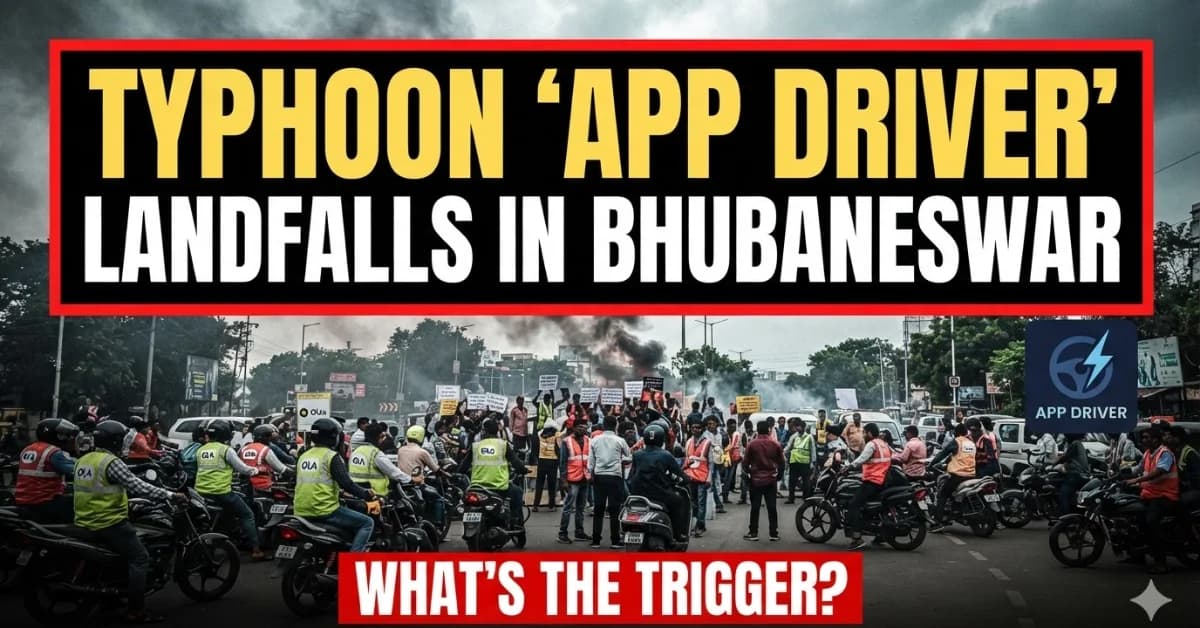
Bhubaneswar: The strike call by Ola, Uber and Rapido drivers turned into a war cry within no time on Wednesday as the nerve centre of the State Capital – Master Canteen and PMG Square – turned into a battlefield, with unruly protesters clashing with policemen, hurling stones and damaging government-run Ama buses. Police used force to bring the situation under control.
The violence came as the agitation entered its third day, with commuters bearing the immediate brunt.
Master Canteen is not merely a protest venue; it is the city's principal railway gateway and one of its busiest thoroughfares. With road movement disrupted around the area, railway passengers, office-goers and other commuters faced a harrowing time.
The violence is reprehensible. But the escalation itself is not an Odisha-only phenomenon.

📱 Get Argus News App
✨Across India's app-based mobility economy, driver protests have repeatedly followed a familiar trajectory – a digital logout or peaceful sit-in first, followed by road blockades, attempts to stop non-striking drivers and, in some cases, clashes with police or damage to vehicles and offices.
The underlying dispute is remarkably similar: drivers say the economics of app-based driving are becoming unsustainable even as platforms retain control over fares, commissions, onboarding and account access.
From Peaceful Strike To Street Battle: The Pan-India Pattern
Odisha's escalation therefore needs to be viewed against a wider national churn in app-based transport.
|
State/City |
What happened |
Trigger for escalation
State response
Odisha — Bhubaneswar, Aug 2026
Stone-pelting, clashes with police and damage to Ama buses were reported around PMG Square and Master Canteen
Dispute over fares, commissions, driver earnings, account restrictions, onboarding and social security
Police used force; protesters were detained/arrested
Maharashtra — Mumbai/Pune
Striking drivers reportedly intercepted non-striking cabs and damaged vehicles
Anger over commissions, operating costs and incentives used to break strikes
Police deployment and restrictions around aggregator hubs
Delhi-NCR
Road blockades and clashes/scuffles were reported during driver protests
Bike-taxi regulation and the use of private/white-plate vehicles
Detentions and police intervention to clear choke points
Telangana — Hyderabad
Aggressive picketing of aggregator offices was reported
Complaints over fare structures, algorithmic pricing and driver payouts
Police intervention and cases against organisers
Karnataka
The agitation has increasingly moved from street protests to a legal battle over gig-worker regulation
Social security, welfare contributions, grievance redressal and platform accountability
Dedicated state legislation, followed by court challenges by aggregators
The pattern is significant: the fight is no longer simply between an individual driver and an aggregator. It has evolved into a three-way contest involving drivers, technology platforms and governments over who should ultimately determine the economics of urban mobility.
What Triggers The Strike?
The Odisha drivers' charter is wider than a demand for a fare hike. Their argument is that the State needs to establish a legally enforceable framework so that drivers do not remain at the mercy of changing algorithms and corporate policies.
The principal demands include a government-regulated fare floor, a cap on aggregator commissions, compensation for waiting and traffic delays, safeguards against arbitrary account deactivation, regulation of vehicle onboarding, local grievance mechanisms and social-security protection. The source material puts the commission demand at a maximum of 20%, while seeking a statutory minimum fare of Rs12/km during the day and Rs15/km at night.
|
Odisha demand |
What it seeks |
What other states have done |
|
Minimum fare |
Legally mandated base fare and fuel-linked revision |
Karnataka has fixed base transport rates; Telangana is still at the proposal/draft stage |
|
Commission cap |
Aggregators' cut capped at 20% |
Telangana has proposed commission regulation; enforcement remains contested elsewhere |
|
Waiting/traffic pay |
Driver compensation when vehicles are stuck in congestion |
Remains largely unresolved nationally; it is a recurring driver grievance |
|
Protection from arbitrary deactivation |
No automated lockout without notice, investigation and opportunity to respond |
Karnataka's framework provides stronger safeguards, including prior notice and dispute mechanisms |
|
Physical grievance redressal |
State-level offices and dispute mechanisms rather than app-only support |
Karnataka has moved towards internal dispute-resolution structures |
|
Vehicle onboarding |
Controls on excessive onboarding and private vehicles competing with commercial drivers |
Delhi and Maharashtra have seen intense disputes over bike taxis and white-plate vehicles |
|
Social security |
State-backed welfare, insurance and safety nets |
Karnataka has enacted a dedicated gig-worker welfare framework; Rajasthan has also pioneered state-level gig-worker legislation |
The present "Zero Supply" agitation In Odisha is not primarily about the absence of an alternative app. The core demand is a legally binding framework applicable across platforms.
Odisha Yatri can offer zero-commission or lower-cost participation, but it cannot by itself impose rules on competing commercial aggregators.
What Triggers App Drivers To Demand So?
At the heart of the dispute is a regulatory gap between India's rapidly expanding platform economy and the rules governing traditional transport.
The Centre's Motor Vehicle Aggregator Guidelines, 2025 provide a national baseline. The guidelines are intended to regulate aggregators on fares, driver welfare, safety and operational conduct. The Centre has also prescribed health and term insurance requirements for drivers and requires inquiry before action is taken on passenger complaints.
But the central framework deliberately leaves significant matters to the States. For instance, aggregation of non-transport motorcycles for passenger journeys can be permitted by a State government under the Motor Vehicles Act.
That creates the central fault line.
The Centre has created the regulatory skeleton; drivers want Odisha to put flesh on it.
Their contention is that getting a fixed percentage of an inadequate fare does not solve the problem. If the underlying base fare is too low, even an 80% driver share can leave the driver struggling after fuel, maintenance, EMI and idle-time costs. Strikes across identify this as one of the principal reasons why driver unions are demanding state-level fare intervention rather than relying only on the central commission framework.
The Centre itself has continued to tighten aggregator compliance. As recently as August 12, MoRTH directed ride-hailing platforms to remove pre-ride tipping prompts, citing the 2025 guidelines.
So, the battle is increasingly about who regulates the algorithm – the platform, the Centre or the State.
Demands' Impact On Consumers
For commuters, the immediate impact is straightforward: if minimum fares, higher driver payouts and waiting-time compensation become mandatory, app rides are likely to become costlier because a significant part of the additional operating cost will ultimately be passed on to passengers.
The only clear benefit it holds out for consumers is greater fare predictability and potentially fewer cancellations if drivers find trips economically viable.
The Road Ahead
The prudent way forward is neither to allow platform companies to dictate the entire mobility market nor to allow driver unions to hold commuters hostage.
A statutory Odisha framework is therefore worth considering – but it has to be a win-win framework, not a one-sided transfer of costs from aggregators to passengers.
The State can prescribe transparent minimum fares linked to fuel and operating costs, establish a rational commission ceiling, provide compensation for prolonged waiting caused by congestion, create a formal grievance mechanism and establish a welfare fund. At the same time, aggregators need predictable rules, protection for legitimate commercial decisions and sufficient room to operate a technology-intensive business.
Importantly, Odisha already has alternatives that demonstrate the basic model. Odisha Yatri operates on a zero-commission principle, while Bharat Taxi, the cooperative mobility initiative backed by the Union government, follows a subscription-based model that allows drivers to retain the full ride fare. The Union government says Bharat Taxi does not charge drivers a commission on rides booked through the platform.
Yet neither alternative completely answers the drivers' demand for a law.
That is because an alternative platform can change the business model; only regulation can set the rules of the road for every platform. The Odisha drivers' own argument is that a zero-commission app cannot prevent another aggregator from undercutting fares, changing its algorithm, deactivating a driver or onboarding more vehicles.
Karnataka provides perhaps the clearest indication of where this battle is headed. The State enacted the Karnataka Platform-Based Gig Workers (Social Security and Welfare) Act, 2025, creating a statutory framework for gig-worker welfare.
Aggregators challenged the law in the Karnataka High Court. On July 3, 2026, the High Court declined to stay the law but granted interim protection from coercive action to petitioning aggregators subject to deposit of the welfare contribution with the court registry.
Uber subsequently approached the Karnataka High Court separately, and the court extended the benefit of the earlier interim arrangement to the company while issuing notice in its challenge.
That judicial intervention offers Odisha an important lesson: the answer to a structural gig-economy dispute ultimately has to be institutional, not confrontational.
For drivers, that means a legal floor for earnings and welfare. For aggregators, predictable and enforceable rules. For commuters, transparent fares and dependable availability.
The streets
of Bhubaneswar may have become the latest battlefield. But the real battle is
being fought over something much larger – who controls India's urban
mobility economy in the age of the app.
Also Read: Odisha Road Safety Overdrive: Record Challans Expose Big Chinks in State Transport Authority’s Enforcement Armour| Special Report
Related Topics
Explore more stories