



Special Report| Diarrhoea takes 8 lives in 10 months, Odisha recorded 9 ADD Outbreaks in 2026!
Key Points
Ganjam has become the 9th district in Odisha to record an ADD outbreak in 2026, marking the third district with reported fatalities this year.
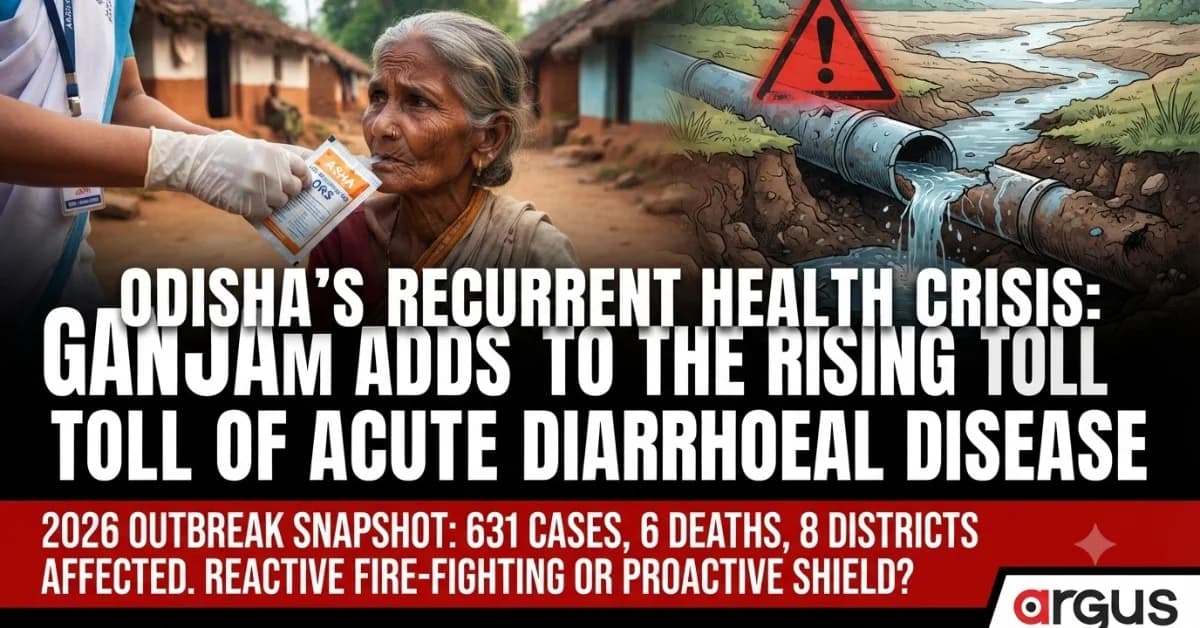
Between January and August 2026, the state recorded 9 distinct disease outbreaks affecting 631 individuals and claiming 6 lives.
Public health experts emphasize that preventing water-borne ADD requires proactive infrastructure audits rather than reactive firefighting
Bhubaneswar: Eight deaths in 10 months. The Acute Diarroheal Disease outbreak in Ganjam has been the 9th episode in last 10-months of 2026 so far. Ganjam joined the list of 8 districts in the state that have recorded ADD outbreaks so far this year, and the third district after Sundargarh and Jhrasuguda to record deaths in the year so far.
The frequency of the ADD oubreaks and the expanding footprint across the swathe of the State lays bare a persistent, structural vulnerability gripping Odisha.
According to recent Integrated Disease Surveillance Programme (IDSP) figures, the state has recorded 9 distinct disease outbreaks between January and August 2026, affecting 631 individuals and claiming 6 lives. Ganjam joins the IDSP list now.
At the core of this annual toll is Acute Diarrhoeal Disease (ADD), which accounts for 241 cases and 4 deaths, cementing its status as the state’s number one recurrent health hazard.

📱 Get Argus News App
✨While health authorities mobilize rapid response teams the moment cases surge, public health experts warn that these figures are symptoms of a deeper systemic flaw: a state health apparatus that remains perpetually trapped in a reactive firefighting mode rather than a proactive shield.
The Ganjam Case Reveals The Chinks
An analysis of the unfolding Acute Diarrhoeal Disease (ADD) outbreak in Ganjam district reveals a highly connected web of transmission stretching across geographically contiguous blocks.
Rather than a single isolated failure, the outbreak has flared up in three highly interactive administrative blocks within Ganjam: Digapahandi, Sanakhemundi, and Dharakote. The spatial proximity of these blocks directly enabled the disease's rapid spread.
The death of a person around September 27 due to a waterborne disease could have activated the early warning system, but by October1, the ADD outbreal has spread to three adjacent blocks affecting over two dozens.
The Anatomy of a Surveillance Blindspot
The Ganjam case is evident of how the IDSP in Odisha get activated. It shows the IDSP operates primarily on "syndromic surveillance."
In practice, this means the system’s warning lights do not flash until a critical mass of patients – exhibiting loose motions and severe dehydration – begins showing up at local primary health centers or community clinics. By the time the District Rapid Response Team (RRT) is dispatched, pathogens have often contaminated local water sources for days, leaving dozens already infected.
A study of ADD outbreaks in the State till 2026 October has revealed that the disease strikes the swathes of the land majorly during Summer (March onward) and Monsoon months.
This epidemiological trend bares the vulnerabilities in the State during the two predictable seasonal blindspots:
The Summer Scarcity & "Chuha" Blindspot: When summer water tables plummet and tube wells dry up, rural communities out of necessity resort to digging shallow holes (chuha) in dry riverbeds or drawing from stagnant ponds. Because these informal, temporary sources lie entirely outside the official public water supply network, contamination remains completely unmonitored until an outbreak erupts.
The Monsoon Pipeline & Leakage Blindspot: During heavy downpours, surface runoff, open defecation waste, and sewage flood the ground. Aging underground water supply pipelines – compromised by cracks and leakages – frequently suck in contaminated surface water. Underground pipeline failures remain invisible to surface-level surveillance, coming to light only after laboratory water testing is triggered by a mass outbreak.
Inside the Ground Protocol: Speed vs. Structural Limits
When outbreaks occur – such as the alarming cluster in Ganjam or recent incidents across districts like Sundargarh and Anugul – local health administrations execute rigorous containment protocols.
Peripheral teams and ASHA workers deploy active door-to-door surveillance, screening residents, tracking symptoms early, and administering contact-dose prophylaxis to prevent family-wide transmission. Temporary medical camps are established directly inside affected villages and school canteens to treat severe dehydration instantly, distributing Oral Rehydration Salts (ORS) packets, chlorine tablets, zinc, and anti-diarrhoeal medications.
Concurrently, environmental interventions kick in: wells, pipelines, and overhead tanks testing positive for fecal contamination or E. coli undergo super-chlorination, panchayats arrange alternative safe drinking water tankers, and sanitation teams inspect hostel canteens and local food vendors.
Yet, despite swift emergency responses, outbreaks recur year after year.
Public health advocates emphasize that preventing water-borne ADD is fundamentally an infrastructure challenge, not merely a clinical one. While ASHA workers can distribute health education and ORS, they do not own or maintain water pipelines.
2026 Odisha Outbreak Snapshot at a Glance
The state’s cumulative toll of 631 cases and 6 deaths spans multiple categories, highlighting diverse vectors:
Acute Diarrhoeal Disease (ADD): 261 cases / 4 deaths (notably in Ganjam, Sundargarh, Anugul, Jharsuguda, Rayagada, Mayurbhanj, Sonepur, and Sambalpur).
Suspected Food Poisoning: 145 cases across Mayurbhanj, Kandhamal, and Nuapada.
Acute Gastroenteritis: 55 cases in Kalahandi.
Other Notable Incidents: Shigellosis in Rayagada (81 cases, 1 death); Viral and bacterial vectors including Chickenpox, Hepatitis A, Jaundice, Measles, and Fever with Rash across Khordha, Cuttack, Jagatsinghapur, and Gajapati.
The Path Forward: Breaking the Cycle
The recurring numbers in 2026 serve as empirical proof that relying solely on clinical disease reporting forces the state to perpetually chase outbreaks rather than stop them.
True prevention requires cross-departmental integration before seasonal vulnerabilities peak:
Rural Water Supply & Sanitation (RWSS) Departments must execute pre-monsoon pipeline audits and routine chlorination before cracks form.
Local Panchayats must proactively position alternative safe water tankers in vulnerable pockets before summer heat drives communities to unsafe riverbed sources.
Until
early warning systems evolve from passive data-gathering tools into
predictive, multi-sectoral shields, Odisha’s communities will
remain vulnerable to a repeating seasonal script, recording ADD
outbreaks year after year.
Also Read: Odisha’s Dengue Warning Bell: Why September’s Receding Floodwater Could Fuel an October Surge in 2026| Special Report
Related Topics
Explore more stories