



Odisha’s Dengue Warning Bell: Why September’s Receding Floodwater Could Fuel an October Surge in 2026| Special Report
Key Points
Odisha faces a high-risk compound scenario with excess monsoon rainfall, receding floodwaters, and El Niño heat aligning with the August–October dengue season.
Historical data and a recent AIIMS Bhubaneswar study show a strong positive association between rainfall and dengue spikes, with a crucial one-month lag.
Health authorities must shift focus from post-flood rescue to aggressive larval control and source reduction before a potential transmission peak.
Bhubaneswar: With receiving the full quota of monsoon rainfall ahead of its schedule ending August, and when this has been an El Nino year, it is not only flood or drought in deficient rainfall regions that are the only lurking dangers, the bigger danger has been that the commencement of Dengue season in Odisha.
The state is now entering the period when dengue historically begins to accelerate, even as floodwaters from an unusually wet August start receding across several districts.
That combination – excess rainfall, stagnant water, warmer conditions and a one-month lag between rainfall and reported dengue cases – is raising the possibility of a sharp increase in transmission through September and October.
The warning assumes greater significance because Odisha's dengue season is not random.

📱 Get Argus News App
✨A study published in the Indian Journal of Community Medicine in August 2026, with AIIMS Bhubaneswar's Sailendra Panda as lead author, found a clear seasonal pattern, with dengue cases peaking between August and October. The study also found a strong positive association between rainfall and dengue, which became stronger when rainfall was considered with a one-month lag. Transmission was higher when temperatures were between 27°C and 34°C.
That makes the next few weeks critical.
The danger may begin after the flood, not during it
The immediate instinct after a flood is to focus on rescue, rehabilitation and removal of floodwater. But from a dengue perspective, the more dangerous phase can begin when the water starts disappearing.
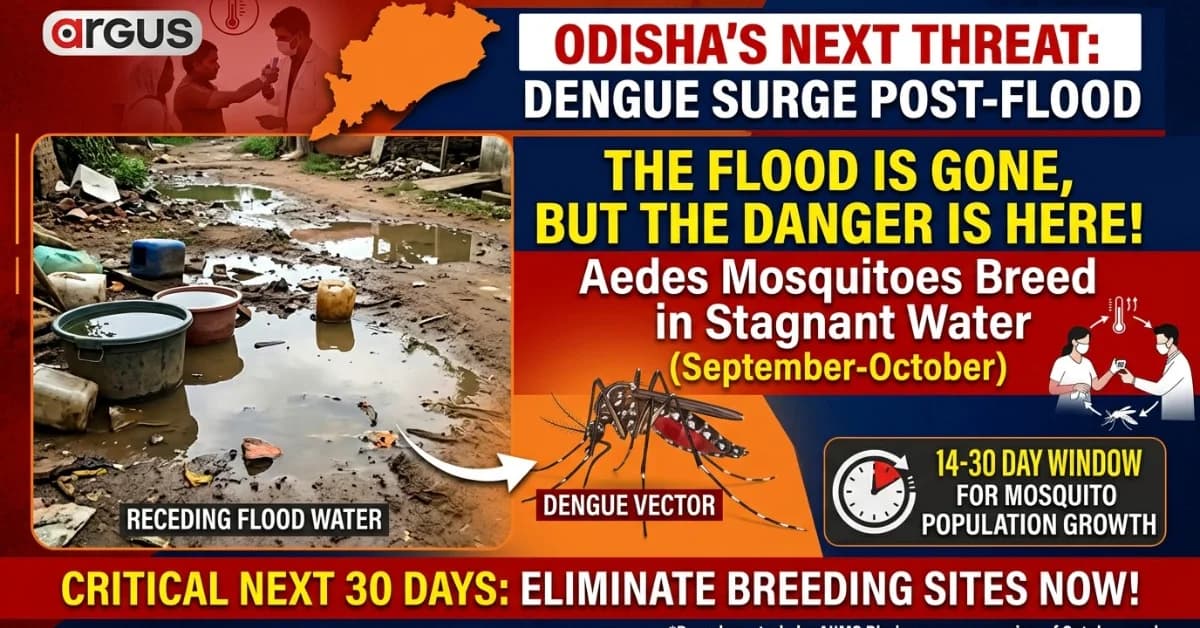
The historical data point to a 14–30-day window between heavy flooding and a possible increase in dengue transmission.
Immediately after flooding, rapidly moving water can wash away mosquito larvae. But as the water recedes, it leaves behind puddles, waterlogged containers, muddy depressions, clogged drains and other small breeding sites.
Those locations can subsequently become ideal breeding grounds for Aedes mosquitoes.
The sequence is therefore straightforward:
Heavy rainfall/flooding → floodwater recedes → stagnant pools and containers remain → mosquito breeding increases → dengue transmission rises after a lag.
The Odisha study provides the epidemiological basis for this warning: rainfall had a strong correlation with dengue cases, and the correlation became stronger after applying a one-month lag.
This is why September could become the month in which Odisha either breaks the transmission chain – or allows it to build towards an October peak.
Odisha has seen what climate shocks can do
The
historical numbers available with NVBDCP provide an important
warning.
When an analysis of the available case data with major climate events done, two
distinct natural disaster triggers emerge:
The Flood Trigger (2022): The state recorded 8,578 cases. In August 2022, Odisha experienced relentless monsoon depressions causing severe floods across 12 major districts – including Cuttack. The subsequent stagnation of water created micro-breeding grounds.
The El Niño Trigger (2023): Cases dramatically peaked at 19,034 cases. El Nino events suppressed the standard monsoon timeline then, creating prolonged dry spells broken by sudden, intense rainfall bursts. Higher ambient temperatures during El Nino accelerate the incubation period of the virus inside the Aedes mosquito, causing rapid transmission rates.
The important lesson is not that every flood will automatically produce a dengue outbreak.
It is that extreme rainfall followed by stagnant water can alter the mosquito ecology at precisely the time when Odisha enters its normal dengue transmission season.
That is the risk 2026 presents. Why?
Why 2026 is different
Current conditions represent a dangerous compound scenario. While 2026 is developing into a historically strong El Nino year, North and Central Odisha – including Cuttack, Jajpur, and Balasore – have simultaneously suffered heavy August floods. This combined extreme heat and receding floodwater creates an ideal breeding ground.
Odisha recorded 27% above-normal monsoon rainfall by September 1, with successive low-pressure systems producing riverine and urban flooding across 22 districts and affecting more than 8.6 lakh people, along with warmer conditions associated with the year's El Niño thermal pattern.
Taken together, these describe a potentially dangerous compound environment:
A wet state + receding floodwater + warm temperatures + the August–October dengue window.
The critical issue is timing.
If floodwater is allowed to recede without aggressive source reduction, the mosquito population can build during September. By the time hospitals begin reporting a noticeable increase in dengue patients, the breeding cycle may already have been established.
That is why the current window should be treated as pre-outbreak intervention time, rather than waiting for case numbers to rise.
Banki offers an early warning signal
The inputs identify Banki in Cuttack as an immediate area of concern, with three fresh dengue cases reported there.
Banki's location within the Mahanadi floodplain makes it particularly relevant to the post-flood risk equation. Waterlogging following heavy rainfall and river-system fluctuations can create multiple small breeding sites around settlements and agricultural areas.
Three cases do not constitute a statewide outbreak.
But epidemiologically, a localized cluster appearing while floodwater is receding is precisely the kind of signal that warrants intensified surveillance – particularly before the historical October peak.
North Odisha could face the first major pressure
A risk mapping places Balasore, Bhadrak, Jajpur and Mayurbhanj in the critical-risk category.
The common factor is prolonged inundation associated with the Subarnarekha, Baitarani and Jalaka river systems. The available data points that some locations having experienced persistent agricultural and village inundation for more than 50 days.
The next risk tier comprises Khurda and Cuttack, where riverine flooding intersects with high population density. The historical data suggest hotspots like Banki, Dampada, Tigiria, Athagarh and urban areas under Cuttack and Bhubaneswar as vulnerable locations.
A third emerging-risk group includes Bargarh, Sundargarh, Jharsuguda and Sambalpur, where localized torrential rain and waterlogging could create breeding pockets, particularly in low-lying municipal areas and mining settlements.
The significance is that Odisha's dengue risk may not be confined to the traditionally watched urban centres.
The apparent dengue-kit shortage needs a closer look
There is another issue that could create confusion if dengue cases rise: the apparently small number of centrally allocated dengue IgM kits.
As per NVBDCP data, Odisha has been allocated 200 IgM kits for 2026. Since each kit contains 96 tests, that represents 19,200 tests. At first glance, the number can appear inadequate for a state that has previously recorded thousands of dengue cases.
But the number should not be interpreted as Odisha's total dengue-testing capacity.
IgM testing is generally used in the later phase of illness, while early suspected cases are screened through NS1 antigen testing or rapid diagnostic tests. The central allocation is also described in the inputs as a base allocation rather than the state's entire diagnostic stock.
The central programme can also provide additional kits from a buffer if a sudden outbreak develops, while states can procure additional diagnostics through decentralized mechanisms.
So the real question for Odisha is not simply how many IgM kits are sitting in the central allocation.
It is whether NS1 testing, confirmatory testing, sentinel surveillance and clinical preparedness are adequately positioned in the districts where the environmental risk is now increasing.
The next 30 days are the real test
Taking into account the historical data, the evolving scenario recommends shifting the administrative focus from flood rescue to aggressive vector control as floodwaters recede.
That means eliminating breeding sites rather than relying exclusively on fogging.
The proposed intervention chain is:
Late-August floods → September water recession → source reduction and larval control → intensified surveillance → prevent October dengue peak.
The distinction matters.
Fogging primarily targets adult mosquitoes. It cannot substitute for eliminating the stagnant water in which Aedes mosquitoes breed. The historical data, therefore, calls for larval control alongside door-to-door removal of standing water in coolers, containers, discarded tyres and other receptacles.
At the health-system level, it has also been the urgency to go for daily monitoring at sub-divisional hospitals and community health centres, with rapid NS1 testing available for early-stage suspected cases.
Odisha still has a window to stop the surge
The most important number in this story may therefore not be the current dengue count.
It is the lag period.
Odisha has a short window between floodwater recession and the point at which a potential increase in dengue becomes visible in hospital statistics.
Once fever clusters begin appearing across multiple localities, the mosquito breeding cycle will already have advanced.
The state has therefore entered a phase where vector surveillance needs to move ahead of disease surveillance.
The 2026 dengue threat is not a prediction that Odisha will necessarily repeat the high case numbers of 2023.
It is a warning that the environmental conditions associated with previous dengue surges are beginning to converge again – and this time they are converging precisely as Odisha enters its established August–October transmission window.
For
Odisha's civic and health authorities, September
is consequently not the month to wait for dengue numbers to rise. It
is the month to make sure they don't.
Also Read: Scrub Typhus Surge in Angul Sparks Calls for Urgent Preventive Actions in Neighbouring Districts| Special Report
Related Topics
Explore more stories